




HIPAA compliance has become a baseline expectation for ticketing systems. Most established platforms today offer encrypted data, audit logs, and a BAA. That box is relatively straightforward to check.
What’s harder is finding a tool that’s compliant and capable enough to handle complex healthcare support queries. Say a patient raises a query about a denied insurance claim. The billing agent needs the nursing team to confirm procedure codes, the nursing team needs the lab report, and the lab report can only be accessed by the CSM team. That ticket touches four people across three departments.
A tool that protects that data but can’t coordinate across those teams will have your staff forwarding PHI (protected health information) to personal inboxes and Slack threads without an audit trail.
That coordination gap is exactly what separates a compliant system from a capable one. That’s why we’ve evaluated 10 HIPAA-compliant help desks on both counts: compliance and capability, so you can find the one that fits how your team actually works.
TLDR:
- Comm100:Live chat-first support, omnichannel healthcare platform.
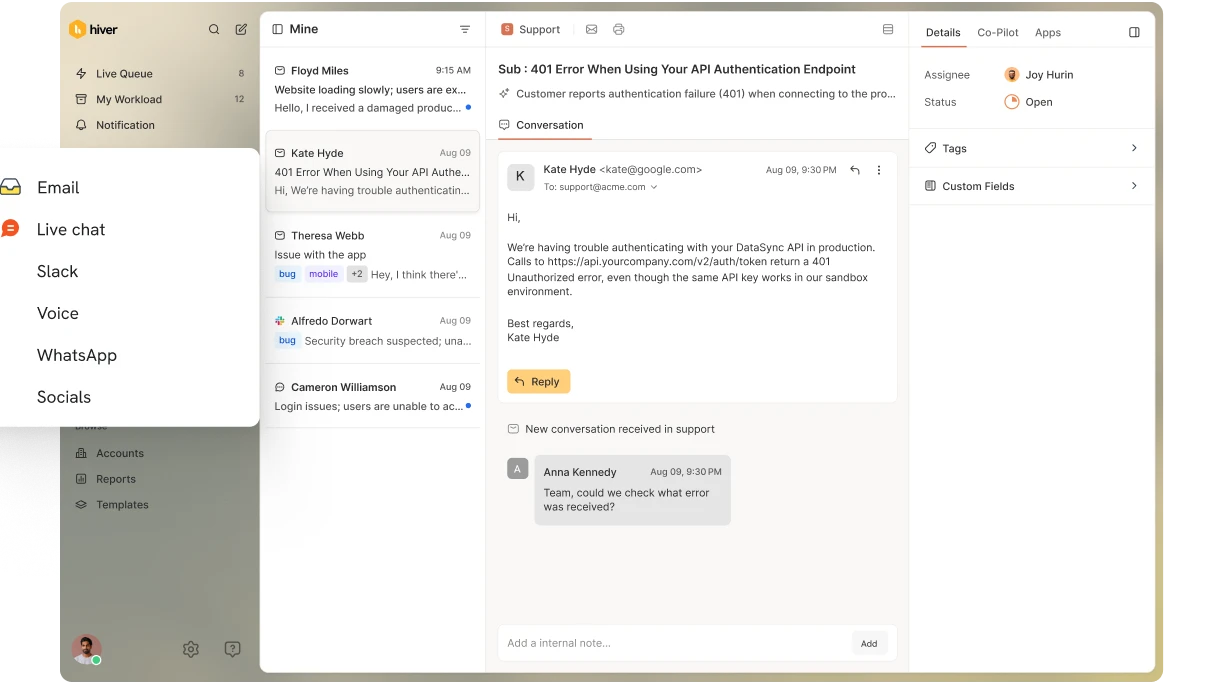
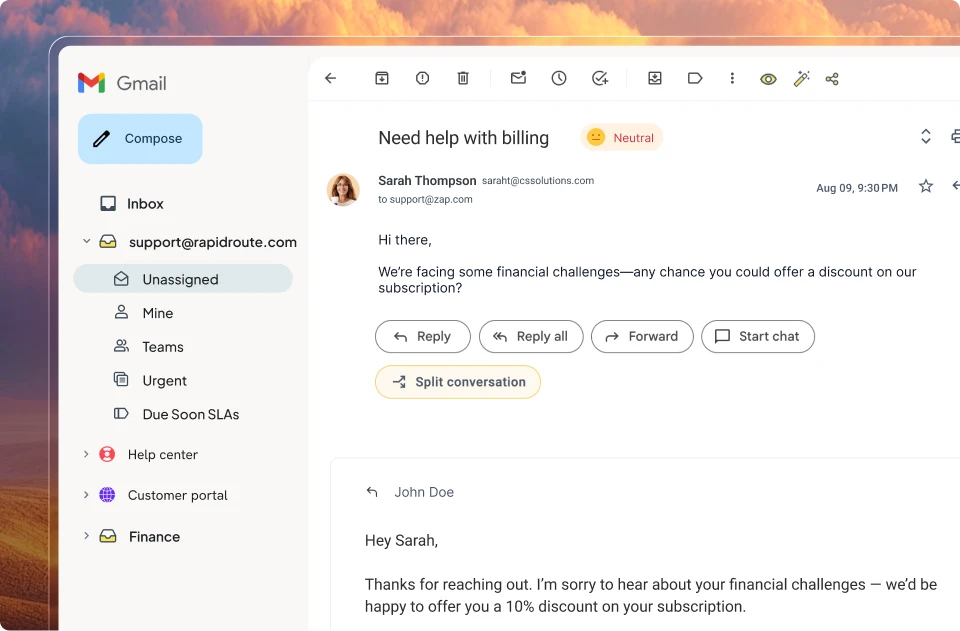
- Hiver: Agentic email support desk, HIPAA-ready, cross-team coordination built in.
- Giva: Cloud help desk, zero-configuration HIPAA compliance out-of-box.
- Freshdesk: Email-centric ticketing, multichannel support, scalable healthcare workflows.
- Zendesk: Enterprise-grade, compliance controls for large healthcare systems.
- OneDesk: Combined ticketing and project management, HIPAA-compliant platform.
- HappyFox: Simple HIPAA ticketing, no bloat, clean workflows.
- Jitbit: Self-hosted option, data sovereignty for healthcare IT.
10 Best HIPAA-Compliant Ticketing Systems to Try
Not every platform that claims to be HIPAA-compliant is built equally. Some require extensive configuration to reach compliance. Others include it by default. Some handle a straightforward patient query well but fall apart when a ticket needs multiple teams.
We evaluated each platform on three counts:
- the strength of its HIPAA compliance coverage,
- how well they handle complex,
- multi-team healthcare support workflows,
…and what verified users on G2 and Capterra consistently say about it in practice.
Here are the 10 that made the cut.
| Tools | Key HIPAA Features | Starting Price | G2 Rating |
| Comm100 | BAA included, annual third-party HIPAA audit by SecurityMetrics, uniform compliance across all channels | $31/user/month | 4.4/5 |
| Hiver | BAA available, AES-256 encryption, data-at-source architecture, audit logging, SOC 2 Type II | $25/user/month | 4.6/5 |
| Giva | BAA included in all plans, cyber liability insurance, zero-configuration compliance, continuous encrypted backups | $69/user/month | 4.6/5 |
| Freshdesk | BAA on Enterprise plan, AES-256 encryption, custom mail server configuration, role-based access controls | $19/user/month (Growth); HIPAA on Enterprise at $89/user/month | 4.4/5 |
| Zendesk | BAA via Advanced Compliance add-on, covers all channels including AI, TLS 1.2+, audit logs | $115/user/month (Suite Professional) | 4.3/5 |
| Salesforce Service Cloud | BAA covers Service Cloud, Slack and Agentforce, AES-256 encryption, role-based access controls | $25/user/month (Starter) | 4.4/5 |
| Help Scout | BAA on request, 256-bit SSL, AI off by default in HIPAA accounts, AWS-hosted | $50/user/month | 4.4/5 |
| OneDesk | BAA included, AWS-hosted, on-premises and private cloud options, activity audit logs | $32.99/user/month | 4.4/5 |
| HappyFox | BAA included, SOC 2 Type II, HIPAA and HITECH compliant, AES-256 encryption | Contact for pricing | 4.5/5 |
| Jitbit | BAA on Enterprise plan, self-hosted option, attachment suppression, AES-256 encryption | $249/month flat rate (Enterprise) | 4.3/5 |
1. Comm100 – Best for teams whose primary support channel is live chat
Healthcare teams increasingly prefer live chat for patient communication. It’s faster than email and still creates a written record of every interaction. Comm100 started as a live chat platform first, then expanded to cover email, SMS, and voice. Today, Comm100 is HIPAA-compliant across all its channels uniformly.

It’s one of the few platforms where compliance has been independently verified across the entire product, including its AI capabilities. Here’s what it means.
Most platforms integrate AI through third-party models (like ChatGPT) that sit outside their compliance boundaries. But with Comm100, every feature, including its AI, is assessed as part of an annual HIPAA audit.
This means when a support agent uses the tool’s AI to draft a response, even the patient data that AI touches stays within the same encrypted infrastructure, access controls, and audit trail as every other conversation on the platform.
That said, Comm100 is built for high-volume and patient-facing support. Teams handling complex queries that require multiple internal teams to coordinate before anyone can respond will quickly outgrow what it offers. For those workflows, Hiver is a stronger fit.
Key features:
- Role-based access controls are strong. Staff only see patient data relevant to their role. A billing agent cannot access clinical notes, and a scheduling coordinator cannot view insurance disputes.
- Comm100 has a clear and documented breach response protocol that all employees must follow, including annual test scenarios evaluated by a third-party assessor.
- Patients are first authenticated before a chat session begins through an SSO. This way, agents are always responding to a verified identity before any PHI enters the conversation.
- Payment information shared is automatically masked across all channels through a feature called credit card masking. Agents never see card numbers, reducing breaches and HIPAA exposure simultaneously.
- Comm100’s AI routes incoming tickets by department, expertise, or priority level. High-priority patient tickets reach the right team immediately without manual triage.
Pricing:
Starts at $31/user/month, billed annually.
Comm100: Pros and Cons
| Pros | Cons |
| Reliable uptime, even under high traffic volumes. | The mobile app is very basic and does not give the dashboard view that’s available on the website |
Solid range of integrations, including Salesforce and custom API connections | Pricing can be steep, making it harder to justify for smaller teams. |
HIPAA Compliant Messaging Apps in 2026: 10 Best HIPAA Compliant Ticketing Systems in 2026
2. Hiver – Best for healthcare teams managing email support queries that require cross-team coordination
Hiver is an agentic email customer support platform that is HIPAA compliant and signs a BAA with customers who require it. You get AES-256 encryption, role-based access controls, audit logging, and a signed BAA across all deployment options.

Beyond compliance, Hiver is built for healthcare support email queries that require cross-team collaboration to resolve. If a client reports that their patient monitoring device has stopped sending alerts, your L1 support agent won’t know upfront whether it’s a configuration issue, a network problem, or a firmware bug. They need to loop in clinical and engineering teams to resolve the issue.
This is where account context matters. With Hiver, the moment an agent picks up that query, it surfaces the full account picture including open escalations, renewal timelines, and interaction history pulled from connected CRMs and ERPs. In healthcare, knowing whether this is a high-value hospital network account with an upcoming renewal changes how urgently and carefully the team responds.
From there, the agent can loop in the right teams directly from the ticket, raise a linked Jira ticket for engineering, and have every subsequent update sync back into Hiver in real time. Every internal discussion stays inside the platform, fully logged, with nothing leaving the secure environment.
Healthcare teams using Hiver have seen this play out in practice . New Hope Fertility Center, handling 2,000+ patient emails a week across nursing, lab, and billing teams, saw a 50% jump in staff efficiency after moving to Hiver. They save 33 hours a month just on cross-team coordination.

We’ve seen a huge uptick in the efficiency levels of our staff. In fact, we’ve also seen a significant drop in the number of complaints from patients.
– Jennifer Nguyen, Operations Associate, New Hope Fertility Center.
Teams looking for a tool focused primarily on simple, high-volume patient queries where AI deflection is the primary goal will find Freshdesk or Comm100 better suited.
Key features:
- Hiver undergoes annual third-party audits that verify security controls across the entire platform.
- Any data processed for synchronization is stored only briefly in secure, encrypted buffers and automatically purged within the hour. This minimizes PHI exposure.
- Hiver’s AI spans the entire support lifecycle. Routine queries like appointment confirmations, and password resets are resolved automatically by AI Agents without any human involvement. When a query needs human intervention, AI capabilities can read the intent, extract relevant details, and route it to the right team automatically. While the agent works the ticket, AI Suggested Response drafts a reply, and AI Summarizer condenses long threads for faster context. After resolution, AI Insights audits the response against the quality parameters the team has defined. At every stage, the AI works within the same secure, compliant environment — patient data never leaves the platform.
- You can set up SLAs based on ticket priority or customer tier. Queries from high-priority accounts get flagged before a breach occurs. You can also set up escalation rules if SLA targets are missed.
Pricing:
Starts at $25/user/month, billed annually.
Hiver: Pros and Cons
| Pros | Cons |
| Hiver’s AI handles the work that slows teams down at every stage — routing queries to the right team before an agent even opens the ticket, drafting responses while they work it, and auditing quality after it’s resolved. | More advanced features are available in higher plans, making it expensive for smaller teams. |
| Internal Notes and @mentions keep cross-team collaboration inside the platform. So team coordination over sensitive patient queries never happens outside the tool. |
Start your free trial with Hiver
3. Giva – Best for teams needing zero-configuration HIPAA compliance
Most platforms treat HIPAA compliance as an add-on that you unlock at a higher tier or configure yourself. Giva takes the opposite approach. HIPAA compliance is included in every plan by default, with nothing to configure.

What sets Giva apart is that it backs its compliance posture with a cyber liability insurance policy. If a breach occurs, Giva shares liability with the customer through the BAA. For smaller healthcare teams without a dedicated legal or security function, that shared accountability is meaningful.
Where Giva falls short is on the operational side. The platform is purpose-built for compliance-first IT and help desk workflows. For teams managing complex queries or needing AI-assisted routing, the feature set is limited. For such cases, Hiver Omni is worth trying out.
Key features:
- All customer data is backed up daily with encrypted off-site copies stored for disaster recovery. HIPAA requires retrievable exact copies of all PHI, and Giva meets this requirement by default.
- PHI-Safe Ticketing Patterns are pre-built ticket workflows designed to handle PHI without exposing it unnecessarily. Healthcare teams don’t have to design compliant workflows from scratch.
- Giva’s AI Copilot surfaces relevant knowledge base articles directly inside a ticket as an agent works on it.
- Giva’s visual reporting tools identify trends and patterns before they impact patients.
Pricing:
Starts at $69/user/month.
Giva: Pros and Cons
| Pros | Cons |
| BAA is included at all pricing tiers. | New releases ship every three weeks, which means teams need to review release notes to stay updated with feature changes regularly. |
| Extremely fast to deploy with a simple interface that teams pick up quickly. | Reporting tools are solid for standard use cases, but users consistently ask for expanded analytics and more customizable report options. |
4. Freshdesk – Best for healthcare teams managing support via email
Freshdesk is one of the most widely used customer service platforms for teams managing queries over email. HIPAA compliance is available on Freshdesk’s Enterprise plan, with a signed BAA, encryption, access controls, and audit logs included.
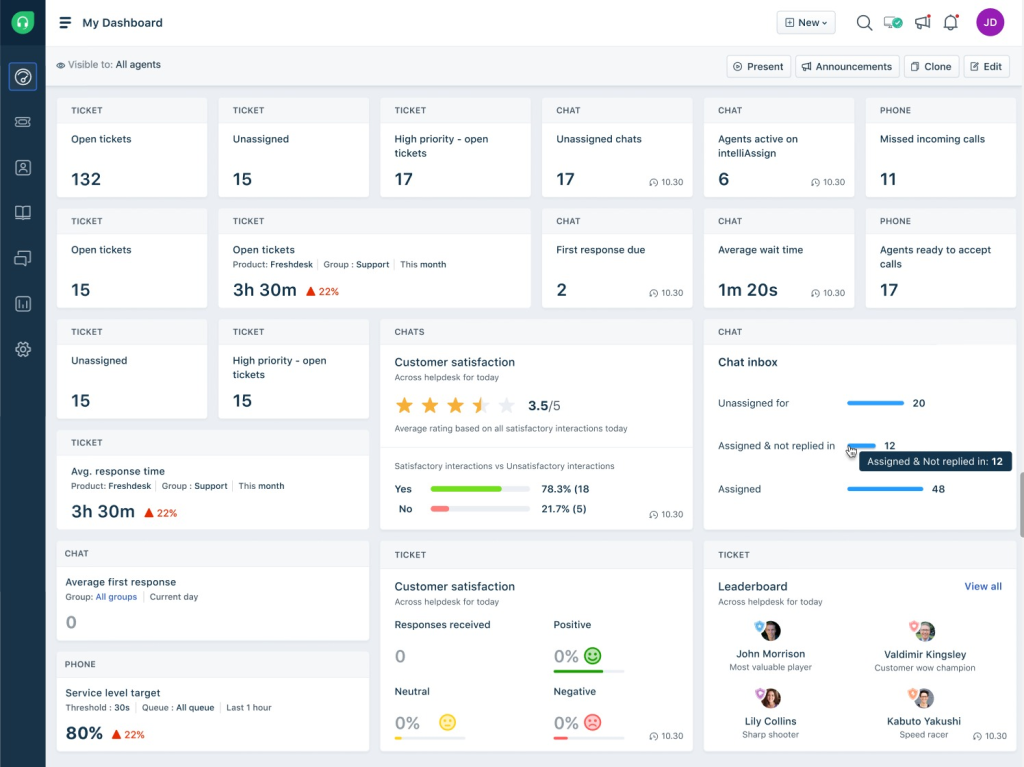
Where Freshdesk stands out is how fast teams can deploy AI without much configuration. Freddy AI comes with 50+ prebuilt agentic workflows ready to launch without custom configuration. A healthcare team can have AI resolve routine patient queries on appointment, billing policy questions, and password resets without involving a technical team.
However, Freshdesk works well for teams managing queries primarily through email. The friction shows up when you need to go omnichannel. Live chat runs through Freshchat, voice through Freshcaller, and the omnichannel bundle is a separate product with its own pricing tier. In such cases, Hiver Omni or Zendesk are worth evaluating. Both offer a single workspace across channels without stitching together multiple products.
Key features:
- Freshdesk allows teams to configure a custom mail server so every outgoing and incoming email is hosted on the organization’s own infrastructure. For healthcare teams, this means email containing PHI never passes through Freshworks’ servers.
- IP and network restrictions let admins whitelist specific IP ranges and restrict agent logins to approved networks only.
- Freddy AI Copilot assists agents in real time by suggesting replies, summarizing long threads, and translating conversations.
- It offers AI insights that give support leaders proactive alerts with root cause analysis before issues escalate. If there’s a spike in SLA breaches or a dip in CSAT, leaders find out before it becomes a bigger problem.
Pricing:
Starts at $19/agent/month. But HIPAA compliance is available on the Enterprise plan at $89/agent/month.
| Pros | Cons |
| Wide range of integrations fits seamlessly into existing workflows, with a high level of customization that lets the platform adapt to different business needs. | HIPAA compliance is only available on the Enterprise plan at $89/agent/month. AI features are priced separately on top of that, which can make the total cost significantly higher than it initially appears. |
| Freddy AI Copilot helps agents with reply suggestions, ticket summarization, and sentiment analysis. | Some advanced features require extra setup and reporting can feel limited without add-ons. |
5. Zendesk – Best for large healthcare systems with dedicated compliance teams
Zendesk’s compliance coverage is among the most comprehensive on this list. The BAA covers ticketing, live chat, voice, help center, analytics, and AI features — all under a single agreement. For large healthcare organizations managing patient queries across multiple departments and channels, that breadth of coverage matters.
That said, Zendesk doesn’t come HIPAA-compliant out of the box. It requires purchasing the Advanced Compliance add-on, signing a BAA, and following Zendesk’s recommended security configurations carefully. For large teams with a dedicated compliance function, that setup is well within reach.

Where Zendesk is genuinely strong for healthcare is its scale and ecosystem. It has a marketplace of 1,500+ integrations, including EHR systems, CRMs, and billing platforms that healthcare teams already use. For a hospital network managing high-volume patient queries, Zendesk’s infrastructure holds up.
But, for smaller teams without compliance resources, Zendesk becomes an operational burden. For them, Giva would be a better alternative since it offers zero-configuration HIPAA compliance.
Key features:
- Zendesk’s security configuration recommendations are published and updated whenever compliance requirements change. Healthcare compliance teams always know exactly what needs to be configured and when something needs to be revisited.
- Offers encryption at rest as well as in transit
- Has its own authenticated help center to prevent unauthorized PHI exposure.
- Workforce Management built into Zendesk lets support leaders forecast ticket volume, schedule agents by shift, and track real-time adherence. For hospital networks managing 24/7 support across multiple departments, this removes the need for a separate HIPAA-compliant scheduling tool.
Pricing:
HIPAA compliance is available on Zendesk’s Suite Professional plan and above, which starts at $115/agent/month.
Zendesk: Pros and Cons
| Pros | Cons |
| Handles multi-channel communication extremely well. | Not HIPAA-ready by default. It must be configured extensively. |
| Workflows and automations can be adapted to very specific support processes. | Can be expensive, especially when scaled across large teams. |
6. Salesforce Service Cloud – Best for teams that need a mobile-friendly ticketing system
Field nurses, clinical coordinators, and support staff working across hospital floors can’t always be at a desk. Salesforce Service Cloud is one of the few platforms on this list with a strong mobile experience. Agents can manage cases, update records, and collaborate from their phones. Its HIPAA coverage extends across Service Cloud, Slack, and Agentforce, making it one of the more comprehensive BAA frameworks on the list.

Service Cloud is known for its depth of CRM integration. Patient and account data from across the Salesforce ecosystem surfaces directly in the agent console. Agents can see renewal timelines, interaction history, and case status without switching systems. For health-tech companies already running their CRM on Salesforce, this is a natural fit.
But Service Cloud works best when you’re already invested in the Salesforce ecosystem. If you are starting fresh without existing Salesforce infrastructure, you will find Help Scout significantly faster to get up and running.
Key features:
- Salesforce’s BAA covers Service Cloud, Slack, and Agentforce under a single agreement. For healthcare teams using multiple Salesforce products, this means one compliance framework across the entire stack.
- The tool maintains a dedicated HIPAA compliance documentation library, updated regularly, that covers exactly which services are covered under the BAA and how to configure them correctly.
- Agentforce handles routine patient queries autonomously across channels like email and chat. It learns from resolved cases and improves over time. So the more your team uses it, the more accurately it routes and resolves incoming queries.
- Slack Swarming lets agents pull in subject matter experts from across the organization directly from an open case, without leaving the Service Console. For complex clinical or technical queries that need multiple people, the entire collaboration stays traceable inside the platform.
Pricing:
Starts at $25/user/month.
Salesforce service cloud: Pros and Cons
| Pros | Cons |
| Strong mobile experience for agents managing cases on the go, across hospital floors or remote clinics | Performance can lag when managing high volumes of cases or large datasets |
| Deep integration across the Salesforce ecosystem means CRM data, case history, and account context are all connected in one workspace. | High learning curve and significant investment required to get full value from the platform. |
7. Help Scout – Best for small teams looking for a HIPAA-compliant shared inbox
Smaller healthcare teams often need a shared inbox before they need a full ticketing system. Front desk, billing, and patient services all work from the same email address with no ownership, no audit trail, and no visibility into who responded to what. Help Scout solves this by bringing an organization’s email addresses – billing@, scheduling@, info@ – into one central workspace where every message has an owner and a status.

Help Scout signs a BAA on request, encrypts all communications over 256-bit SSL, supports two-factor authentication and SSO, and is hosted on AWS – a HIPAA-eligible infrastructure. The setup takes minutes, and doesn’t require IT involvement to get started.
Help Scout’s AI features are turned off by default in all HIPAA accounts. To enable them, teams sign a separate AI addendum alongside the BAA. For smaller healthcare organizations without a compliance officer reviewing every AI interaction, that default-off posture reduces the risk of accidental PHI exposure.
Help Scout is purpose-built for shared inbox management. For teams that need to go beyond email support like managing internal projects and tracking tasks across departments, OneDesk is a better fit.
Key features:
- Help Scout signs a BAA on request across all plans. You won’t find this in all tools since most offer HIPAA compliance in their enterprise plans.
- Help Scout supports data redaction in notifications, reducing the risk of sensitive patient information appearing in email alerts.
- Beacon is Help Scout’s embeddable support widget that can be added to any webpage or patient portal. It surfaces relevant knowledge base articles, enables live chat, and lets patients escalate to a human agent in two clicks if AI can’t resolve their query.
- Its Inbox Assistant summarizes long patient email threads, drafts replies, and adjusts the tone of your responses before they are sent.
Pricing:
Starts at $25/user/month.
Help Scout: Pros and Cons
| Pros | Cons |
| Conversations feel personal rather than transactional. Ticket numbers are hidden from patients, so every interaction feels like a direct email exchange rather than a support queue. | Built-in SLA controls are limited. May require an add-on. |
| Ability to remove PHI from threads provides a safety net if something is shared by mistake. | Users report that the Android app often has performance issues like glitches and bugs. |
8. OneDesk – Best for teams that need ticketing and project management in one HIPAA-compliant platform
OneDesk combines a full help desk with project management capabilities in a single platform. Healthcare MSPs or health-tech companies can handle patient queries, track internal tasks, manage deadlines, and coordinate team workloads without switching between tools. For instance, a healthcare brand can resolve a clinic’s EHR access ticket and track the engineering fix it triggered – all from the same workspace.

On the compliance side, OneDesk is hosted on AWS, signs a BAA on request, and offers on-premises and private cloud deployment for organizations with strict data residency requirements. All data is encrypted in transit and at rest, with two-factor authentication, activity audit logs, and role-based access controls included.
The project management layer adds depth, but also complexity. For teams that need more of a shared inbox without that overhead, Help Scout and Freshdesk are worth evaluating instead.
Key features:
- OneDesk is hosted on AWS and offers on-premises and private cloud deployment options. For healthcare organizations where patient data cannot touch third-party servers, this on-premises option is one of the few on this list that gives full infrastructure control.
- Activity audit logs track every user action across tickets and tasks, giving compliance officers a timestamped, exportable record of every interaction with patient data.
- Linked Tickets and Tasks let support agents connect a patient-facing ticket directly to an internal engineering or operations task. When the internal task is updated, the linked ticket reflects it.
- You can create Gantt Charts and Kanban Boards to get a visual view of all active projects and support workloads simultaneously.
- Odie AI Copilot surfaces contextual suggestions as agents work on a ticket, pulling from the knowledge base and past resolutions.
Pricing:
Custom pricing. Not explicitly mentioned on the website.
OneDesk: Pros and Cons
| Pros | Cons |
| You can customize workflows and automations to handle complex organizational models. | The customer-facing interface can be unintuitive, creating friction for patients or clinic staff submitting requests through the portal. |
| Combines a full help desk with project management capabilities in one platform. | Security permissions lack granularity between regular users and admins. |
9. HappyFox – Best for smaller healthcare teams that want an easy-to-use ticketing system
Not every healthcare support team needs heavy features and integrations. Some need a ticketing system that handles patient queries, keeps PHI protected, and doesn’t require a consultant to set up. HappyFox is built around this. Teams can go live within an hour, with dedicated onboarding support included regardless of plan.
HappyFox is fully HIPAA-compliant with 256-bit AES encryption, role-based access controls, audit logging, BAA included, and SOC 2 Type II certification. It also meets HITECH and applicable state-level requirements, which is a broader compliance framework than most tools on this list.

What makes HappyFox well-suited for healthcare is that patient support, internal IT, and back-office operations all run on the same platform. A front desk team handling appointment queries and an IT team resolving EHR access issues can work from the same shared workspace.
HappyFox works well when support is the primary workflow. For teams where patient support is tightly connected to account management and CRM data, Salesforce Service Cloud or Hiver Omni may fit better.
Key features:
- HappyFox meets HIPAA, HITECH, SOC 2 Type II, and CCPA requirements under one compliance framework. For healthcare organizations operating across multiple states with varying privacy regulations, this reduces the compliance surface area significantly.
- Role-based permissions let admins create distinct access levels for physicians, nurses, administrative staff, and management.
- Smart Rules automate appointment confirmations, insurance verification reminders, and follow-up scheduling without manual intervention.
- Business Intelligence dashboards track response times, SLA compliance, inquiry volumes, and care coordination bottlenecks in real time.
Pricing:
Enterprise plan is required for HIPAA (contact for pricing).
HappyFox: Pros and Cons
| Pros | Cons |
| Very quick to deploy as it requires minimal setup. | Reporting isn’t very robust. Teams that need detailed analytics across departments or complex custom reports will find the options limited. |
| Customer support and onboarding assistance are widely praised. | Knowledge base and contact management tools are less flexible compared to larger platforms like Zendesk. |
10. Jitbit – Best for healthcare IT teams requiring data sovereignty
Some hospital networks have strict data residency policies. For example, mental health institutes handling highly sensitive PHI cannot allow patient data to leave their own infrastructure under any circumstances. Jitbit is one of the very few platforms that offers a genuine self-hosted option, installed behind your firewall on your own Windows servers.
For teams that prefer cloud, the SaaS version runs on AWS with AES-256 encryption, TLS 1.2+, role-based access controls, and a BAA included on the Enterprise plan. Either way, the compliance coverage is the same.
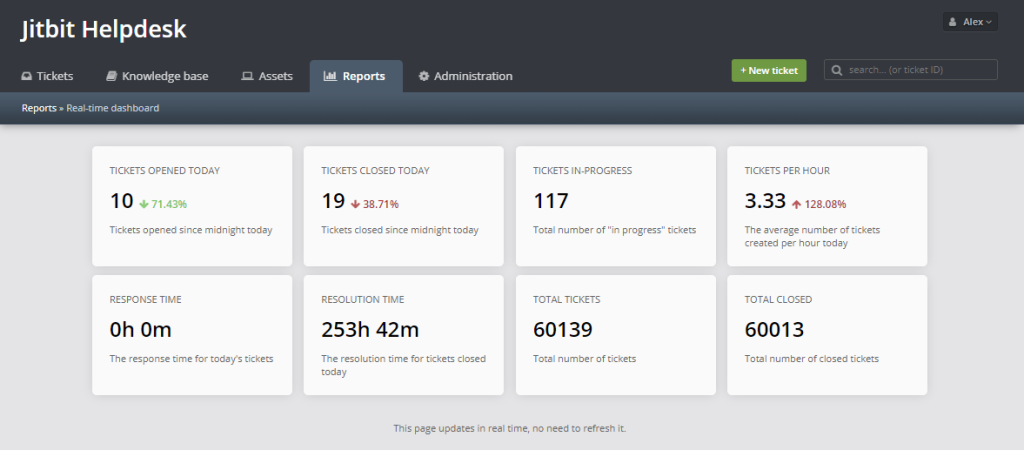
Jitbit’s AI only processes ticket data when an agent explicitly triggers them. No patient data is sent to OpenAI automatically. For healthcare IT teams with strict policies around AI, an explicit opt-in model is a standout feature.
Where Jitbit trades off is on omnichannel depth. It’s an email-first platform. For teams that need to manage patient communication across chat, voice, and email from a single workspace, Hiver Omni can be a better fit.
Key features:
- Jitbit’s self-hosted version installs on Windows servers behind your firewall. Source code is available for organizations that need deep customization of their security environment
- Configurable data retention and deletion policies let compliance teams define exactly how long patient data is stored and when it’s purged.
- SAML 2.0 and Active Directory integration mean staff log in with their existing credentials. For hospital networks managing hundreds of staff accounts, there’s no separate identity management layer to maintain.
- Automation rules can auto-assign tickets by department, send interim replies to after-hours queries, and escalate overdue tickets automatically.
Pricing:
HIPAA compliance is only available with Jitbit’s Enterprise plan priced at a flat rate of $249/month.
Jitbit: Pros and Cons
| Pros | Cons |
| Unlike most platforms that charge per agent, Jitbit’s self-hosted license is a one-time purchase. | Integration options are limited compared to cloud-native platforms. Deep EHR connections may require custom work. |
| Clean and simple interface that works well for both technical and non-technical users. | Mobile app has reliability issues. Some users report chat notifications arriving 10-20 seconds late. |
What is HIPAA?
The Health Insurance Portability and Accountability Act (HIPAA) is a U.S. federal law that governs how organizations handle protected health information (PHI). PHI includes anything that can identify a patient, such as names, addresses, medical records, insurance details, and even appointment scheduling information.
HIPAA applies to covered entities (hospitals, clinics, health plans, clearing houses) and their business associates (any vendor that handles PHI on their behalf).
That includes your ticketing system, too. For a vendor to legally process PHI, they need to sign a Business Associate Agreement (BAA) with your organization. A properly drafted BAA should clearly define each party’s responsibilities and include provisions covering:
- Permitted uses and disclosures of PHI: Specify exactly how the vendor is allowed to use, access, and share protected health information.
- Safeguards for PHI: Require the vendor to implement appropriate administrative, physical, and technical safeguards to protect patient data.
- Breach and security incident reporting: Define how quickly the vendor must notify you if PHI is improperly accessed, disclosed, or compromised.
- Subcontractor compliance: Require any subcontractors that handle PHI to comply with the same HIPAA obligations and sign equivalent agreements where necessary.
- Access to PHI: Ensure patients can access their health information when required under the HIPAA Privacy Rule.
- Amendments to PHI: Require the vendor to support requests to correct or amend protected health information when applicable.
- Accounting of disclosures: Maintain records of when and why PHI has been disclosed so organizations can meet HIPAA accounting requirements.
- Government audits and compliance reviews: Require the vendor to provide relevant records if the U.S. Department of Health and Human Services (HHS) investigates compliance.
- Return or destruction of PHI: Specify that PHI must be securely returned or destroyed when the business relationship ends, unless retention is legally required.
- Termination for non-compliance: Allow the covered entity to terminate the agreement if the vendor materially breaches its HIPAA obligations and fails to resolve the issue.
These provisions ensure that both your organization and your software provider are legally accountable for protecting patient information.
What Happens When Your Ticketing System Isn’t HIPAA-Compliant?
Between 2024 and 2025, over 700 healthcare data breaches exposed more than 275 million patient records. Not all of them started with a cyberattack. Many began closer to home like a forwarded email, an unencrypted ticket field, or a tool nobody thought to put under a BAA. Others started with a coordination gap: a billing agent forwarding PHI to a personal inbox because their ticketing system had no secure way to loop in another team.
Whether the gap is technical or operational, the consequences are the same:
- The financial impact: HIPAA penalties scale with the severity of the violation. Unknowing violations start at $100 per incident, while willful neglect that goes uncorrected can reach $1.5 million per violation category per year. According to HHS enforcement data, a single breach involving thousands of patient records can trigger multiple categories at once, with settlements routinely running into millions. Here’s a breakdown of what OCR might fine your business depending on your level of culpability:
| Tiers | Level of Culpability | Minimum Fine | Maximum Fine |
| Tier 1 | A violation that you were unaware of and could not have realistically avoided, or a violation that you engaged in a reasonable amount of care in an effort to abide by HIPAA Rules. | $100 | $50,000 |
| Tier 2 | A violation that you should have been aware of but could not have avoided even with a reasonable amount of care. (but that still falls short of willful neglect of HIPAA Rules). | $1000 | $50,000 |
| Tier 3 | A violation suffered as a direct result of “ your willful neglect” of HIPAA Rules, in cases where you have attempted to correct the violation. | $10,000 | $50,000 |
| Tier 4 | A violation of HIPAA Rules constituting willful neglect, where you have made no attempt to correct the violation within 30 days. | $50,000 | $1,500,000 |
- The reputational harm: Breaches affecting more than 500 patients get publicly listed on the HHS portal, permanently searchable by patients, partners, and insurers. For a health-tech company managing hospital accounts, that record shows up in renewal conversations at exactly the wrong moment.
And the damage doesn’t stop at the listing.
Patient trust is hard to rebuild. When a breach becomes public, even an honest mistake feels deliberate. They see an organization that failed to protect them. For healthcare businesses managing long-term partner accounts, that perception affects renewals, referrals, and relationships that took years to build.
Must-Have Features of a HIPAA-Compliant Ticketing System
Not every feature matters equally in healthcare. These are the ones that directly affect compliance, patient experience, and how well your team handles complex queries.
- Business Associate Agreement (BAA): Any vendor processing PHI on your behalf must sign a BAA. Some platforms, including Zendesk, require a paid add-on for BAA access. Others, like Giva and Jitbit, include it as standard. Always ask before committing.
- Data Encryption: PHI must be encrypted in transit and at rest. AES-256 at rest and TLS 1.2 or higher in transit are the current standards. If a vendor can’t confirm both, move on.
- Role-Based Access Controls: Look for RBAC, multi-factor authentication, SSO support, and automatic session timeouts. A billing coordinator shouldn’t see clinical notes. A front desk agent shouldn’t access insurance disputes. Platforms like Hiver let admins configure access by role, inbox, and query type.
- Audit Logs: Every interaction with patient data should be logged, timestamped, and tamper-evident. Ask specifically whether logs cover AI-generated actions and automated workflows, not just human agent activity.
- Secure Internal Notes: Support teams need to discuss patient cases internally without exposing those conversations to patients. Internal notes clearly separated from external replies prevent accidental PHI disclosure.
- Intelligent Ticket Routing: Healthcare queries are time-sensitive. Intelligent routing reads the intent of an incoming query and assigns it automatically based on issue type, priority, or account tier. Hiver’s AI Tasks does this without human intervention, so when a hospital’s IT admin reports EHR login failures, the ticket reaches the right team regardless of how the issue is described.
- Collision Detection: Two agents responding to the same patient query is both an operational failure and a compliance risk. Collision Detection alerts agents when someone else is already working a ticket, preventing duplicate responses.
- Knowledge Base and AI Deflection: A well-maintained knowledge base connected to your AI deflects routine queries before they reach an agent. Hiver’s AI Agents pull answers exclusively from your team’s approved content, so patients get accurate answers around billing policies or treatment protocols.
- EHR and CRM Interoperability: Without EHR and CRM integration, agents handling patient queries are working blind — piecing together account history, treatment context, and billing status from multiple disconnected systems before they can even begin to respond. The right ticketing system surfaces this context automatically. Hiver pulls billing history, prior escalations, and account data from connected CRMs and ERPs the moment an agent picks up a query, so the team knows the full picture before typing a single word.
- Employee Training and Risk Assessments: A compliant vendor conducts annual HIPAA risk assessments and trains employees on PHI handling. Vendors like Giva back this with annual third-party assessments by SecurityMetrics – an independently verifiable record, not a self-reported claim.
What to Do When There’s a Breach
Even with a HIPAA-compliant ticketing system, no organization is completely immune to security incidents. What matters is how quickly and effectively you respond when they happen.
Under the HIPAA Breach Notification Rule, covered entities and business associates are required to investigate breaches of unsecured protected health information (PHI), mitigate any harm, and notify affected parties when necessary.
Here’s what you need to do exactly:
1. Contain and Investigate the Breach
As soon as you suspect a breach, work to contain it immediately.
This may involve revoking user access, disabling compromised accounts, isolating affected systems, or changing credentials. At the same time, preserve logs and other evidence so you can determine what happened, what information was involved, who was affected, and whether the data was actually viewed or acquired.
HIPAA also recommends performing a risk assessment to determine the likelihood that the PHI has been compromised before deciding whether breach notifications are required.
2. Follow HIPAA’s Breach Notification Requirements
If the incident qualifies as a reportable breach, HIPAA requires notifications without unreasonable delay and no later than 60 calendar days after the breach is discovered. The specific requirements depend on how many individuals were affected:
- Fewer than 500 individuals affected: Report the breach to affected individuals and the HHS Secretary no later than 60 days after the end of the calendar year in which the breach was discovered.
- 500 or more individuals affected: Notify affected individuals, the HHS Secretary, and prominent media outlets serving the affected area within 60 days of discovery.
3. Post a Substitute Breach Notice (If Required)
If you discover that you don’t have up-to-date contact information for some of the affected individuals, your work isn’t over. HIPAA requires you to make a reasonable effort to notify everyone whose protected health information (PHI) may have been exposed.
If you’re missing contact information for fewer than 10 people, you can provide substitute notice through another reasonable method, like a phone call or an alternative written notice.
But if you’re unable to contact 10 or more individuals, you must post a substitute breach notice prominently on your organization’s website (or publish it through major print or broadcast media where those individuals are likely to reside). The notice must remain accessible for 90 consecutive days and include a toll-free phone number that stays active for the same period so people can find out whether their information was involved in the breach.
This step is easy to overlook, but failing to provide substitute notice when required can put you out of compliance with HIPAA’s Breach Notification Rule.
4. Prevent Future Breaches
Once the immediate incident has been addressed, focus on reducing the likelihood of it happening again.
Review what caused the breach, update your security policies, retrain staff where necessary, strengthen access controls, and apply technical safeguards such as encryption, multi-factor authentication, audit logging, and least-privilege access.
It’s also good practice to review your incident response plan regularly and conduct periodic risk assessments so your team is prepared if another incident occurs.
Which HIPAA-Compliant Ticketing System Is Right for You?
Comm100 suits teams where live chat is the primary patient channel. Giva removes compliance configuration entirely — it’s built in by default. Freshdesk works well for teams that want AI deployed quickly. Zendesk is a strong fit for large healthcare systems with dedicated compliance teams. Salesforce Service Cloud is a natural choice for teams already on Salesforce CRM. HappyFox is built for straightforward HIPAA ticketing without feature bloat. Help Scout works well for smaller teams transitioning from a shared inbox. Jitbit is worth evaluating if patient data cannot leave your own infrastructure. OneDesk covers teams that need ticketing and project management combined.
For healthcare teams managing complex, multi-department support, compliance is just the starting point. The harder requirement is a system that coordinates queries across departments, surfaces full account context the moment a ticket comes in, and keeps every interaction inside a secure, auditable environment.
That’s what Hiver is built for. Intelligent routing, full account context, cross-team collaboration, AI-assisted responses, and quality checks — all within a secure, auditable environment, across the entire support lifecycle.
Try it free for 7 days, no credit card required.
Frequently Asked Questions (FAQs)
1. Are ticketing systems HIPAA compliant by default?
No. Most ticketing systems require configuration, add-ons, or higher-tier plans to meet HIPAA requirements. A few platforms like Giva include compliance by default. Always verify before assuming.
2. Can automation rules in a ticketing system lead to HIPAA violations?
Yes. An automation rule that sends a ticket summary to an unencrypted email address, or routes PHI to an agent without the right access controls, can create a compliance gap. Every automation rule that touches patient data needs to be reviewed against your BAA and access policies.
3. Is it possible to make a non-HIPAA-compliant ticketing system compliant?
Not always. Some systems lack the technical infrastructure — encryption, audit logging, access controls — that HIPAA requires. If the vendor doesn’t sign a BAA, no amount of internal configuration makes the system compliant.
4. What types of situations can impact HIPAA compliance in ticketing systems?
The most common ones: agents forwarding patient emails to personal inboxes, AI features processing PHI outside the BAA boundary, unsecured file attachments in ticket notifications, and third-party integrations that aren’t covered by the vendor’s BAA.
5. How can organizations maintain ongoing HIPAA compliance in their ticketing systems?
Conduct annual risk assessments, review access controls whenever staff roles change, audit automation rules regularly, and verify that any new integration is covered under your BAA. Platforms with built-in audit logging make this significantly easier.
6. Should you get an on-premise or cloud ticketing system?
It depends on your data residency requirements. Cloud platforms hosted on HIPAA-eligible infrastructure like AWS — including Hiver, Freshdesk, and HappyFox — are sufficient for most healthcare teams. Organizations with strict data sovereignty requirements, like certain hospital networks or government-affiliated healthcare institutions, should consider on-premise options like Jitbit.
7. What security measures are essential for a HIPAA-compliant help desk?
AES-256 encryption at rest, TLS 1.2+ in transit, role-based access controls, multi-factor authentication, tamper-evident audit logs, automatic session timeouts, and a signed BAA. These are the baseline — not a checklist of nice-to-haves
8. How long should HIPAA-related tickets and logs be retained?
HIPAA requires covered entities to retain documentation for a minimum of six years from the date of creation or the date it was last in effect. Your ticketing system should support configurable data retention policies that meet this requirement.
9. Is a ticketing system itself enough to make an organization HIPAA-compliant?
No. HIPAA compliance covers administrative, physical, and technical safeguards across your entire organization. A compliant ticketing system addresses one part of the technical safeguards requirement. Staff training, physical security, and organizational policies all need to be in place too.
10. Do you need a BAA for a ticketing system to be HIPAA-compliant?
Yes, if the system processes, stores, or transmits PHI on your behalf. Without a signed BAA, the vendor has no legal accountability for how they handle patient data — and your organization carries the full liability if something goes wrong.