




Quick summary
Freshdesk is affordable, but gates advanced routing and AI behind higher tiers. Salesforce is deeply customizable but costs two to three times the license price once implementation is added. Hiver is the agentic omnichannel customer service platform for complex support, with ticketing, cross-team collaboration, workflows, and AI that handles multi-step requests.
| Tool | Key features | Pricing | Best for |
| Freshdesk | Omnichannel ticketing, automation, Freddy AI | $19–$89/agent/month, billed annually | External customer support |
| Salesforce Service Cloud | Agentforce AI, CRM integration, custom workflows | $25–$550/user/month, billed annually | Large enterprises using Salesforce |
| Hiver | Cross-team collaboration, workflow automation, AI Agents | From $25/user/month, billed annually | Complex, cross-team customer support |
Picking the right helpdesk when support gets complex
Freshdesk and Salesforce Service Cloud both serve large customer bases, but for very different reasons. If you’re comparing them for complex support, the decision usually comes down to three things: how complex your support operation is, how much you can spend, and how quickly you need to get up and running.
AI matters too, but it is only useful when the underlying platform can support the work around it. Hiver’s 2026 survey found that only 14% of support leaders have seen AI meaningfully improve resolution times so far. That makes the broader platform choice just as important as the AI features themselves, especially when requests span teams, systems, and multiple steps.
We’ll compare Freshdesk, Salesforce Service Cloud, and Hiver across customer service capabilities, implementation complexity, customization, AI, pricing, integrations, and which types of teams each platform fits best.
Why listen to us
We’ve spent years building software for the kind of support that spans teams, channels and systems. Over 10,000 teams, including Gusto, Ping Identity, and Epic Games, run complex support on Hiver today. Bynder’s Customer Success team used to juggle Zendesk, Gmail, and Salesforce just to answer one message; after switching, they automated 2,500 workflows and saved 198 hours a month.

Freshdesk vs. Salesforce: detailed comparison
Freshdesk
Best for: High-volume support teams that need an affordable, quick-to-deploy helpdesk.

Freshdesk is Freshworks’ customer support platform. It handles email, chat, phone, WhatsApp, Facebook Messenger, and Instagram from one workspace. Over 50,000 businesses use it, so it’s one of the most widely deployed helpdesks you’ll find.
If your team handles a high volume of straightforward tickets, it’s a solid fit. You’ll get omnichannel ticketing and SLA management on every paid plan, plus a marketplace with over 1,000 integrations. Freddy AI Agent can resolve common questions automatically, and you’ll get 500 AI sessions per month on paid plans. But if you’re dealing with complex, cross-team requests, Freddy AI may not be able to resolve these tickets, and you’ll quickly hit limits on routing and collaboration.
Key features
- Omnichannel ticketing: Manage conversations across email, chat, phone, social media, and messaging apps from one inbox.
- SLA management: Set response and resolution time targets by ticket priority, with automatic escalation when an SLA is about to breach.
- Marketplace integrations: Connect Freshdesk to over 1,000 apps, including Salesforce, Slack, Shopify, and Jira.
- Freddy AI Agent: Resolve common customer questions automatically using your knowledge base, with 500 sessions included on paid plans.
- Freddy AI Copilot: Give agents AI-drafted replies, ticket summaries, and tone suggestions ($29/agent add-on).
Pricing
Freshdesk’s pricing is per agent, per month, billed annually:
- Free: $0 (up to 2 agents)
- Growth: $19/agent/mo
- Pro: $55/agent/mo
- Enterprise: $89/agent/mo
All paid plans include a 14-day free trial. Freddy AI Agent sessions (500/mo) are included on Growth and above. Freddy AI Copilot is a $29/agent add-on on any paid plan. Additional AI sessions cost $49 per 100 sessions.
Pros
- Fast to set up with minimal technical work
- 1,000+ marketplace integrations
- Freddy AI Agent included on paid plans at no extra cost
Cons
- Advanced routing and AI Copilot both sit behind higher tiers
- Voice runs through a separate product, Freshcaller
- Cross-team collaboration is limited compared to platforms built for multi-department workflows
Salesforce Service Cloud
Best for: Large enterprises with an existing Salesforce ecosystem and dedicated admin resources.

Salesforce Service Cloud is the support arm of Salesforce’s CRM platform. It’s deeply customizable, with workflow automation, custom objects, and reporting that’ll match almost any support process. If your team already lives inside Salesforce, the native CRM integration is hard to beat.
But that flexibility comes at a price. Implementation runs three to six months on average. You’ll spend two to three times the listed license once you add consultants, integrations, and add-ons. Agentforce AI isn’t available on lower payment plans, and AI resolutions cost an additional $2 per conversation.
Key features
- Omnichannel routing: Route cases to the right agent by skill, availability, and workload across every channel.
- Custom workflows: Build complex automation rules using Flow Builder, with no-code and pro-code options.
- CRM integration: Pull customer data, account history, and deal context directly into every support case.
- Agentforce AI: Deploy autonomous AI agents that resolve customer requests using your knowledge base, CRM data, and custom workflows.
- Einstein analytics: Get AI-powered insights on agent performance, case trends, and customer sentiment.
Pricing
Salesforce Service Cloud is priced per user, per month, billed annually:
- Starter Suite: $25/user/mo
- Pro Suite: $100/user/mo
- Core: $195/user/mo
- Advanced: $395/user/mo
- Max: $550/user/mo
Agentforce AI is available from the Core tier and up. Each AI conversation costs $2. The Max tier includes unmetered agent access and the full AI suite.
Pros
- Deep customization for complex, multi-team workflows
- Native CRM integration with full customer context
- Enterprise-grade reporting and analytics built into the platform.
Cons
- Implementation takes months and typically needs consultants
- AI requires a higher tier plus a per-conversation fee
- Ongoing customization usually needs a dedicated admin or partner
The best Freshdesk and Salesforce alternative: Hiver
Best for: Teams managing complex, cross-team support requests that need collaboration, automation, and AI without a long implementation.

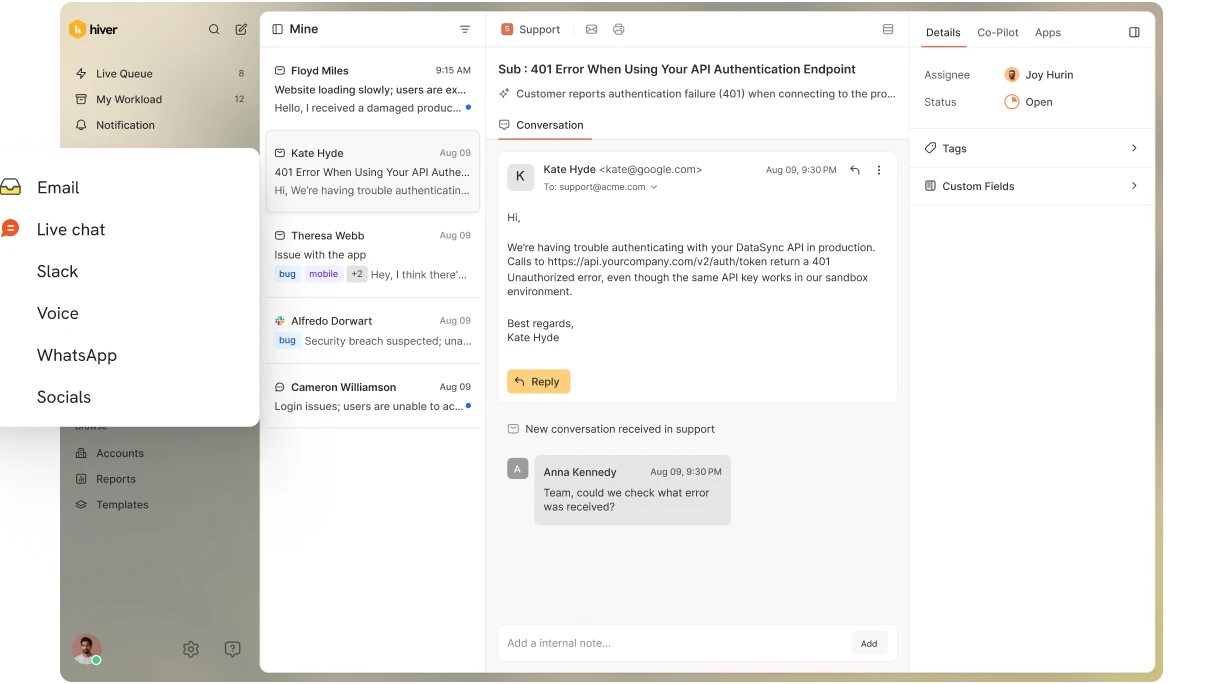
Hiver is the agentic omnichannel customer service platform built for complex support that spans teams, tools, and channels. Email, chat, voice, and social come into one workspace, where every request has clear ownership, status, priority, custom fields, SLAs, and a complete history. Hiver’s AI Agents work from that same context, so they can understand the request, follow your procedures, pull information from connected systems, and resolve multi-step issues end to end instead of stopping at a suggested reply.
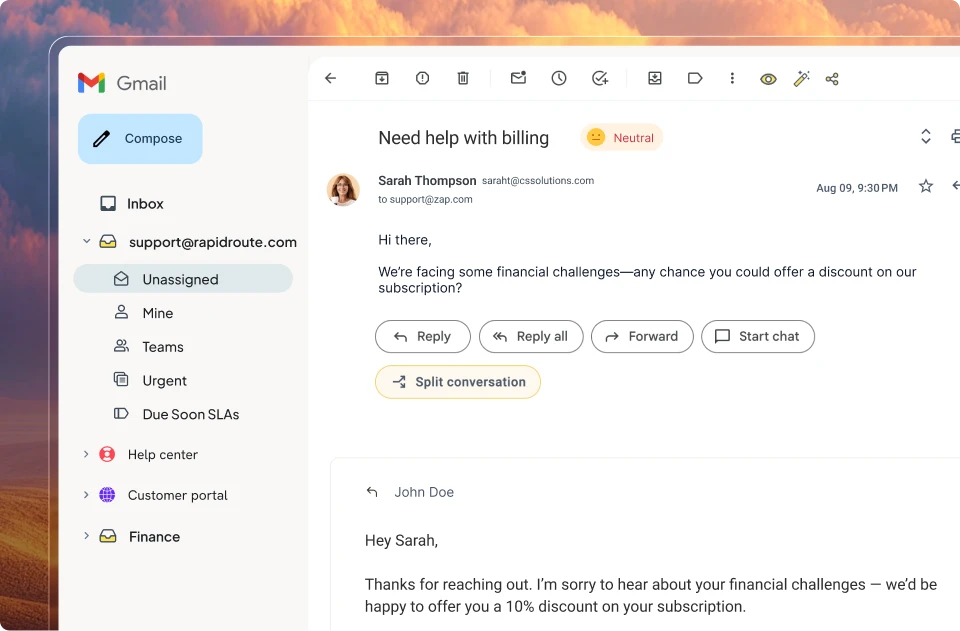
When a ticket needs another team, support reps can bring them in with @mentions and internal notes, with the full context staying attached through every handoff. Workflow Automation handles routing, assignment, tagging, and escalation using conditions from connected apps, while integrations keep the data needed to resolve the request close to the conversation.
With Salesforce, for example, contact, account, and case context can surface directly inside the support workflow, so reps do not have to switch tabs to understand who the customer is or what has already happened. AI Agents can use that same context to work through the request, while AI Copilot helps the rep take over with relevant history and a grounded draft when human judgment is needed.
That level of autonomy still needs control. 61% of support leaders remain cautious about letting AI represent their brand directly. Hiver addresses that with AI Guardrails and Observability, so teams can define in plain language what AI is allowed to handle, where approval is required, and how those boundaries change as trust grows.
Key features
- Ticketing: every request gets clear ownership with status, priority, custom fields, SLAs, and a complete audit trail, configurable in natural language.
- Cross-team collaboration: conversation history, private notes, handoffs, and Slack discussions all stay connected to the customer thread.
- Workflow Automation: route, assign, tag, triage, and escalate using conditions and data from connected apps, built in natural language.
- Omnichannel Inbox: email, chat, Slack, voice, SMS, WhatsApp and social land in one queue
- Integrations: connect over 100 tools, including Salesforce, Jira, Linear, Slack, HubSpot, and NetSuite, with updates syncing in real time.
- AI Agents: pick up a ticket, understand intent, and resolve requests across connected systems, bringing in a support rep when judgment is needed.
- Analytics: reporting across teams, inboxes, and channels rolls into one dashboard, tracking volume, response times, resolutions, and SLAs.
- AI Copilot: draft replies from the full conversation history, pull similar past issues, and suggest next steps for review.
- AI QA: automatically scores your team’s responses for quality, flags gaps, and surfaces coaching opportunities.
- Customer Intelligence: support threads, CRM fields, and product telemetry roll into one continuously updated account view.
Pricing
Hiver’s pricing is per user, per month, billed annually:
- Growth: $25/user/mo
- Pro: $55/user/mo
- Elite: $85/user/mo, adding AI QA, AI Insights, and analytics across every channel. AI Agents and AI Copilot are included from Growth, the entry tier.
Pros
- Ticketing, cross-team collaboration, and workflows on every plan
- AI Agents resolve complex, multi-step requests autonomously, not just draft-and-suggest
- AI Observability and Guardrails give teams control over what AI handles on its own
Cons
- Built for complex, cross-team support, so teams with simple, single-touch tickets may not need the depth.
Freshdesk vs. Salesforce vs. Hiver: feature comparison
| Feature | Freshdesk | Salesforce Service Cloud | Hiver |
| Cross-team collaboration | Internal notes and collaboration | Case teams and Chatter | Shared threads, Slack, linked Jira/Linear issues, and in-context handoffs |
| Customer context | Customer and company records | Deep CRM and account data | Customer context from CRM, tickets, calls, and product usage |
| Workflow automation | Rule-based automation | Flow Builder and custom development | Routing, triage, escalations, and cross-tool workflows |
| AI Agents | Freddy AI Agent | Agentforce | AI Agents for multi-step, cross-system requests |
| AI agent assistance | Freddy Copilot | Einstein AI | AI Copilot with context and suggested next steps |
| Quality assurance | CSAT and reporting | Analytics and AI features | AI QA reviews responses against defined quality standards |
| Cross-tool workflows | Integrations and marketplace apps | Deep Salesforce ecosystem | Real-time updates across tools such as Salesforce, Jira, NetSuite, and Linear |
| Implementation | Relatively quick setup | Typically requires more configuration | Designed to go live quickly, with AI and workflows configured in days |
| Starting price | $19/agent/month | Varies by edition | $25/user/month |
Ready for support that handles the hard requests
The right choice depends on what “complex” means for your team. Freshdesk handles high ticket volumes with straightforward workflows well; Salesforce offers deeper customization for teams already inside its ecosystem.
For complex support that spans teams, tools, and channels, Hiver keeps the full context connected while AI Agents work through multi-step requests end to end.
Book a demo to see how it works on your own tickets.
FAQs
Is Freshdesk cheaper than Salesforce for customer support?
Yes, by a wide margin. Freshdesk starts at $19/agent/mo, and even its top-tier Enterprise plan runs $89/agent/mo. Salesforce Service Cloud starts at $25/user/mo for the Starter Suite, but you’ll pay $195/user/mo or more to get AI features with Agentforce. Add implementation costs and you’re looking at two to three times the license price. Hiver starts at $25/user/mo and goes up to $85/user/mo on the Elite tier, with AI included from the entry tier rather than gated behind a higher-priced plan.
Can Salesforce Service Cloud work for small teams?
The Starter Suite runs $25/user/mo, so it’s technically accessible. But Salesforce isn’t built for small teams without dedicated admins. If you don’t have the resources for a multi-month implementation, you’ll struggle with setup and maintenance. Freshdesk and Hiver are both faster to get going and simpler to maintain.
Does Hiver work outside of Gmail?
Yes. Hiver offers two products. Hiver in Gmail runs inside your inbox for teams that prefer it. Hiver Omni is a standalone omnichannel platform that works independently of Gmail. It supports email, chat, voice, Slack, SMS, and social.
What’s the difference between Freshdesk’s Freddy AI and Hiver’s AI Agents?
Freddy AI Agent resolves common, straightforward questions using your knowledge base, with 500 sessions included on paid plans. Hiver’s AI Agents go further. They understand intent, run multi-step procedures, and take actions across connected systems like Salesforce and Jira. They’re built for complex requests where a scripted answer won’t cut it.
Which platform is best for B2B support with complex escalations?
If your support involves multi-team coordination and account-sensitive decisions, Hiver handles this well. Ticketing keeps every request structured, cross-team collaboration preserves full context through every handoff, and AI Agents manage multi-step requests autonomously. Salesforce can handle complex support too, but you’ll need months to configure it and a dedicated admin to maintain it. Freshdesk works best for simpler, high-volume support.
How do the three platforms compare on implementation time?
Freshdesk is fast to set up, usually hours to a couple of days. since AI Agents and workflows come configured out of the box rather than needing custom build-out. Salesforce is the longest by far, typically three to six months or more, especially if you need custom workflows, integrations, and Agentforce configuration.