Niraj Ranjan Rout (00:01):
Hi, Todd. Welcome to the podcast.
Tod Ellington (00:03):
Hi, thanks for having me.
Niraj Ranjan Rout (00:05):
Hey, Todd. I’d love to start by learning a bit more about Whitestone and what you do there.
Tod Ellington (00:15):
Sure. Whitestone is a creative branding agency that’s been around for 13 years. It was founded by a gentleman named Joe Summers, who’s been a friend of mine for many years. Our core focus is creating experiences for clients around branded merchandise, with a strong emphasis on creativity and sustainability.
Niraj Ranjan Rout (00:47):
Excellent. So can you tell us a bit more about your role at Whitestone?
Tod Ellington (00:53):
I’ve been here for about 10–11 months. I joined in September as Vice President of Operations. I oversee the big picture strategy and direction of the company after sales are made. In short, the sales team makes promises to our clients, and my job is to make sure we keep them. That means building the right teams, structures, and workflows to make it happen every day.
Niraj Ranjan Rout (01:27):
Makes sense. So essentially, you’re responsible for everything operational post-sales—making sure promises are met and customers continue to get the support they need.
Tod Ellington (01:40):
Yeah, absolutely. That’s the name of the game. We want to be able to answer the bell whenever a client needs something. In the creative branding space, requests can be pretty out there. The goal is to say “yes” to as many opportunities as possible, without being limited by process or technology.
Niraj Ranjan Rout (02:02):
Can you tell us a bit more about what the post-sale experience looks like for customers? What are the general touchpoints, and why do they reach out to your team?
Tod Ellington (02:18):
We work with all kinds of companies—different sizes, different industries. Clients usually come to us in two ways. One is for one-off projects, like branded experiences at an event such as South by Southwest. The other is enterprise clients looking for more programmatic engagement, like ongoing programs for employees, vendors, or customers.
For those clients, we build e-commerce experiences that are automated, synced, and manage inventory for branded merchandise. It could be for recruitment, employee engagement, or customer programs. The process is always similar, but never the same—there’s always nuance. Our team is skilled at asking the right questions to make sure the experience isn’t just good, but great.
Niraj Ranjan Rout (04:11):
And what kind of teams help you do this? What roles and functions sit under you?
Tod Ellington (04:24):
We’ve got several teams that carry the client experience forward after sales. There’s our production team, which takes projects from approval to delivery. Then we have a technology team, a logistics and fulfillment department for global distribution, a full creative team, marketing, and finance.
Under my purview specifically are production, logistics, technology, and overall strategic operations.
Niraj Ranjan Rout (05:47):
That’s a wide operational role. I’d love to know how you landed here—what your career path looked like.
Tod Ellington (05:57):
My career has spanned a few different areas. Out of college, I started in sales, working across both B2C and B2B, and eventually led sales teams. Then I moved into marketing, and later into marketing operations. That transitioned into pure operations at my last company, Thumbprint, where I spent 12 years.
After that, I was ready for new challenges. I’d known Joe, Whitestone’s founder, and Dominique, our president, for years. They had opportunities here where my experience across sales, marketing, and operations could come together. That’s how I landed at Whitestone.
Niraj Ranjan Rout (07:24):
I also saw that during your time at Thumbprint, you drove significant revenue growth. Can you walk us through that journey?
Tod Ellington (07:45):
Thumbprint was where I really developed professionally. When I joined, it was a small, family-owned business, mostly regional. We had to figure out how to grow it organically. The client experience was always paramount, but that meant on the operational side we had to be creative—sometimes manual, sometimes building processes and systems from scratch, sometimes experimenting.
There was no fear of failure. We tried things, pivoted when needed, and made sure we focused on people, processes, and technology. You can’t just throw more people at problems—you need systems that allow you to scale. That philosophy has stuck with me.
Niraj Ranjan Rout (09:34):
What were some of the most consequential initiatives you took, either at Thumbprint or Whitestone?
Tod Ellington (10:04):
At Whitestone, nothing was broken—it’s a fantastic business. My goal was to come in at the edges and add layers of technology and standard processes for scale. For example, we implemented tools like Hiver and Asana to automate manual processes. We also partnered with third-party logistics providers for global scaling. Those were big changes in the last year.
Niraj Ranjan Rout (11:14):
How do you decide which tools to adopt? Who recommends them, and how do you ensure the right decision is made?
Tod Ellington (11:37):
I’m not afraid to experiment, but we try to minimize misses. For example, I had never used Hiver before—I was on Office 365 at my old company. But after Whitestone acquired a company where a teammate had used Hiver successfully, I saw the impact firsthand. We started small, tested within a department, and expanded from there. Same with Asana—we standardized it across teams after trialing. The key is to pilot, measure impact, and then scale.
Niraj Ranjan Rout (13:28):
With such a large operational span, how do you know things are going well? What metrics or dashboards give you visibility?
Tod Ellington (13:52):
Analytics are central. Every new process or tool has key metrics tied to it. For example, customer service hours used to be tracked manually on a Google Sheet. Now, with Hiver and Asana, every email or task is tagged. That data flows into Zoho Analytics, giving us real-time dashboards by client, by team, by type of request.
It’s a balance: I think strategically, but my team ensures we’ve got KPIs and checklists so we’re not just chasing change for the sake of it.
Niraj Ranjan Rout (15:53):
You’ve driven a lot of change in a short time at Whitestone. What are your biggest learnings about adoption and resistance?
Tod Ellington (16:20):
Earlier in my career, I pushed too hard. At Whitestone, I’ve learned the importance of listening—engaging the team, valuing diverse perspectives, not surrounding yourself with just “yes people.” Change needs to move fast enough to avoid paralysis, but not so fast you miss important input.
Niraj Ranjan Rout (17:34):
What’s your methodology for rolling out new tools?
Tod Ellington (17:56):
You need a champion—either a person or a department. For Hiver, our customer support team quickly became that. For Asana, we standardized how tasks were managed, created clear SLAs, and built a technology team around it. Then other departments wanted in. The approach is: pilot, blueprint, train, and empower teams to adapt it for their needs.
Niraj Ranjan Rout (20:53):
Let’s talk specifically about Hiver. What did life look like before and after, and what impact has it had?
Tod Ellington (21:07):
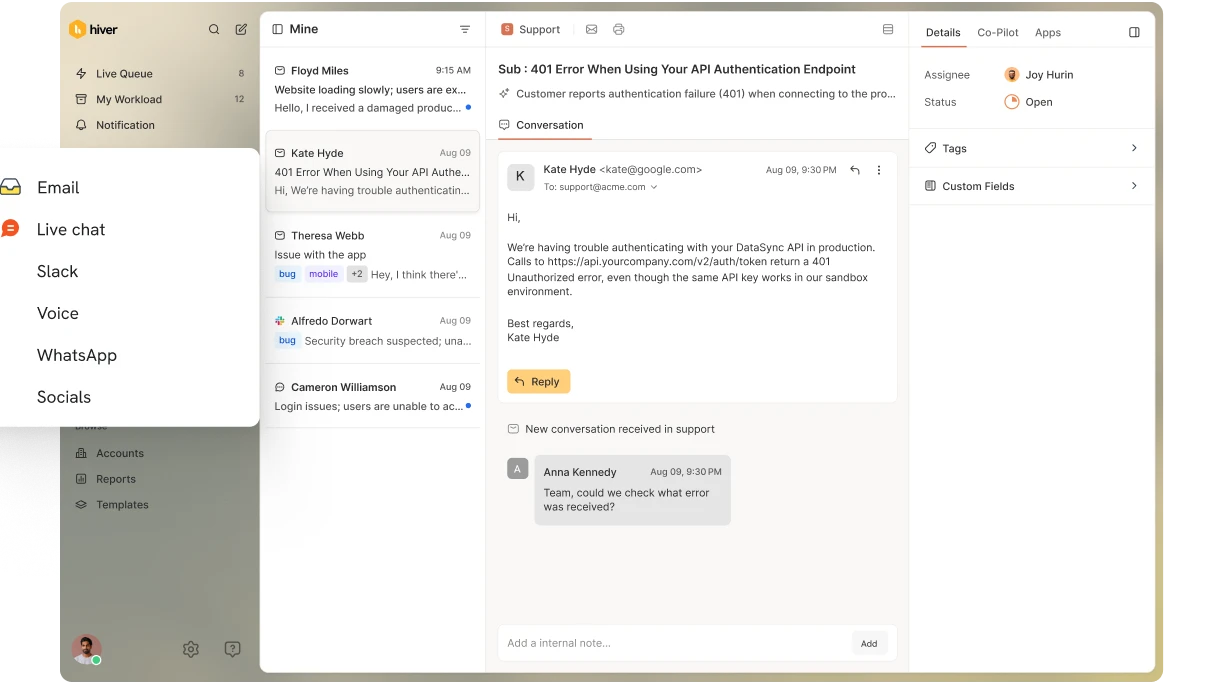
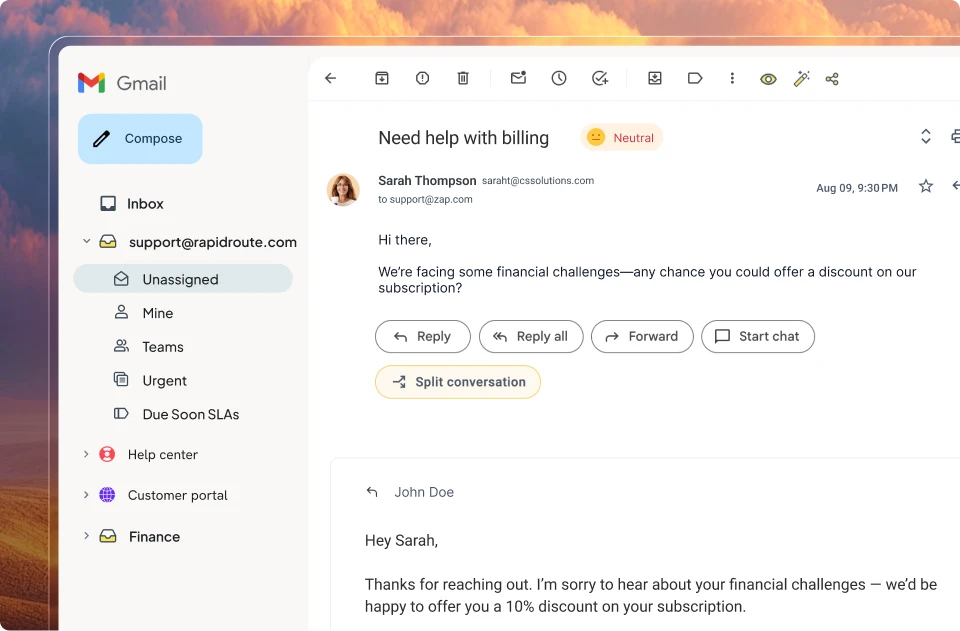
Before, we had shared inboxes with shared credentials—not secure, not efficient. No one knew who owned an email or how to escalate. With Hiver, we created shared inboxes, tagging, and workflows. That gave us accountability, clarity, and real-time tracking of customer service hours, which is often billable.
It’s since expanded beyond support into logistics and production. We even switched from monthly to annual subscription—it’s become that core to our operations.
Niraj Ranjan Rout (22:50):
Great to hear that. Before we wrap up, how do you see AI impacting your work—across design, production, and customer service?
Tod Ellington (23:18):
AI is evolving so fast. On the operations side, it’s already saving us money by handling coding tasks we used to outsource. But prompts still need human context—you need to frame business problems properly.
In sales and marketing, AI is helping us with messaging and presentations. In creative work, it’s less about replacing people and more about augmenting them. It can handle simple tasks like logo placement, but nuanced design still needs humans. Overall, I see it enhancing rather than replacing, especially for data entry and repetitive tasks.
Niraj Ranjan Rout (26:47):
Makes sense. That’s a great overview, and very relevant to many industries.
Tod Ellington (26:55):
Yeah, and I’m excited to see even in tools like Hiver how AI is being integrated. Automatic insights on customer support will be a massive lift for us.
Niraj Ranjan Rout (27:39):
Absolutely. Thanks so much for joining, Todd. This was a great conversation.
Tod Ellington (27:49):
Thank you.