Skip to content


Freshdesk vs Help Scout: Which Customer Service Platform Should You Opt For [2025]
Freshdesk vs Help Scout at a glance
Quick Decision Guide
Feature Comparison Table
Feature Deep Dive
Freshdesk is feature-rich but complex, Help Scout focuses on conversations, and Hiver works seamlessly
Nearly every scenario is cheaper with Hiver (and you won't have to worry about feature gates)
Hiver's AI features are included, while competitors charge extra or require complex setup
Real Success Stories of Hiver
Freshdesk vs Help Scout at a glance
Stack Freshdesk and Help Scout side by side and the question isn’t just what you want to do, but how much you want to think about it. Freshdesk comes heavy: most of its power sits behind a wall of features and settings, waiting for the right combination to unlock real usefulness. If you want automation, triggers, advanced reporting, you’ll need to roll up your sleeves and, more often than not, shell out for the higher tiers.
Help Scout goes the other way. It’s quiet, straightforward, collaborative; less about levers to pull and more about showing up for the conversation. Everything’s accessible and the interface doesn’t get in your way, which makes it a breath of fresh air if you’re tired of software that insists on being the centerpiece.
For teams that won’t settle for extremes, Hiver cuts through the noise. Built for fast adoption, bolstered by AI where it counts, and upfront about pricing. Let’s dive in.
Quick Decision Guide
Choose Freshdesk if: You’re looking for a feature-rich help desk and omnichannel support. A good choice for large or fast-growing teams that have the resources to manage a more complex platform.
Choose Help Scout if: You prefer a more personal and conversation-driven approach to customer support. Its shared inbox and Beacon chat make it ideal for small to medium-sized teams.
Choose Hiver if: You want a modern, AI-powered customer service platform to deliver stellar support across multiple channels. It’s best suited for fast-moving businesses that value simplicity, speed, and seamless collaboration.
Feature Comparison Table
Ease of setup
Feature-rich interface requires significant configuration and training
Easy conversation-based setup; advanced features require learning curve
Familiar interface works immediately; team productive in minutes
Pricing
Complicated tiered pricing with key features locked behind expensive plans; difficult-to-parse upgrade costs
Contact-based pricing can be unpredictable; unlimited users but costs scale with customer volume
Simple “per user” pricing with transparent costs; AI included at every paid level
Automation
Advanced workflow automation available but requires configuration expertise
Basic automation with AI assistance; limited compared to traditional ticketing systems
AI Copilot handles routing and responses automatically
Multi-channel
Comprehensive omnichannel support across email, social, phone, and chat
Primarily email and chat focused; limited social media integration
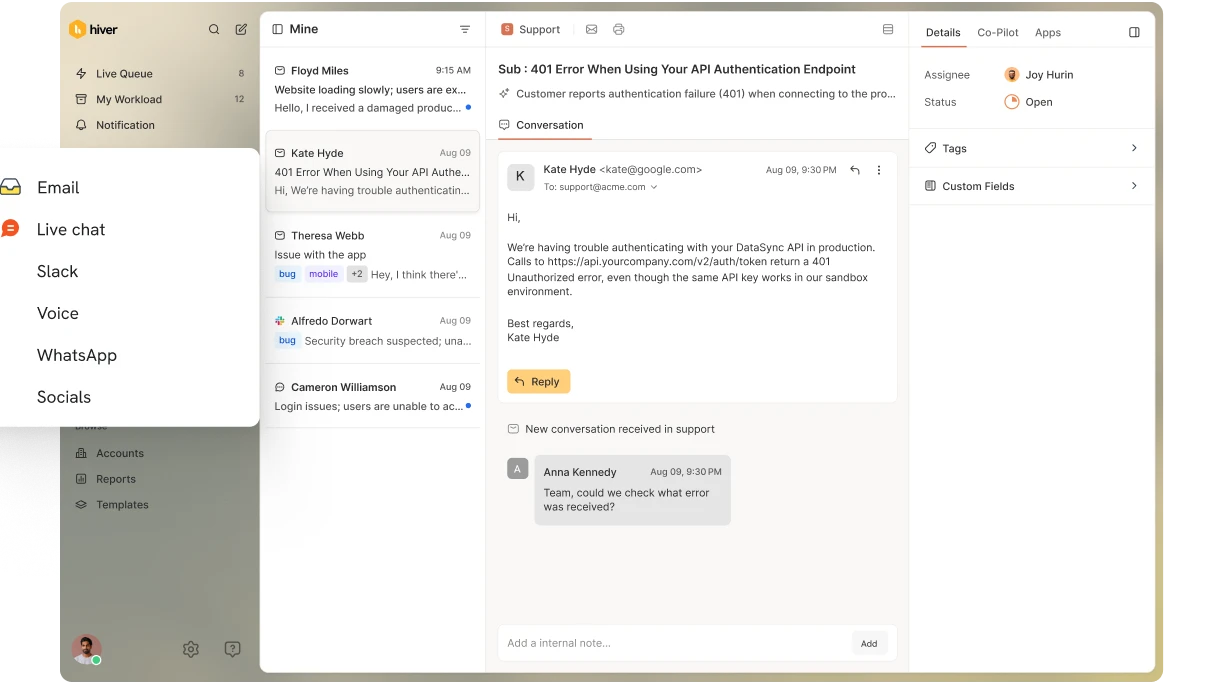
Email, chat, WhatsApp, voice, and more unified in single platform
Learning curve
Steep learning curve with extensive training required for team adoption
Minimal learning curve for conversation management approach
Zero learning curve. Extremely easy for teams to get started.
Feature Deep Dive
1. Ticketing & Email Management
Freshdesk
- What makes it powerful: Supports multi-channel ticketing, parent-child tickets, SLAs, complex workflows.
- Where it struggles: Setup is complex; custom workflows need support; UI can be cluttered.
Help Scout
- What makes it powerful: Seamless conversation threading, personal profiles, easy to use.
- Where it struggles: No natural multi-brand or tiered escalation; lacks parent-child tickets.
Hiver
- What makes it powerful: Effortlessly manage and handle all incoming emails to addresses like support@, info@, and more, along with easy collaboration on emails with your team and non-Hiver users using internal notes, @mentions, and permalinks.
2. Automation & AI
Freshdesk
- What makes it powerful: Extensive automation, Freddy AI, predictive capabilities.
- Where it struggles: High setup/config effort; plans pricey; training needed.
Help Scout
- What makes it powerful: Basic automation (tags, assignment), Drafts AI.
- Where it struggles: Limited automation scope; no predictive AI; no bots.
Hiver
What makes it powerful: AI Copilot to draft responses instantly, simplify long messages into quick summaries, auto-close non-actionable conversations, and get smart template suggestions for responses.
Where it struggles: Automation less flexible than Freshdesk; limited for complex flows.
3. Multi-Channel Support
Freshdesk
- What makes it powerful: Supports email, chat, social media, voice, WhatsApp.
- Where it struggles: Adding channels can be complicated; some channels require extra payment.
Help Scout
What makes it powerful: Email and live chat, simple setup.
Where it struggles: No native voice or social channels; limited broader channel support.
Hiver
What makes it powerful: Manage customer conversations across channels like email, chat, WhatsApp, voice in a single unified platform
Where it struggles: Less extensive social channels
4. Integration Ecosystem
Freshdesk
- What makes it powerful: Marketplace of 1000+ apps.
- Where it struggles: Quality varies; some integrations are costly or complex.
Help Scout
What makes it powerful: Good CRM, e-commerce, collaboration integrations.
Where it struggles: Fewer total integrations; advanced connectors via Zapier only.
Hiver
What makes it powerful: Integrates with 100+ tools key tools like CRM, Slack, Google Workspace.
Where it struggles: Smaller ecosystem.
5. Reporting & Analytics
Freshdesk
- What makes it powerful: Custom dashboards, SLA reports, agent performance.
- Where it struggles: Advanced reports require higher tiers; complexity hampers quick insights.
Help Scout
- What makes it powerful: Clear, simple reports on response times, CSAT, productivity.
- Where it struggles: Limited customization; not suitable for in-depth BI needs.
Hiver
- What makes it powerful: Core metrics accessible in interface; response times, resolution times, and CSAT scores can be measured; great for small teams.
- Where it struggles: No advanced dashboards; less suited for complex data analysis.
6. Collaboration & Internal Notes
Freshdesk
- What makes it powerful: internal notes, collision detection, escalation.
- Where it struggles: Collaboration can be noise-heavy; Slack integration needed for fluid communication.
Help Scout
- What makes it powerful: Notes, mentions, shared inbox, collision detection.
- Where it struggles: Limited roles and permissions; not enterprise-grade collaboration.
Hiver
- What makes it powerful: Fast-track responses and collaboration, turn frequent replies into templates, avoid duplicate responses by seeing who’s working on a query in real-time, organize emails by shared emails
- Where it struggles: Role-based permission limits; lacks deep org-level controls.
Freshdesk is feature-rich but complex, Help Scout focuses on conversations, and Hiver works seamlessly
Freshdesk takes a traditional help desk approach with structured ticketing, automation, and multichannel workflows. It’s built for large teams that need deep customization and advanced controls, but the trade-off is setup complexity and a steeper learning curve. Many essential capabilities, like advanced automation or multi-brand support, are locked behind higher pricing tiers, which can add to cost and configuration time.
Help Scout, on the other hand, centers around customer conversations rather than tickets. Its shared inbox and Beacon chat make support feel personal and simple to manage, which is great for smaller teams or those who prefer an email-like experience. However, it can feel limited for businesses that need detailed workflow automation or granular reporting.
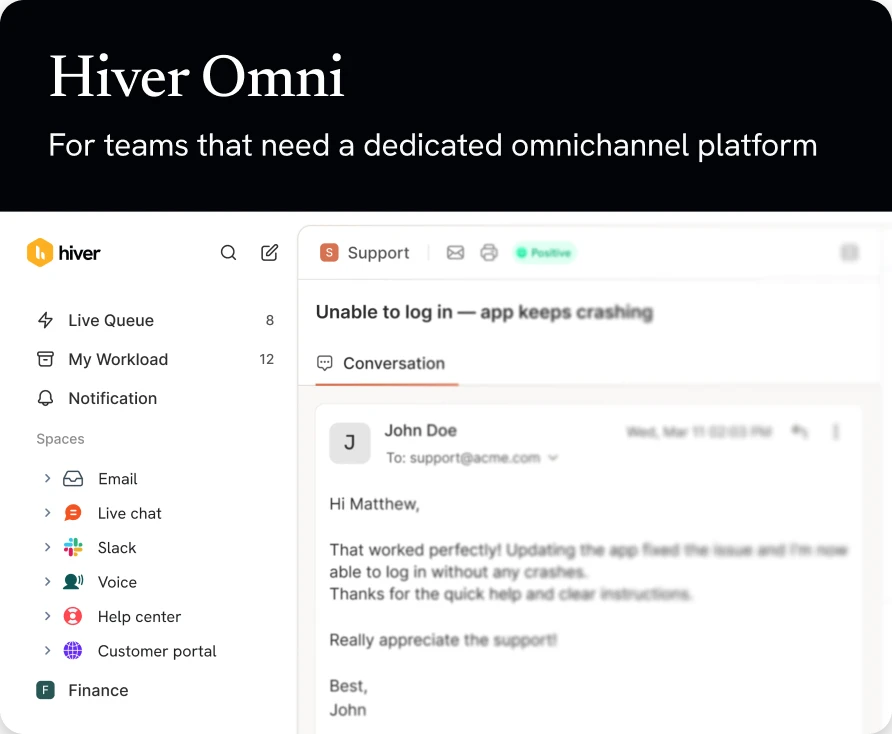
Hiver’s platform is as simple as it can get, yet it is a powerful AI customer service platform with all the professional customer service features you need. Your team keeps using the interface they already know while gaining AI-powered routing, collaboration, and automation.
For teams whose members may be reluctant to learn new systems or change established workflows, Hiver has the advantage of working exactly like email while providing all the professional features you need. And it’s a big advantage. Most support teams already live in email, so there’s no adoption curve.
But here’s the rub: getting real value from Freshdesk requires significant setup and training, while Help Scout requires rethinking your support philosophy. If you want something that works immediately without changing how your team operates, Hiver has the advantage there. Freshdesk setup can take weeks; Hiver works in minutes.
Nearly every scenario is cheaper with Hiver (and you won't have to worry about feature gates)
Freshdesk’s pricing is thorough, but it requires patience to navigate. The structure is clear once you dig in: growth at $15 per agent, pro at $49, enterprise at $79—all monthly when billed annually. What takes time is figuring out which features live where and what add-ons you’ll actually need. Yes, it’s expensive as you scale up, but the pricing itself is transparent once you work through the tiers. Many of the automation and reporting tools that make Freshdesk powerful do require the higher plans, so factor that into your real cost.
Freshdesk Pricing Structure:
- Free: $0 for up to 2 agents with basic email and social ticketing
- Growth: $15/agent/month with automation and collision detection
- Pro: $49/agent/month including custom roles and SLA policies
- Enterprise: $79/agent/month with advanced security and AI features
Help Scout’s contact-based pricing sounds reasonable until you realize your costs can fluctuate unpredictably as your customer base grows, making budget planning nearly impossible.
Help Scout pricing structure:
- Free: $0 (100 contacts/month, unlimited users)
- Standard: $50/month (up to 100 contacts, scales from there)
- Plus: $75/month (up to 200 contacts)
- Pro: Custom pricing for larger volumes
Meanwhile, Hiver decided on straightforward per-user pricing and mostly just sticks to it. Sure, there are different tiers with different feature sets, but for the vast majority of teams, you’ll know exactly what you’re paying and what you’re getting. In addition to its simplicity, Hiver’s pricing is typically cheaper than comparable features from either competitor.
Hiver pricing structure:
- Free: $0 (Free forever) – Get multi-channel shared inboxes, manage all your support channels from your inbox, Ticketing, Live chat, WhatsApp & Voice, Knowledge Base, Team collaboration, Slack integration, and 24*7 email and live chat support
- Lite: $19 (per user, per month) – Everything in Free plan, plus, Customer portal, Workflow automations, Round-robin auto-assignment, Service level agreements, Custom fields, Approval workflows, Analytics for conversation data, and Essential integrations
- Growth: $29 (per user, per month) – Everything in Lite, plus, Analytics for team performance, Custom reports, Advanced integrations
- Pro: $49 (per user, per month) – Everything in Growth, plus, Chatbots, CSAT survey, Business hours, Advanced analytics, Scheduled data exports, Premium integrations & API access
- Elite: Customer pricing – Everything in Pro, plus, Skill-based routing, Custom roles, HIPAA compliance, Single sign-on, Simplify access management with the convenience of single-sign-on functionality powered by Okta app integration, Additional success services, Custom build hours
That said, Help Scout does have one pricing advantage: unlimited users on all plans means growing teams don’t face per-seat costs. But the contact-based pricing can spiral quickly, and most teams prefer predictable monthly costs over variable contact-based billing.
Hiver's AI features are included, while competitors charge extra or require complex setup
Hiver includes AI Copilot as a standard feature across all paid plans, with no per-conversation charges or complex configuration required. The AI analyzes conversations, suggests responses in your brand voice, routes inquiries intelligently, and automates routine tasks, all without any setup. Paid users can get Hiver AI for $20 per user per month for a flat pricing, without any hidden AI fees.
As I mentioned earlier, users who want advanced automation with Freshdesk need to pay for higher-tier plans and invest significant time in configuration. The Freddy AI features require Enterprise plans starting at $79/agent/month, and even then you’ll need technical expertise to set up workflows properly.
Help Scout includes AI features across all plans, which is great, but the capabilities are more limited compared to dedicated AI-powered platforms. The AI assists with drafts and answers but doesn’t provide the comprehensive automation that modern teams expect.
Rather than charging premium subscriptions for AI access or requiring complex setup, Hiver’s AI just works out of the box. For teams that want immediate productivity gains without technical overhead, this is a massive advantage.
Real success stories

“We tried Zendesk, Salesforce—everything felt complicated. But Hiver being right inside Gmail makes it a breeze to work with.”
James McNeil
President & CEO, Daybreak Metro

“With Hiver, we’re finally having real conversations with our customers. No ticket numbers, no robotic emails—just personal, human interactions.”
Scott Gellatly
General Manager, itGenius
Frequently asked questions
Which platform is best for small businesses?
Can I migrate from Freshdesk or Help Scout to Hiver?
Which has better automation capabilities?
Is Hiver as secure as enterprise platforms?
What about reporting and analytics?
Which platform integrates best with CRM systems?
Can these platforms handle enterprise-level support volumes?
Do I need technical expertise to set up these platforms?

Vasundhara is a Senior Copywriter at Hiver who works in the Digital Marketing team at Hiver. They research from platforms like Reddit, Product Hunt, G2, Gartner, and Capterra to put forward real-world experiences and present balanced software comparisons that help readers make informed decisions.
Customer service software that feels like your inbox