




Quick summary
Omnichannel customer service brings customer conversations from different channels into one connected experience. Instead of treating email, chat, phone, social, and messaging as separate conversations, your team can see the customer’s history and pick up where the last interaction ended.
This guide explains how omnichannel support works and how to build a strong experience.
Curious about omnichannel support?
Verint’s 2024 data shows 61% of customers prefer digital channels, yet phone still carries 76% of interactions by volume.
Both numbers are true because different issues call for different channels. The problem is, each channel could end up with its own version of the customer’s history. And that’s where things start to fall apart
According to Salesforce research, 56% of customers say they repeat information to different reps. That happens when your chat tool, email platform, and phone system each hold their own records. The customer feels it every time they switch.
Omnichannel customer service solves that by tying every channel to one shared record. This guide covers what that looks like in practice, the channels involved, and how to build it step by step.
Why listen to us
Hiver is an omnichannel customer service platform used by more than 10,000 teams. When Oakland Public Education Fund switched to Hiver, they responded 72% faster and saved 61 hours a month. Fireco brought email, live chat, and WhatsApp under one roof and now saves 114 hours monthly. We’ve helped teams figure out omnichannel in practice, so the advice in this guide comes from what we’ve actually seen work.

Fireco: Email, Chat and WhatsApp in One Place
What is omnichannel customer service?
Omnichannel customer service is a support model where every channel, email, live chat, SMS, social media, WhatsApp, voice, feeds into one shared view of the customer. A customer can start a conversation on WhatsApp, follow up by email, and call in later. A support rep picking up any of those threads sees the full history, without asking the customer to repeat themselves.
That gets confused with multichannel support constantly, even though the two work very differently. A multichannel setup also covers email, chat, and social, but each channel runs its own system, its own inbox, its own history. A customer who switches from chat to email starts over, because nothing connects the two.
The real test is whether a support rep on one channel can see what happened on another without needing to switch tabs, ping a teammate or ask the customer to repeat themselves.
How omnichannel customer service works
True omnichannel support comes down to three main layers. Hiver handles all three, here is a quick video showing how it works:
<iframe width=”560″ height=”315″ src=”https://www.youtube.com/embed/Bv9mtBCmbd0?si=AJLicsX3Z5bSCh3t” title=”YouTube video player” frameborder=”0″ allow=”accelerometer; autoplay; clipboard-write; encrypted-media; gyroscope; picture-in-picture; web-share” referrerpolicy=”strict-origin-when-cross-origin” allowfullscreen></iframe>
Channel consolidation
Your customers reach out over email, chat, phone, WhatsApp, SMS, and social. In most setups, each of those channels runs its own tool with its own queue. A support rep handling chat can’t see what came in by email.

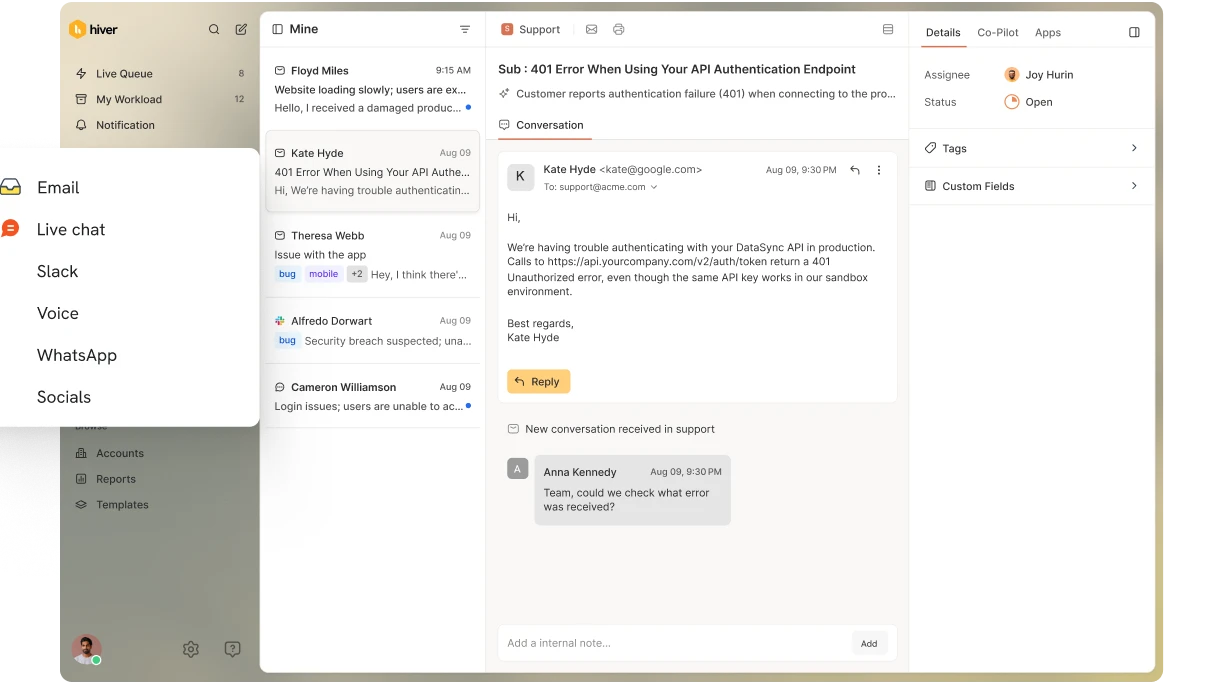
Omnichannel support platforms pull every channel into one queue. Your team works from one screen. A WhatsApp message sits right next to an email, and support reps can triage, assign, and respond to both without switching tools.
Cross-channel analytics
Most reporting tools show you how one channel is doing. Chat has its own dashboard, email has its own, phone has its own. The problem is, you can’t see across them.

Cross-channel analytics puts it all in one view. You can track CSAT, SLA compliance, and volume across every channel your team runs. If chat response times look great but email is lagging, you see it right away instead of finding out when a customer complains.
A single customer view
Say a customer chats with you on Monday, sends an email on Wednesday, and calls on Friday. In a connected setup, all three show up on the same timeline under one record. The support rep picking up Friday’s call sees Monday’s chat and Wednesday’s email, plus any internal notes from the team. Nobody asks the customer to explain the issue again.

That only works if your platform ties every conversation back to a single customer identity. If it doesn’t, you end up with three separate histories. And that’s still just multichannel.
Benefits of omnichannel customer service
Faster resolution times
When support reps can see the full conversation history across channels, they spend less time asking customers to repeat themselves or piecing together context. Retailers using unified omnichannel platforms report 45% faster resolution times, according to Stealth Agents. Fireco, one of our clients, puts that into practice: by bringing email, live chat, and WhatsApp into one place, it saves 114 hours every month.
Higher customer satisfaction
Connected omnichannel support reaches 67% CSAT compared to 28% for disconnected multichannel support. That gap comes down to one thing. Customers don’t have to repeat themselves.
Lower support costs
Omnichannel integration cuts duplicate work. When support reps aren’t reinvestigating issues that were already handled on another channel, they close more tickets per shift. Integrated tools lower service costs by up to 35%, per Stealthagents.
Stronger customer retention
McKinsey research shows that companies with strong omnichannel strategies retain 89% of their customers. Companies with weak ones retain 33%. That’s a gap you can’t ignore.
How to implement omnichannel customer service
1. Audit your current channels and identify the gaps
Map every channel your team uses and how data flows between them. For each channel, answer three questions.
- Where do conversations live?
- Can a rep on one channel see what’s happening on another?
- What happens when a customer switches mid-issue?
You’ll likely discover that channels operate as silos. The chat tool, the email platform, and the phone system each hold their own data. That’s the gap you’re solving.
2. Build a unified customer profile
Decide what a complete customer record looks like before you pick a platform. It should include every conversation across channels, account details, internal notes and tags, and linked tickets in connected systems.
This unified profile is the foundation. Routing, automation, and AI all build on top of it.
3. Choose the right platform
Your platform needs to bring all channels into one view and keep the customer record intact. Look for native channel support, a unified inbox that connects conversations, cross-channel routing, integrations with your CRM and internal tools, and cross-channel analytics.
Not every platform that calls itself “omnichannel” connects data across channels. When you’re evaluating helpdesk solutions, check for these specifics.
- A true unified inbox. Every channel feeds into one view. A customer’s chat, email, and phone call appear on the same timeline.
- Cross-channel routing. Routing rules that work across channels. A VIP customer’s email and chat should get the same priority.
- AI that reads the full record. AI features should pull from the entire customer history across every channel.
- Bidirectional integrations. Native connectors to your CRM, billing, and internal tools that sync both ways.
- Cross-channel analytics. Reporting that lets you compare performance across channels.

Hiver brings email, chat, voice, Slack, SMS, and social into one omnichannel platform. Whether a request arrives by email, chat, or phone, it lands in one timeline tied to that customer’s account. AI Agents handle requests from intent to resolution, and AI Copilot drafts replies grounded in the conversation history so your team edits and sends. Setup takes minutes, and you don’t need to involve IT or hire a consultant.
4. Integrate your existing tools
Omnichannel doesn’t mean replacing everything. It means connecting what you’ve already got. Your CRM, billing systems, and project management tools all need to sync with your support platform.
The test for a good integration is bidirectional sync. When a support ticket triggers a Jira issue and engineering updates it, the update flows back automatically. One-way integrations create the same data silos you’re trying to eliminate.
5. Set up routing and automation
Build routing rules based on the customer’s tier, the issue type, the channel, the support rep’s skills, and any active SLA deadlines. Automation handles the repetitive work, from auto-tagging and assignment to status updates and follow-up sequences.
6. Train your team on cross-channel workflows
Your reps need to understand how conversations move across channels and how to pick one up that started somewhere else. It’s a mindset shift. In a siloed setup, a support rep owns a ticket. In an omnichannel setup, they own a customer relationship across multiple touchpoints.
That takes training on reading conversation timelines, adding internal notes for the next rep, and knowing when a conversation should stay on its current channel.
Omnichannel customer service metrics that matter
First contact resolution (FCR)
FCR is the metric most correlated with customer satisfaction. A 1% lift in FCR drives a 1% lift in CSAT. But with omnichannel, you’ve got to calculate FCR across all channels. A WhatsApp issue marked “resolved” that triggers a follow-up email wasn’t resolved at all. A good benchmark is 70-75%.
Customer satisfaction score (CSAT)
CSAT measures how customers feel about specific interactions, and a strong score sits between 75% and 85%. Track it by channel and by overall experience. If your chat CSAT is 90% but email CSAT is 55%, that tells you where to focus.
First response time (FRT)
This is how quickly your team responds to a new request, and each channel has its own expectation. Chat should respond within 30 seconds, email within 4 hours, and social media within 1 hour.
Customer effort score (CES)
CES measures how easy it was for the customer to get their issue resolved. It captures the omnichannel experience better than CSAT alone. It accounts for how many times they explained the issue and how many support reps they spoke to.
How AI helps omnichannel customer service
AI doesn’t replace the omnichannel infrastructure. It runs on top of it. And how well it performs depends entirely on the quality of the customer data it can access.
AI for first response and resolution
AI agents can read incoming requests, figure out what the customer needs, pull up their history, and respond. Freshworks’ 2025 data shows AI brought first response times from over 6 hours down to under 4 minutes.
That sounds great on paper, but most teams aren’t seeing that play out at scale. Hiver’s State of AI Customer Support in 2026 report surveyed 700+ support leaders. Only one in eleven say AI handles a real chunk of their ticket volume, and just 14% have seen a significant improvement in resolution times. AI is fast when it knows what to do. The problem is most teams haven’t found a way to give it enough tickets it can actually handle.
This is what Hiver is built for. AI Agents work inside the same workspace where your tickets, customer history, workflows, and integrations already live. So they can investigate requests, follow your team’s procedures, pull data from tools like Salesforce or HubSpot, and actually resolve issues. Not just triage them, not just draft a reply, but close them out. And because Hiver includes AI Agents and AI Copilot on every paid plan, you can scale AI across your entire ticket volume without paying per session or buying add-ons.
AI for assisting support reps assist
When a request needs a human, AI does the prep work. It finds similar past issues, gathers context, and drafts a reply in the team’s tone. The support rep reviews, edits, and sends.
Hiver’s AI Copilot drafts replies grounded in the conversation history and the customer’s account data. AI QA scores each response against the rubric your team sets, catching tone mismatches and missing steps before anything reaches the customer.
The trust and context challenge
Miles Goldstein, a global support executive, put it this way in Hiver’s AI CX Trends report. “Too many companies will try to apply AI where it does not belong.” Half of AI scaling failures come down to trust and context. Static knowledge bases give AI stale information, and customer context hidden in calls and CRM records stays invisible.
Our AI Knowledge Hub addresses this by scanning resolved conversations, identifying gaps, and drafting help center articles. That way the knowledge base stays current without manual upkeep.
Build support that keeps up with your customers
Your customers already move between channels without thinking about it. They start on chat, follow up by email, and call when the issue is urgent.
Omnichannel customer service closes the gap between how customers communicate and how support teams are set up. The companies that get this right don’t just resolve issues faster. They build the kind of experience that earns long-term loyalty.
If you’re ready to bring your channels together, Hiver connects email, chat, voice, and social into one platform with AI that handles requests end to end. Start a free trial or book a demo to see how it works for your team.
FAQs
How is omnichannel customer service different from multichannel?
With multichannel, you’re available on several channels, but each one runs its own queue and holds its own data. Omnichannel ties them together into one record, so a support rep on chat can see the email thread from yesterday and the phone call from last week. The difference is whether the data travels with the customer or stays locked in each tool.
Which channels should I prioritize first?
Start with the channels your customers use the most. For B2B support, that’s usually email and chat. Add phone for high-complexity interactions, and bring in social and messaging once your core channels share a unified record.
How long does it take to implement omnichannel customer service?
It depends on your current setup. Plan for 2-4 months to consolidate onto a unified platform, integrate existing systems, and train your team. Some platforms, like Hiver, can get teams running in minutes for basic setup.
How do you measure the ROI of omnichannel customer service?
Track three categories. Efficiency metrics like first response time and resolution time. Satisfaction metrics like CSAT, CES, and FCR. And business metrics like retention rate and support cost per ticket.