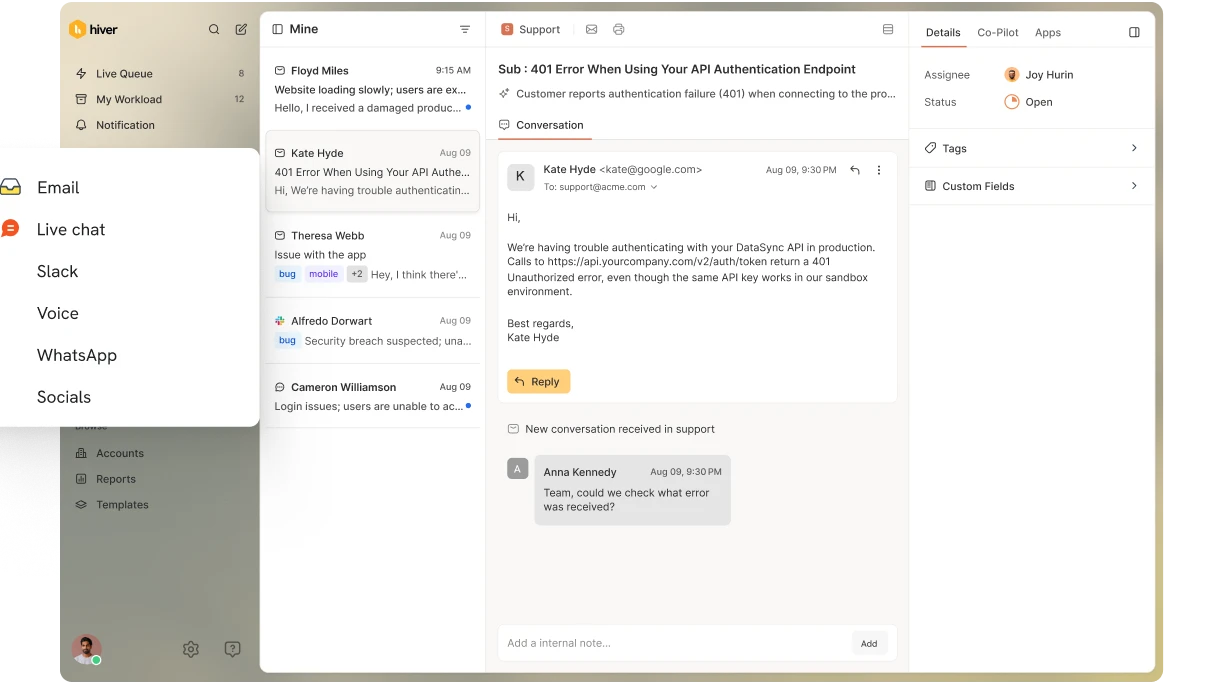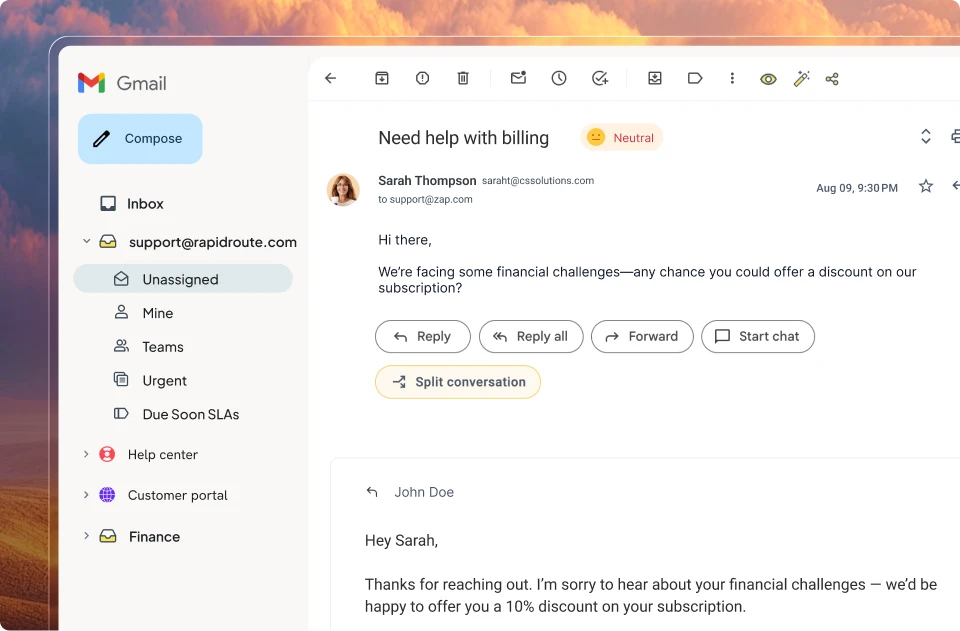


Support conversations reveal what customers struggle with, what they need, and where their trust is wearing thin. But that knowledge often stays inside the helpdesk, disconnected from the account history, renewal timelines, and product usage data that give it wider meaning.
Leaders are left piecing together the customer story. Which recurring issues need investment? Which accounts need attention before renewal? Finding answers means reading conversations, pulling reports, and asking other teams to fill in the gaps.
That disconnect extends to the AI assistants teams increasingly use. Working on a customer request still means copying over conversations, explaining the context, and bringing drafts or updates back into the helpdesk.
Hiver MCP connects Hiver’s conversations and operational data to AI assistants, so teams can analyze them alongside other connected systems and work directly on requests. They can review customer history, draft replies, add notes, and update tags from their assistant.
It brings support knowledge into business decisions and helps teams act on it from the AI tools they already use.
Table of Contents
Introducing Hiver MCP
Model Context Protocol, or MCP, is an open standard that lets AI assistants access data and take actions in connected tools.
Hiver’s MCP server brings that capability to your support workspace. From a compatible assistant such as Claude, your team can work on conversations, investigate performance, and connect support history with context from other business systems.
With Hiver MCP, you can:
- Manage conversations: Find open requests in a specific inbox, add internal notes, and update tags.
- Investigate support trends: Explore conversation volume, SLA performance, CSAT, and sentiment.
- Prepare replies: Review earlier exchanges and save shared drafts in Hiver for your team to review and send.
- Understand team workload: See how work is distributed and where requests need attention.
- Connect customer context: Analyze support conversations alongside account data from CRMs such as HubSpot and Salesforce when those systems are also connected to your assistant.
Go beyond dashboards to understand what drives support performance
Dashboards are essential for tracking performance. They show how response times, SLA attainment, and customer satisfaction are changing. The next question is often less predictable: what is driving the change, and what should we do about it?
Consider a month when replies get faster but CSAT falls. Understanding that pattern means looking beyond the averages to the issues customers faced, how those issues were handled, and whether the answers actually helped.
With Hiver MCP, a support leader can ask:
“Compare last month’s CSAT and response times with the previous month. Look at conversations with low ratings and identify recurring issues that could help explain the change.”
Then follow the evidence:
“Which of those issues also appear in repeat contacts? Show examples we should review.”
Leaders can investigate the questions that emerge from the data without defining every report in advance. They can explore a pattern, examine the conversations behind it, and decide whether the next step is better guidance, a process change, or a fix that needs another team’s attention.
Bring the rest of the customer story into view
The value extends beyond support operations. With the relevant systems connected and access authorized, teams across the business can explore customer questions that would otherwise require assembling information by hand.
Customer success can prepare for the conversations that matter
“For accounts renewing in the next 90 days, review their recent support conversations. Which have repeated unresolved issues or signs of growing frustration? Summarize the concerns account by account.”
Renewal dates from the CRM provide timing. Support history provides the experience behind the account. Together, they can help customer success decide where an earlier conversation is needed and arrive prepared to address specific concerns.
Product can see where customers struggle
“Review support conversations about our new permissions feature from the last 30 days. What are customers trying to do, and where are they getting stuck?”
This gives product teams a clearer view of the gap between how a feature was designed and how customers experience it. With access to a connected issue tracker, the assistant can also help check whether those problems are already being addressed.
Sales can understand concerns before the next meeting
“Which accounts currently evaluating our product have raised concerns through support? Group them by account and summarize what still needs attention.”
Combining opportunity context with support conversations can help sales teams prepare for objections, coordinate follow-up, and avoid asking customers to explain the same problem again.
Connect an individual ticket to a business priority
Consider how an investigation into slow analytics exports could develop when the relevant data is available across connected systems.
Start with the customer experience in Hiver:
“Which customers reported slow analytics exports last month?”
Add performance data from a connected analytics source:
“Did those customers experience unusually long export times during the same period?”
Then bring in CRM context:
“Which affected accounts are worth more than $100,000 annually or renew in the next 90 days?”
What began as a question about support conversations now informs a business decision. Product can assess the problem with evidence of its impact. Customer success can identify accounts that need outreach. Leaders can weigh the issue against other priorities with a clearer understanding of what is at stake.
Each source contributes something the others cannot explain on their own.
Put the insight back to work
Once you know which issues and accounts need attention, the next step is acting on that insight. Without a connection to your helpdesk, that means switching tools, finding the right threads, and transferring the context manually.
Hiver MCP lets you continue that work from your AI assistant. You can review conversations, add internal notes, update tags, and save reply drafts directly in Hiver.
For example:
“Add a note to each affected account’s open conversation summarizing the export issue and its renewal timeline.”
Then:
“Review our earlier exchanges with this customer and save a draft follow-up acknowledging their concerns.”
The findings become part of the conversation, giving your team the context to follow through. Drafts stay in Hiver for a teammate to review and send.
Get started with Hiver MCP
We’re building Hiver to make complex support feel effortless. That means bringing together the context, collaboration, and actions it takes to resolve a request, while making the knowledge gained along the way useful to the whole business.
Hiver MCP extends that vision into the AI tools your teams already use. It brings customer understanding into more decisions and helps teams act without piecing together conversations and moving information between systems.
Every customer interaction should make the next response more informed and the next decision clearer. That’s the future we’re building toward.
Follow the Hiver MCP setup guide