

“Our people are everything to us,” says Adam Boca, NCM Insurance’s CEO. “We want our customers to know that they’re dealing with real people and not with an AI chat agent or somebody that’s faceless or nameless.”
That people-first instinct forms the core of NCM’s business model. NCM Insurance was born in 2009 when members of the National Corvette Museum kept asking the same question: who do you recommend for insurance? Adam Boca, then an event planner at the museum, was asked to start the agency. Eighteen years later, NCM insured roughly 50,000 collector vehicles across the country.
And that’s what makes this support operation high-stakes.
A collector-car policyholder isn’t asking about a commuter sedan, they’re asking about the car they’ve dreamed about, restored, or waited decades to own. A skipped email, a wrong detail on a lienholder change, or two contradicting replies isn’t a minor service miss. It’s a crack in a relationship built on trust.
“All we write is collector vehicle insurance,” Adam explains. “We can be extremely consistent within our approach.”
The breaking point: Skipped emails and colliding replies
For years, the team ran on a standard Outlook shared inbox. As Adam puts it, it “was good, but it wasn’t great.”
Two problems kept surfacing as volume grew.
The first was that emails were getting skipped. “Emails were getting passed up for somebody else to answer,” he says. “Nobody wanted to take the responsibility to answer some of the hard questions.” With no ownership on any message, the difficult requests; the ones where a careful, correct answer mattered most, sat ignored the longest.
The second was collisions. “I would send an email and somebody else would also send an email,” he recalls. A customer “getting two emails from two different people within minutes of each other just didn’t look great on our efficiency.”
For an agency whose entire promise is careful, personal service on someone’s prized possession, neither problem was acceptable. NCM started evaluating alternatives.
Choosing a platform built for the volume
The team evaluated various customer service platforms like Front, Superhuman and others. What Adam was looking for was a platform his team could handle the volume of conversations that they were dealing with. Front’s sprawling option set worked against it as the adoption would have taken a lot longer.
With Hiver, the switch didn’t cost them an adoption curve. “When we flipped the switch to Hiver, it was instantaneous. Our team was in it. They were using it, and the results were showing.”
Every conversation owned: How work flows now

Today, inbound email routes automatically across NCM’s three internal groups:
- The quoting team – NCM’s virtual assistants in the Philippines, who receive every quote request and enter them into carrier systems.
- The CSR group – handling ID card requests, declarations pages, lienholder changes, and day-to-day policy service.
- The agent group – where customer questions route to the right licensed agent.
“We are able to automatically route emails to the appropriate teams,” he says, “and then it gets distributed amongst individuals.” Every conversation has an owner. The skipped-email problem is structurally gone: there’s no such thing as an unattended request anymore.
Ask Adam which capability has made the biggest difference, and his answer isn’t a flashy one: “Automated routing, ownership of requests, and templates for consistent responses, and then the templates. They’re not super flashy, but it’s probably the feature that has the biggest impact on how we operate every single day.”
Full account context from every system NCM relies on, right beside the reply

High-stakes support is account-centric, and NCM’s setup reflects it.
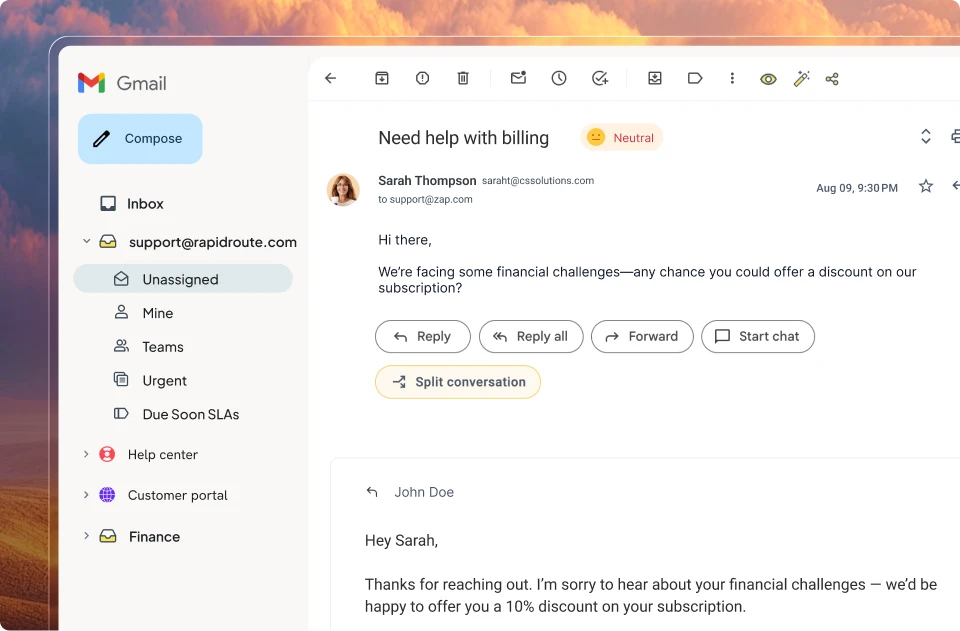
Hiver integrates seamlessly with Outlook and connects the tools that hold customer context, the agency’s CRM, AMS, Microsoft Teams, and Glovebox, the declarations-page retrieval tool that their policyholders use. “We’ve made some integrations with Hiver, not a ton, but it all still works together,” Adam says.
“When we send an email, it gets attached to that client record automatically. Knowing who responded, what the response was; that consistency is extremely important for us.”
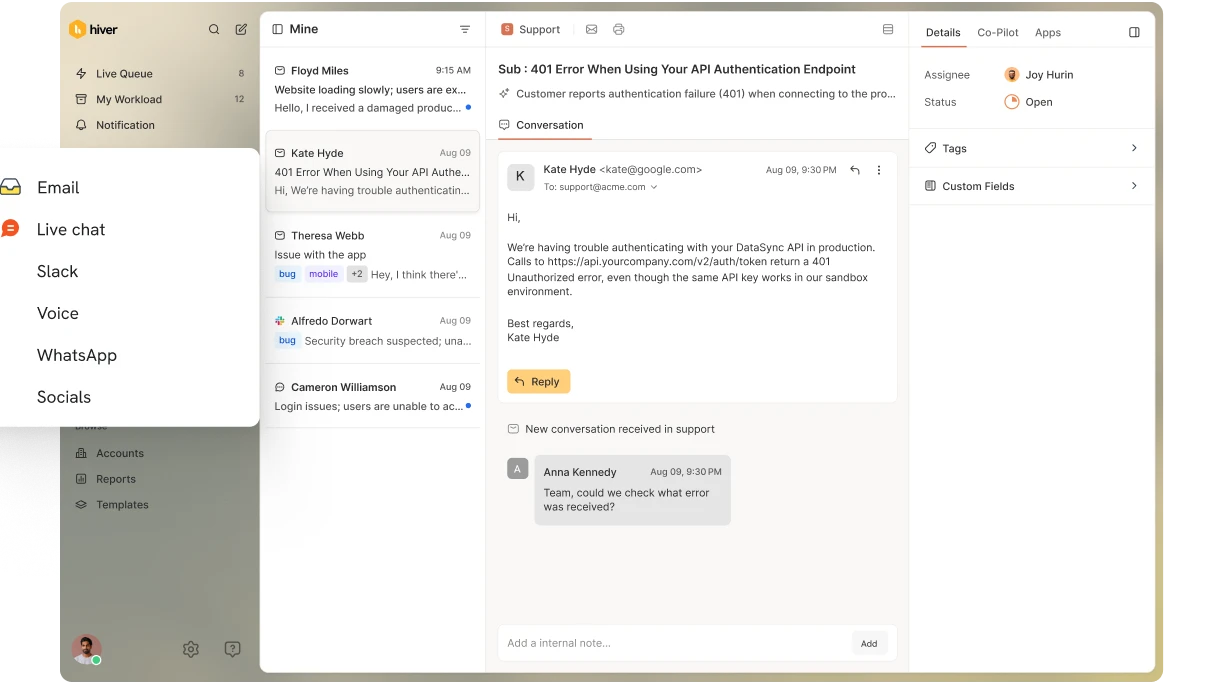
And when an agent opens a conversation, the account is already in front of them. “On the left side of Hiver, when you open an email, it’s all the information on that customer,” Adam says. No tab-switching, no asking around, the full picture sits beside the reply being written. On a policy question about a six-figure vehicle, that context isn’t a convenience. It’s what makes a correct answer possible on the first try.
Collaboration: A team answer that reads like one voice

This is where NCM’s high-stakes reality shapes the workflow most. In collector-vehicle insurance, the cost of a wrong or inconsistent answer is a damaged relationship, so the hardest replies at NCM are often a team effort, not a solo one.
It starts with visibility. Whoever picks up a thread inherits the complete history: every prior reply, every commitment made, every open question. Nothing is lost in the handoff between the CSR group, the agents, and the quoting team. The context travels with the conversation, every single time.
Then the team shapes the answer together, right beside the email. “We can add our thoughts to help that person who’s replying know exactly what’s been happening with that customer,” Adam says.
Internal notes and @mentions pull the right colleague into the conversation without a single forwarded email or side thread. “The ability to help craft the messages across multiple people is phenomenal, it’s extremely helpful to us.”says Adam.
AI that ensures quality across every customer response

NCM is deliberate about AI. Their brand promise is real people, so the first AI they adopted is the kind that makes their people better, not the kind that replaces them.
The team uses Hiver’s AI quality assurance (AI QA), which reviews and scores agent responses. “It helps identify coaching opportunities that would have been missed otherwise,” Adam says. “It helps us stay consistent across the team. For us, consistency is key, it’s the same messaging time after time, and AI QA really helps us keep that message uniform no matter who’s answering it.”
“Notice what NCM is measuring: not how many conversations AI can take off the team’s plate, but whether every answer that goes out, from any of 18 people, meets the same bar. In a business where each reply concerns someone’s most prized possession, that’s the metric that matters.“
Analytics, SLAs and CSAT – The building blocks of great CX
For a business handling ~5,000 conversations a month about people’s most valuable possessions, “we think we’re doing well” isn’t good enough. NCM measures it.

Adam is a heavy data user. Hiver’s analytics give him volume, response and resolution patterns, and per-agent performance across the whole operation, which he exports and casts to a dashboard on the office TV, so the team sees where they stand month over month.
Underneath sit two commitments the team holds itself to: SLA policies define the response and resolution times NCM promises its policyholders, measured against business hours so the numbers reflect real working time. And CSAT surveys go out when a conversation closes, turning every resolved request into a signal the team can act on.

The picture that emerged from April to June 2026 was one of approximately 4,950 conversations per month, a 96% resolution rate, and zero first-response SLA breaches, while the volume climbed from 4,848 in April to 5,018 in June.

Assigning customer emails is a breeze
The team has put an end to forwarding emails for good. When Nathan has to assign an email to someone on his team, he just attaches a Tag with the teammate’s name to it. It’s easier for him to give every email an owner. They have stopped missing emails altogether.
If it’s the end of the shift and someone has to hand off emails to a teammate, they just have to Tag the next person (takes just one click). They get access to the entire email thread and the discussions around it. No time is wasted on building the context for the next person.

“Our business is scaling. It’s growing. It shows in the numbers. But what really stood out to me was the SLA breaches and the conversations resolved. I think it really shows that our team cares. Not only do we run a tight ship, but it shows that they care, and that translates back to the customer.”
Adam Boca, CEO, NCM Insurance

What’s next: Expanding AI, one proven step at a time
NCM is expanding AI the same way they’d underwrite a policy: verify first, then extend trust.
AI QA came first because it improves quality with zero risk to customer interaction.
From there, the roadmap Adam’s team is exploring runs deeper into the operation, AI-driven tagging and triage of incoming requests, sentiment analysis on quote inquiries, automated extraction of policy and quote numbers, and eventually AI-assisted drafting grounded in NCM’s own knowledge: their policies, premium structures, and payout terms, so anything AI helps write is anchored to what’s actually true for that customer.
Every step follows the same rule that governs everything else at NCM: it has to make the answer better, not just faster. “Speaking with anybody at Hiver, we always walk away with that aha moment when we realise that okay, we can be using this a little bit differently, and it only aids to the progress and to our business,” Adam says.
For a team whose customers trust them with the safety of their dream cars, that’s the standard AI has to meet before it earns more responsibility. So far, Hiver’s AI has stood up to the task and the numbers show what the operation looks like when every answer is owned, informed, and consistent. About 4,950 conversations a month, 96% resolved, and not a single missed first-response commitment.