

Gage Burton brings more than a decade of logistics experience to his role as EVP at ProSport, a Chicago-area logistics group spanning freight brokerage, an asset trucking fleet, drayage, and transloading. He oversees the brokerage business and works across the asset side.
Before Hiver, the operations team worked from a shared Outlook login. Everyone could access the inbox, but nobody could clearly track who had acted or what still needed attention. For a business coordinating customers, carriers, and shipments around the clock, that lack of visibility put follow-ups and bookings at risk.
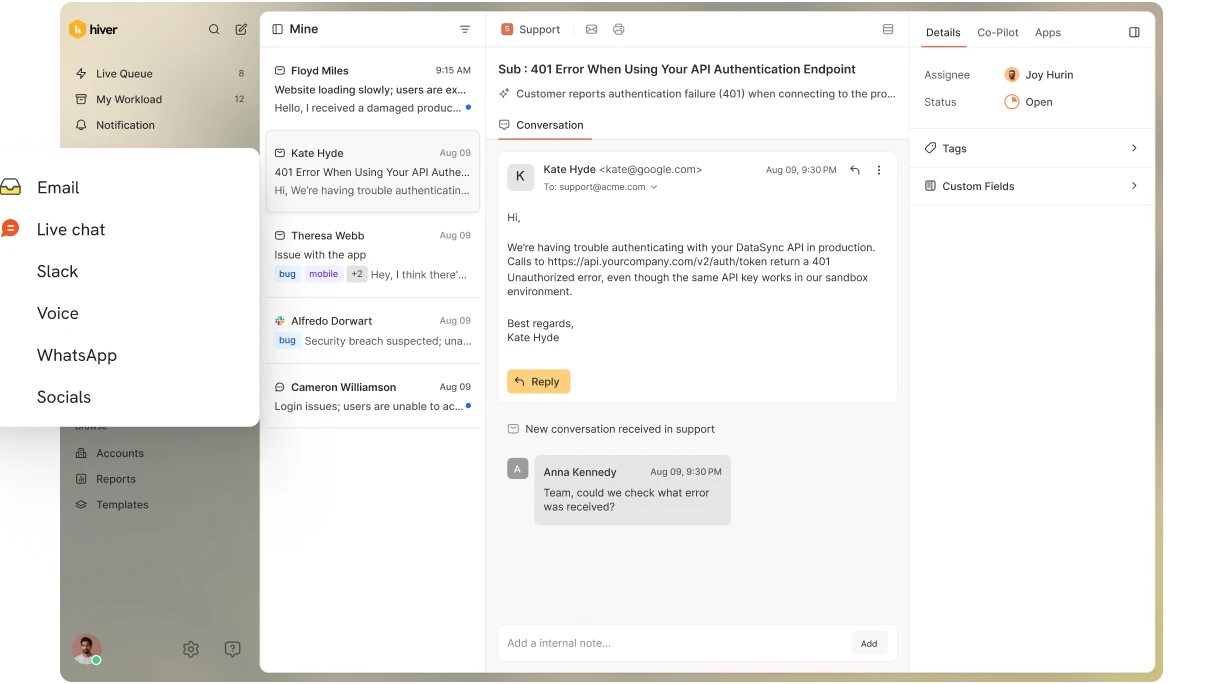
Today, Hiver gives ProSport’s brokerage teams a shared view of every request, its owner, and the next step. Customer conversations, carrier updates, and internal handoffs stay connected across three shifts, so each team can pick up where the last one left off.
“Prosport’s like an onion,” he says. “You don’t fully see the range of what we offer, or how many people are behind it, until you start peeling back the layers.” That perspective has shaped how the company adjusted its operating structure for internal scale, supporting a far more diverse set of offerings and a much larger team. He has one operating belief that shapes everything else.
A growing operation needed clearer ownership
Before Hiver, ProSport coordinated freight through Outlook and Microsoft Teams, using a mix of shared inboxes, personal inboxes, and distribution lists. As conversations spread across these tools, ownership and follow-ups became difficult to track:
- Context disconnected from conversations. Internal updates lived in busy Teams channels, separate from the customer or carrier emails they explained. When something went missing, the team had to piece together what had happened. Revisiting emails to gather information was becoming difficult. Customer service was slowing down.
- Duplicate emails, unclear ownership. The team used a single operations@ inbox to manage communication with all of their customers. Distribution lists copied messages to that inbox and reps’ personal inboxes, leaving everyone to sort the same emails without knowing who had acted.
- Scattered work across shifts. After-hours staff had to check five or six mailboxes to find requests that needed attention.
The search for a partner that would grow with ProSport
Gage came across Hiver while looking at alternatives. His experience with Front made it clear what ProSport needed, including a responsive team to help when things went wrong.
Hiver’s willingness to work through issues with ProSport became a reason to stay. He points to the pattern: immediate response to a ticket, a call to recreate the issue together, then a fix. Plus the willingness to come out and train his people.

“It’s not if, it’s always when something goes wrong. How adaptive, how reactive is the team behind it? That’s what we took a chance on, and it’s paid off. The support was there, and the Hiver team jumped in and helped and problem-solved and did really well.”
Gage Burton
Executive Vice President

Giving each team a clear view of their work
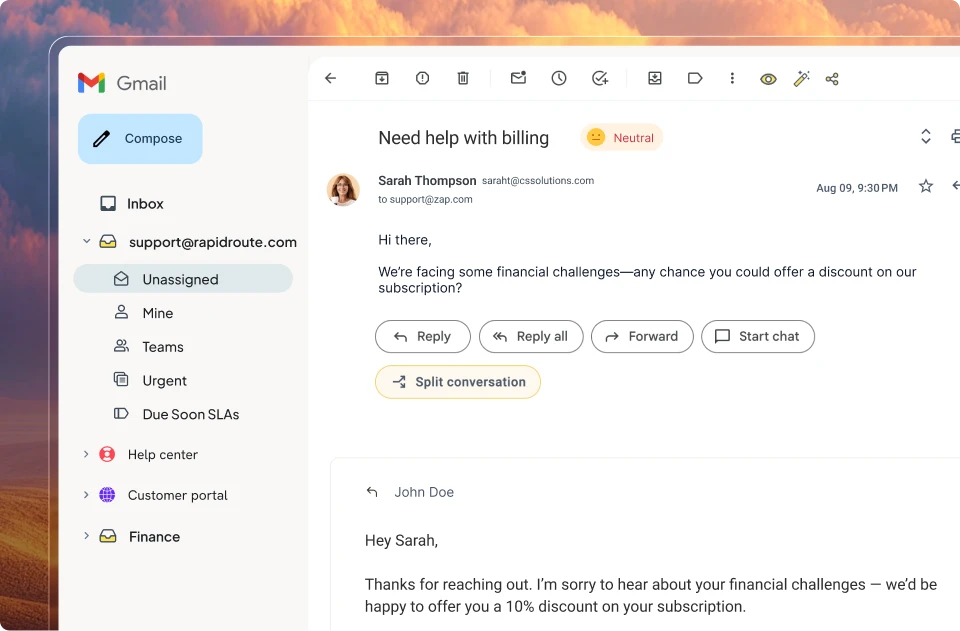
ProSport’s 24 person logistics team uses Hiver inboxes organized around its work. Customer emails reach the responsible team’s inbox and are automatically tagged by account. Carrier-facing work has dedicated inboxes:
- Brett Cunningham’s procurement and carrier-sales team manages inbound leads, offers, and negotiations.
- Opportunity receives 300 to 1,000 carrier emails a day, and reps send 300 to 400 load-detail responses daily using information from McLeod.
- Dispatch handles tracking updates and rate confirmations, with Diana leading and Katelyn covering after hours.
- Gage and Jimmy handle spot rates, while accounting manages invoices and proofs of delivery.
- Reps see the inboxes they need, while Gage and Brett retain visibility across teams.

“There are numerous people touching every email, whether it’s the customer team, the carrier team, or the behind-the-scenes team doing operations. Those handoffs are imperative. Making sure who did what, who touched what, and all of that is noted for us.”
Gage Burton
Executive Vice President
Most requests arrive unassigned, and an available rep claims ownership so colleagues know who is handling them. The activity history records assignments, replies, and status changes. Handoffs stay in the conversation through internal notes explaining what is outstanding and who needs to act next. That lets another team or shift pick up the work with the context already in place.
Using automations to keep up with growing complexity
With multiple customers and request types flowing into shared inboxes, keeping everything organized can quickly get complex. Hiver automates the sorting and routing:
- Emails are tagged by sender domain, keeping each customer’s requests identifiable within shared queues.
- Keyword tags categorize detention requests, spot quotes, proofs of delivery, and invoices. Those same tags support reporting by request type.
- Spot-rate and quote emails move into dedicated pricing inboxes, with quote requests assigned directly to the people who handle them.
“Whenever a quote comes in, that’s going to get auto-assigned to people who are knowledgeable in quoting. And because we have a group setting where multiple customers feed into one inbox, it auto-tags based upon the domain that it’s received on. So we could easily differentiate: this is from customer A, this is from customer B, and easily see it.”
Gage Burton
Executive Vice President
Unified search for shipment updates across inboxes in one place.
A shipment’s history can span several conversations. Hiver lets the team search a load number, purchase order number, or customer reference across the inboxes they can access. Brett can follow both the customer correspondence and the carrier’s updates without opening each mailbox separately.
Integration with Highway: Carrier verification right inside Hiver.
Carrier emails come into Prosport from all directions. Some arrive through Highway’s system, DAT, load boards, or lead-generation tools. Others are replies to emails Prosport sends when it needs a truck on a specific lane.
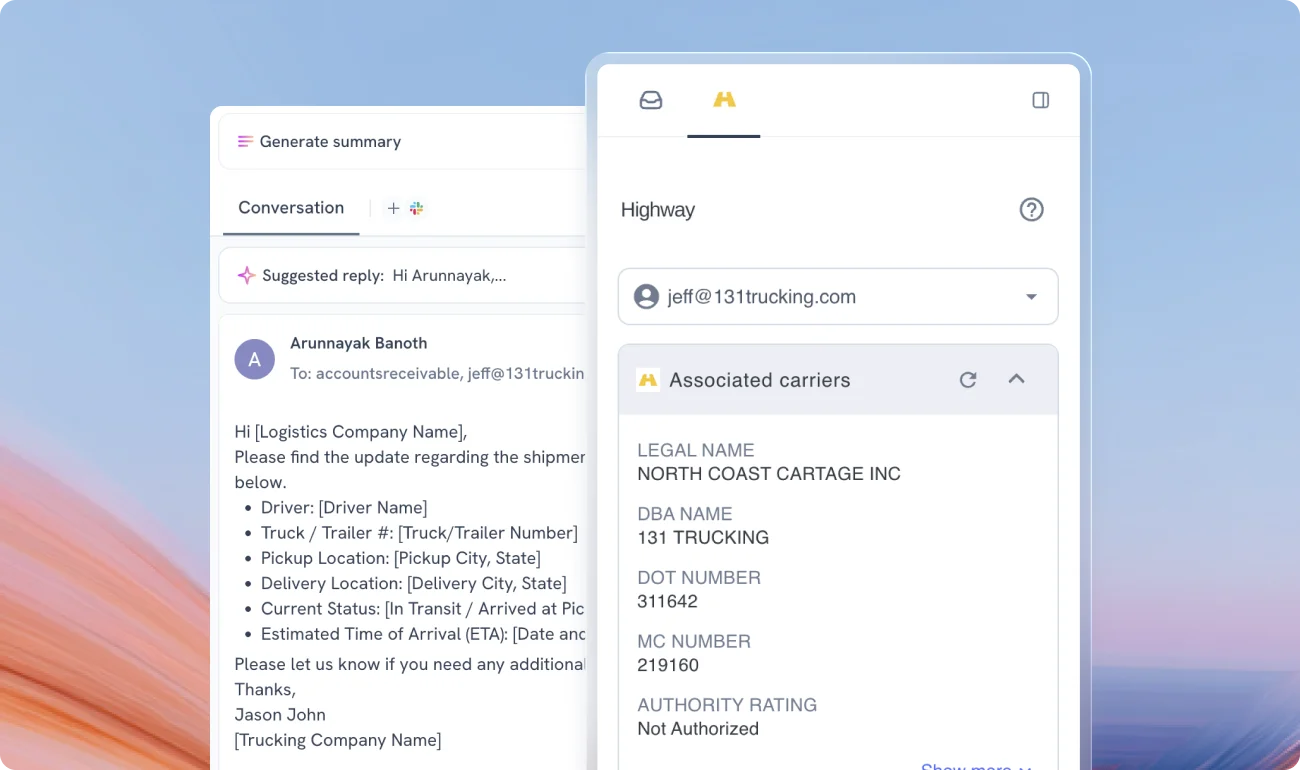
Highway runs inside Hiver, so every inbound contact is cross-referenced against Highway’s database and tagged on arrival: verified, not verified, or potential fraud. The status is on the email when the rep opens it. Nobody switches tabs, nobody looks anything up, and nobody has to remember to.
“It’s not a matter of digging. It’s just there. It’s very quick to see — is this an email we can respond to, or is this something that could be potentially dangerous for us as a company?”
Screening happens at acquisition, before anyone discusses a shipment. “We’re able to rule out bad actors and make sure that we’re not even talking to them.” Brett’s philosophy governs the rest of the stack.
“We keep it simple. We just live in Hiver, McLeod, and Highway. So if you get the integration with Highway, then now it’s two pieces.”
AI Agents for manual load entry
ProSport’s next area of exploration is the repetitive work behind building a load. On the asset side, five employees currently enter details from rate-confirmation documents into their TMS, McLeod.

The workflow scoped with Hiver would use AI Tasks to extract order details, addresses, and appointment times from a PDF, then pass that information through Bitfreighter to create the load in McLeod. This remains planned work.
For Gage, the purpose is to give people more time for the relationships and decisions that need their attention.
“The people are really what make the magic. It’s making sure they have the proper tools and the technology to support their mission, and the time and bandwidth to keep taking on more.”
Gage Burton
Executive Vice President