

In tech support, the ticket queue looks deceptively flat.
A password reset and a broken enterprise integration arrive in the same place, get worked in roughly the same order, and receive roughly the same level of attention. The issue? A chatbot could have closed the password reset query in seconds, but the other needs your best agent, and the time to work it.
That is what the three-tier framework is built around. Self-serve handles the simple, documented queries. AI owns the repeatable ones. Your senior agents take the complex, high-stakes problems, with the time to actually work them.
This guide breaks down how each tier works when it is built right.
The Three Tier Framework: Self-Serve, AI-Owned, and Human-Owned
Most support teams have some version of these tiers. Very few run them well, and the gap between the teams that do and the teams that don’t is bigger than most support leaders expect.
| Tier 1: Self-Serve | Tier 2: AI-Owned | Tier 3: Human-Owned, AI Assisted | |
| Who resolves it | The customer | AI, with optional human review | Human agent, with full context |
| Query type | Stable, documented, no account context needed | AI, with optional human review | Human agent, with full context |
| Examples | Password resets, billing FAQ, setting up an integration, adding users to their account | Refund inquiries, bug acknowledgments, subscription changes, integration troubleshooting | A feature not working as intended, a refund that needs engineering to debug the root cause, a fourth contact on the same unresolved issue, a critical bug from an enterprise account with renewal 60 days out |
| Key failure mode | Stale content, poor discoverability | AI breaking under complex multi-step, multi-system scenarios | Agents lacking context before they respond |
| What good looks like | Deflection rate rising | AI resolution CSAT on par with human-handled tickets | Shorter resolution time and SLAs met |
Tier 1: Self-Serve and Deflection
Tier 1 is about helping customers solve simple problems on their own before they ever reach your support team. Done well, it reduces ticket volume without adding friction.
The types of queries that belong here: Password resets, billing FAQ, feature documentation,, standard integration guides,. Basically anything where the correct answer doesn’t depend on account-specific context.
Your Knowledge Base is the foundation of this tier. It’s where customers go before they email your team, and where your AI pulls answers from when a query comes in through chat. Keeping it current is where most teams struggle though. More often than not, a product update ships or a policy changes, and the article explaining the old behavior sits there untouched until a customer points it out (or worse, until an AI pulls the wrong answer from it and sends a customer in the wrong direction entirely).
Hiver’s Knowledge Base uses AI to close that gap continuously. It drafts new articles from resolved ticket history, so documentation keeps pace with the questions customers are actually asking. It also surfaces content gaps, topics where tickets keep arriving but no article exists, so your team knows where to write first.

And the self-service doesn’t stop at documentation. A customer portal lets customers check ticket status and submit requests through structured forms that capture the right information upfront. As they fill one out, AI reads what they are describing and surfaces a relevant help center article or a suggested fix, often resolving the issue before the ticket is ever submitted. The “any update?” follow-ups stop arriving. On live chat, an AI-powered chatbot trained on your knowledge base handles first-contact resolution for your most common query types.
The signal that this tier is working is simple: your knowledge base and chatbot are handling a rising share of contacts each month, while inbound ticket volume from those query types stays flat or declines. If volume keeps climbing despite your self-serve options, your content is stale, hard to find, or covering the wrong topics.
Tier 2: AI-Owned
The queries that land here have a clear resolution path and a recognizable pattern. A human doesn’t have to write that response every time.
What belongs here? Subscription changes, refund inquiries, bug acknowledgments with a known workaround, and integration troubleshooting with documented steps.
Most platforms don’t offer AI that can handle complex, multi-step, multi-system requests. Hiver’s AI Agent, however, reads the conversation, understands what the customer actually needs regardless of how complicated it is and acts on it. They route it to the right team, extract relevant details, send an interim reply, and in many cases resolve the issue end-to-end without anyone on your team touching it.

What makes this work is AI Operating Procedures, or AOPs. An AOP is the set of instructions you define for the AI Agent to carry out. You write them in plain language, the same way you would brief a new team member: what the agent is allowed to handle, which systems it can access, what tone it should use, when it needs to involve a human, and what it should pass along when it does.
For example: when a refund request comes in, the AOP can lay out the exact procedure. It looks up the customer in the billing system, checks the refund against your refund policy to see if it applies, then triggers the refund and sends an acknowledgement email to the customer. If the refund doesn’t qualify under policy, it routes an approval request to finance instead.
The signal that Tier 2 is working: CSAT on AI-handled conversations is close to human-handled tickets, and the escalation rate from this tier is declining as your knowledge sources improve.
Tier 3: Human-Owned
By the time a ticket reaches this tier, it is a different category of problem. Escalated bugs, customers who have contacted your team multiple times about the same issue and are running out of patience, enterprise accounts whose renewal is 60 days out and who just submitted a critical issue.
These conversations can determine whether a customer stays or leaves. They require reading a complicated situation, drawing on relationship context, and responding in a way that makes the customer feel heard. That is still a human job.
Most teams fail here not because of their support trap, but because those agents are walking into hard conversations without the context they need to handle them well.
Picture this: a ticket lands on someone’s desk. The customer is frustrated. Your agent has no idea this is their fourth contact in three weeks, no idea the account is high-value, no idea the last reply they received from your team was actually wrong. They’re reading a single email with no backstory. That’s avoidable.
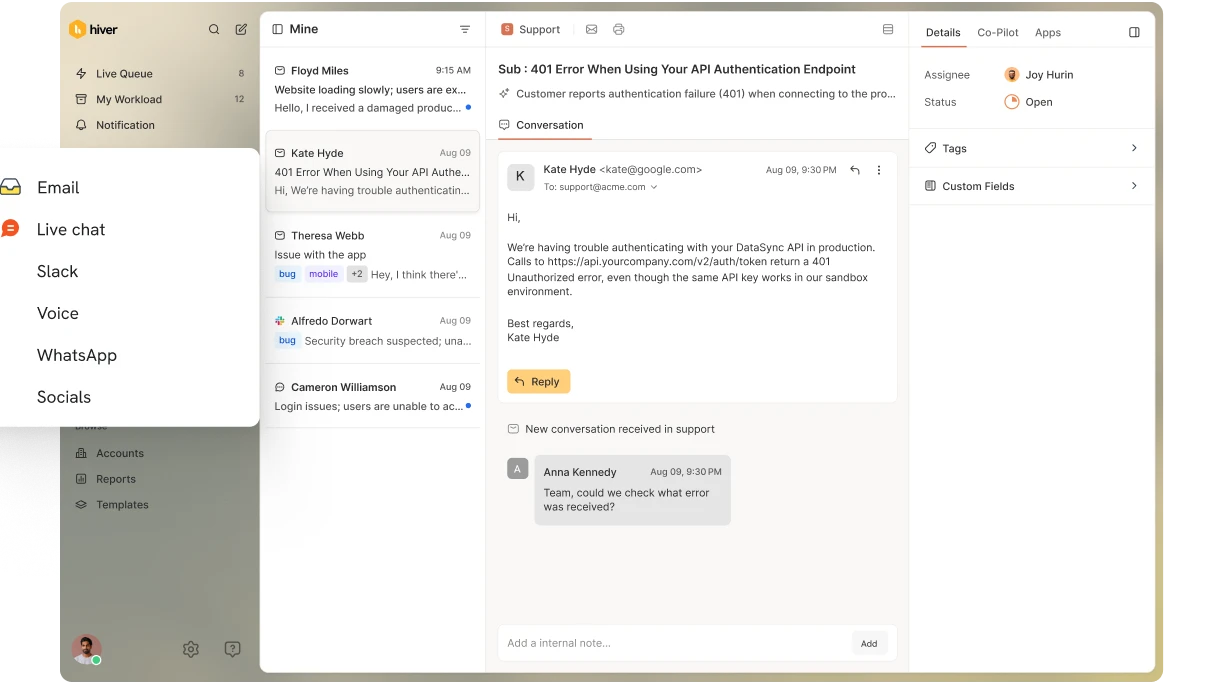
When a Tier 3 ticket reaches an agent in Hiver, most of the groundwork is already done. The thread is summarized, the customer’s history is visible, and the agent knows exactly what kind of account they are dealing with. Instead of piecing together what happened from a single email, they step into a situation they already understand and can act on immediately.
Hiver makes this possible:
- Ask AI lets agents query the knowledge base mid-conversation. When an enterprise customer describes a specific integration failure, the relevant documentation is seconds away instead of a ping to engineering.
- AI Suggested Response drafts replies grounded in the full conversation context, ready for agents to review, edit, and send.
- AI QA Coach checks every draft for tone, empathy, and completeness before it goes out. A curt reply to an enterprise customer mid-escalation is exactly the kind of thing you want caught before the customer sees it.
See it in action
Kiwi.com handles over 1,500 partner emails a month and had previously missed their internal 24-hour SLA due to a lack of workflow visibility. After implementing Hiver’s automations and SLA management, they reached a 100% SLA success rate and saved 167 hours monthly. Their business development lead summed it up: “Our clients choose us over competitors due to our speed and quality of communication.”
The signal that this tier is working: Your best agents are spending their time on your hardest problems, SLAs on high-value accounts are being met, and CSAT on escalated tickets is improving.
The Accountability Layer: What Runs Across All Three Tiers
One big mistake teams often make is to set up their tiers, declare victory, and move on. Six months later, the Tier 1 knowledge base is stale. AI accuracy on Tier 2 tickets has dropped because your internal processes and response guidelines have shifted. Tier 3 agents are burning out because tickets that should have been resolved earlier keep reaching them.
- AI Topics surfaces the most common themes across all conversations automatically, so if the same integration issue has appeared 80 times this month, you know it’s a knowledge gap or a product gap before it compounds.
- AI QA Insights gives managers a continuous quality picture across every sent response: scorecards per agent, tone trends, completeness gaps, all connected to CSAT outcomes.
- Analytics closes the loop with first response time, resolution time, SLA compliance, and agent workload, filterable by inbox, agent, tag, or time period. These are the signals that tell you a tier is underperforming before customers feel it.
Getting the Framework Right
Most support teams have these tiers, but very few of them actually work.
Even though AI deflects 45% or more of queries, only 14% of those issues are actually resolved, which means customers leave thinking their problem was handled when it wasn’t. They come back frustrated, having already spent time on a resolution that went nowhere. As a result, the re-contact rate within 72 hours sits at 11.3% on AI-resolved tickets versus 8.7% on human-resolved ones. And every one of those repeat contacts is a ticket that should have been closed at Tier 1 now landing at Tier 3.
The common denominator beneath all of these is a tooling problem. Most support tools have AI built in, but they work as standalone features, each solving a slice of the problem without connecting to the next layer. A ticket that starts in chat has no thread when it reaches email. A knowledge base article that gets flagged as outdated sits unresolved until someone has time to fix it.
Hiver is built to solve this differently, with AI running across all three tiers as one connected system rather than a set of features bolted onto each other. When the tiers connect, work closes at the level it should, and your senior agents get their time back for the problems that actually need them.
If you want to see how it works across your support operation, book a demo with our team.