




A help desk service is one of the most underrated tools in building a strong customer-centric business. While flashy marketing campaigns and aggressive sales pushes often steal the spotlight, its customer support that quietly holds everything together.
Any experienced business leader will tell you: if you want to build something sustainable, you start with your existing customers. And the way to retain them? Consistent, thoughtful, and timely support.
But that kind of consistency isn’t accidental – it comes from having the right systems in place. A help desk service keeps your support team organized, responsive, and ready to scale as your business grows.
In this article, we’ll cover:
- What a help desk service is
- 5 real examples of brands using help desk services to streamline support operations
- Key benefits of using a help desk system
Table of Contents
- What Is a Help Desk Service?
- 5 Real-life Examples of Brands Using Help Desk Services
- Benefits of Using Help Desk Services
- What These Brand Stories Tell Us
What Is a Help Desk Service?
A help desk service is a software that helps businesses manage and resolve customer queries more efficiently. It acts as a central hub for communication between your support team and your customers – ensuring that every request is tracked, prioritized, and addressed.
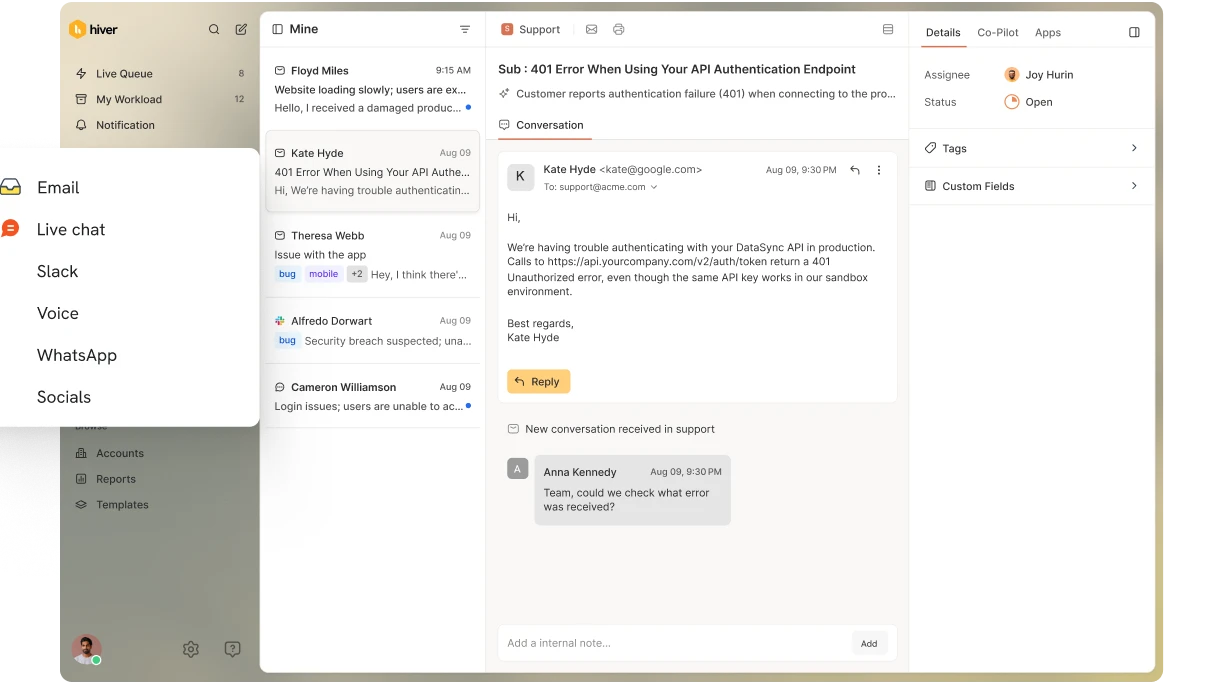
Most help desk services consolidate multiple support channels – such as email, live chat, phone, and social media – into a single dashboard. This allows your team to organize incoming requests, assign them to the right people, and respond in a timely manner.
The core purpose of a help desk service is simple: to prevent queries from falling through the cracks and to ensure customers get consistent, helpful responses – no matter how they choose to reach out.
5 Real-life Examples of Brands Using Help Desk Services
Let’s look at how some brands and companies are using help desk services to level up their support and run things more smoothly.
1. Morgan State University
Morgan State University (MSU) is Maryland’s largest HBCU, with over 10,000 students and a wide range of academic programs.
The Challenge:
With a large and diverse student base, the university’s operations team was flooded with daily queries – from students, parents, and faculty. And managing this volume across multiple shared inboxes quickly became overwhelming.
There were a few recurring issues, such as –
- Missed emails: The team relied on manual tracking, which often resulted in important messages being overlooked.
- Overloaded team members: Without a structured system, emails piled up. Staff had to scroll through cluttered inboxes, wasting time and delaying responses.
- Manual assignments: Assigning emails by hand consumed valuable time. There was little visibility into who was handling what, which created confusion and further delays.
After evaluating a few help desk tools, they ultimately found one that suited their needs exactly. And the results were fantastic.
The Result:
Saved 533 hours in a single month. Boosted team productivity by 90%. Reduced missed emails to less than 1%.
Instead of manually sorting and assigning emails, every incoming query is now automatically routed to the right person – so there’s always a clear owner, and no emails slip through the cracks.
When team members need input from a colleague, they simply leave a Note directly on the email thread. There’s no need to forward messages or jump into another tool. Collaboration happens right where the conversation is – making things faster and far more organized.
With better assignments, faster responses, and more efficient teamwork, the operations team at MSU has drastically improved how they handle student and faculty queries.
Recommended reading – Hr Helpdesk Software
2. Travelist
Travelist is a Poland-based travel management company that curates high-quality deals on flights, hotels, and vacations. As part of the Secret Escapes group, it serves a large customer base – with over 2 million monthly visits and thousands of customer emails each month.
The Challenge:
The team handled all customer and partner communication via email. But without a centralized system, collaboration became difficult and time-consuming.
Some of the key challenges they faced:
- Lack of visibility: Agents managed emails from their personal inboxes, which meant no one had a clear view of who was handling which customer or query.
- Inefficient internal communication: Team members had to email each other to coordinate daily tasks, review assignments, or avoid overlapping efforts.
- Limited oversight for managers: It was nearly impossible for managers to track workload, monitor response progress, or identify who needed support.
- Previous tools didn’t fit: The team tried using a help desk tool but found it too rigid for their workflow. This particular tool turned every email into a ticket, making things feel overly complicated for a team used to working with email.
The Result:
Saved 324 hours in a single month. 50% faster first responses. 44% improvement in resolution time.
By switching to a shared inbox and using a help desk service, every team member at Travelist gained visibility into incoming emails and knew exactly what they were responsible for. Managers could assign emails without forwarding or CCing, and easily track who was handling what.
Internal collaboration became far more efficient. Instead of relying on email threads for internal coordination, team members now leave Notes directly on conversations to ask for input or share updates. This reduced delays and eliminated unnecessary back-and-forth.
Preventing work duplication also played a key role. With collision alerts in place, two agents never ended up working on the same email – helping the team resolve queries faster and with more confidence.

3. Fishburners
Fishburners is a Sydney-based startup community that supports early-stage tech ventures through co-working spaces, events, and networking opportunities. With dozens of startups relying on them for day-to-day support, managing member queries efficiently is essential to keeping things running smoothly.
The Challenge:
The account management team handled a wide range of inquiries – from onboarding and billing to membership plans – but their existing email setup made it difficult to stay organized.
Some of the key challenges they faced:
- Lack of visibility: Member queries arrived in multiple inboxes, and team members had no clear view of who was working on what.
- Reliance on personal inboxes: If someone was out of office, no one else could access their emails – which meant queries could easily get missed.
- Manual email forwarding: Account managers often had to forward emails to the right teammate, which was time-consuming and prone to delays.
- Limited collaboration: Without a centralized system, passing context between teammates required extra effort – especially when queries were reassigned or needed input from others.
So when they opted for and implemented a help desk service, they immediately noticed positive changes.
The Result:
Faster response times, better team coordination, and no missed queries.
Fishburners’ account management team gained full visibility into incoming member queries. Every email now had a clear owner, making it easier to prioritize work and avoid confusion — even when someone was out of office.
Instead of forwarding emails or sending internal messages, team members could instantly reassign queries or leave Notes with @mentions to loop in colleagues. This made internal collaboration much smoother and eliminated delays caused by context-switching.
Using tags and assignment rules, the team was able to auto-route membership-related queries to the right person – saving time and reducing back-and-forth. As a result, communication became faster, responses more consistent, and the team was able to support members more efficiently, without letting anything slip through the cracks.
4. Align Brooklyn
Align Brooklyn is a boutique wellness studio in New York offering yoga, pilates, fitness classes, and nutrition consulting. With over 30 instructors and a strong reputation for customer experience, the studio handles a high volume of email inquiries – from prospective clients to ongoing support for existing members.
The Challenge:
Co-founder Pamela Brown knew that managing these conversations efficiently was essential to maintaining their 5-star service. But their existing setup wasn’t working.
Some of the key challenges they faced:
- No centralized system: The team used personal inboxes to respond to customer emails, which led to messages getting siloed and overlooked.
- Lack of visibility and accountability: Pamela had no clear way of knowing who was working on what, or whether every inquiry was being handled.
- Manual coordination between shifts: When handoffs happened between team members, there was no smooth way to share context – often resulting in delays and inconsistent replies.
- Limited organization: Emails couldn’t be sorted or prioritized easily, making it difficult to respond quickly to urgent customer needs.
In order to address these challenges, Align Brooklyn adopted a help desk service and moved all customer communication to a shared inbox.
The Result:
Saved 50+ hours in a month. Faster responses, fewer missed emails, and a more consistent customer experience.
The first positive shift this brought about was that the entire team got visibility into incoming queries and clear ownership over who was handling what. Emails no longer got buried, and Pamela could easily assign messages with just a couple of clicks.
Tagging and prioritizing urgent requests became simple, allowing the team to respond to time-sensitive emails within hours, not days. Handoffs between shifts also improved – team members now leave Notes directly alongside email threads, so nothing gets lost in transition and customers get timely, uninterrupted support.
The team also began using templates and shared drafts to speed up responses and keep messaging consistent across the board. As a result, Align Brooklyn can deliver the kind of reliable, personalized service that keeps customers coming back – without the stress of disorganized inboxes.
5. Get It Made
Get It Made is a London-based manufacturing-as-a-service company that helps businesses source complex, custom-manufactured parts through a global network of factories. Their clients span industries like aerospace, medical, and R&D – where timelines are tight, requirements are precise, and communication needs to be flawless.
The Challenge:
As the company continues to grow, so does the volume and complexity of communication. Project updates, quotes, payments, and supplier coordination all happened via email – and the system they had in place wasn’t built for scale.
Some of the key challenges they faced:
- Single inbox chaos: Initially, all communication went through one Gmail account, which led to confusion, missed emails, and overlapping efforts as the team grew.
- Lack of accountability: With no clear assignment system, tracking who was handling what became difficult, leading to delays in closing projects.
- Manual processes: Rewriting responses for repeat queries and scrambling to find critical project details wasted valuable time.
- Collaboration gaps: As the team shifted to remote work, coordinating tasks and sharing context over email became even harder.
By switching to a help desk service, Get It Made brought structure and clarity to their growing communication needs.
The Results:
Saved 53 hours in a month. 250% improvement in team efficiency. 25% faster response times.
The team could now assign incoming quotes, project updates, and client emails with ease – ensuring every message had an owner and nothing slipped through the cracks.
Using email templates for frequently asked questions allowed them to respond in seconds instead of drafting repetitive replies from scratch. Notes helped the team collaborate on complex cases without relying on separate tools or long email chains.
Even as the team shifted to 100% remote work, collaboration remained smooth and uninterrupted. Everyone had visibility into project conversations, and internal handoffs became seamless.
Benefits of Using Help Desk Services
A good help desk service helps support teams in a number of ways – centralize customer conversations, route tickets automatically, monitor key metrics, and improve collaboration – all while delivering faster, more consistent experiences. Here are some of the most impactful ways it helps teams work more efficiently and improve the customer experience.
1. Centralize all support tickets
Instead of juggling five different tools, your team gets one clear view of every customer conversation. Whether it comes from email, chat, or social – everything lands in one place, making it easier to stay on top of things.
Hiver for instance, is a help desk service that mimics the interface of your email inbox. Much like the way your inbox displays sections on the left – Starred, Snoozed, Drafts, and more – Hiver features a similar left panel to manage all your support channels in one place. Under every channel, you get insights into how many conversations are pending, work in progress and closed, and what every person in the team is working on.

2. Organize and route incoming tickets
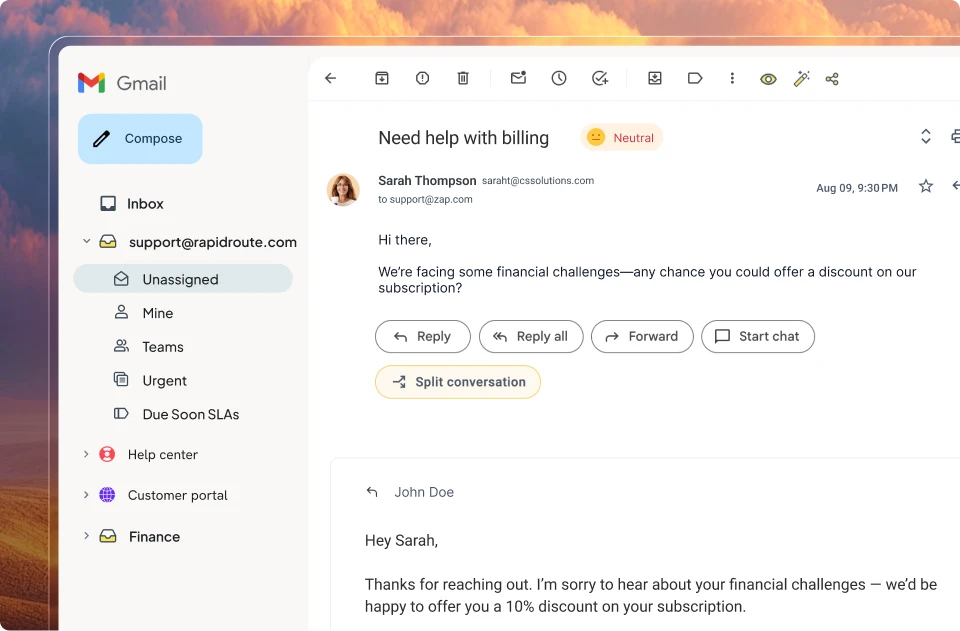
A good help desk service makes it easy to organize and route incoming tickets, so your team isn’t wasting time manually assigning queries. Instead of sorting through email threads to figure out who should handle what, tickets can be automatically assigned based on rules you set – like topic, customer type, or workload. This not only speeds up response times but also ensures that every team member knows exactly what they’re responsible for.
With Hiver, you can automate ticket assignment using simple “if-then” rules. For example, queries containing words like refund, discount, or payments can automatically be routed to specific team members – say, your finance specialists.
Alternatively, you can also enable round-robin assignments to evenly distribute tickets across a queue of agents, ensuring no one gets overburdened. Agents can even control their availability, so tickets only go to those who are actively working. These processes eliminate manual effort and reduce the risk of missed queries.

3. Analyze data and provide insights
Help desk services also give you valuable data on how your support team is performing and how customers are experiencing your service. You get insights and visibility on things like –
- Ticket Volume – How many tickets are your agents handling each day?
- First Response Time – How long does it take for agents to respond to a customer after the ticket is received?
- Average Resolution Time – On average, how long does it take to fully resolve a customer query?
- CSAT Score – How satisfied are your customers with the support they received?
- First Contact Resolution Rate – What percentage of tickets are resolved in the very first interaction?
And a lot more. So what does this do for you?
Let’s take the example of average resolution time. If you notice that this number is unusually high, you can dig deeper and identify which categories of tickets are taking longer to resolve, which agents are handling them, and whether they might need additional support or resources. This kind of visibility allows you to spot bottlenecks early and stay on top of things.

Recommended reading
15 Best Help Desk Metrics and KPIs to Measure and Track in 2025
4. Enable Self-Service for Faster Resolutions
Most good help desk services also come with built-in self-service tools like knowledge bases, FAQs, or customer portals. These resources allow customers to quickly find answers to common questions on their own – without waiting for an agent to respond. It also reduces the workload of your agents, who would otherwise have to spend valuable time and energy answering routine, run-of-the-mill questions.
Hiver lets you set up a knowledge base that’s public (for customers) or private (for employees) where you can create help articles and FAQs that help people find answers on their own. You can customize the look and feel of your knowledge base to fit your brand language.
Another way Hiver boosts self-service is by offering a customer portal. It’s essentially a platform where customers can submit queries, track the status of their tickets in real time, and get updates without needing to follow up with your support team. It reduces unnecessary back-and-forth.

5. Improve Collaboration Within the Team
Help desk service tools offer many useful collaboration features that make the way your agents coordinate feel seamless. They won’t have to constantly switch between different tools every time they want to loop someone in or share context about a query.
For example, Hiver lets your team leave internal notes on email threads, @mention teammates to bring them into conversations, and view the full ticket history in one place. It keeps everything contextual and transparent and makes collaboration very smooth.

6. Set SLAs to Stay on Track
Help desk platforms let you set SLAs, which define how quickly your team should respond to or resolve tickets. They bring structure and accountability, help manage workloads, and make sure urgent issues are flagged before they slip through.
With Hiver, managing SLAs is very easy. You can set clear performance benchmarks for first response and resolution times, helping your team stay consistent and responsive.
You can also create multiple SLA policies tailored to different types of queries or customer segments, and align them with your team’s business hours – even across time zones – to avoid unnecessary violations.

What These Brand Stories Tell Us
If there’s one takeaway I’d like to leave you with from this article – it’s that making customer experience a priority pays off in a big way. The brands you’ve just read about didn’t make drastic changes to how they operated – they simply adopted a help desk service that fit their needs.
That’s all you need to empower your customer support agents to do their jobs to the best of their ability and give your customers the timely, helpful support they want.
If you’d like to explore a help desk service that is as easy to use as your Slack or email inbox, check out Hiver. You can get set up and start using it in a matter of minutes. Try it for free here.
Start using Hiver today
- Collaborate with ease
- Manage high email volume
- Leverage AI for stellar service