

Quick summary
Agentic customer service software uses AI to resolve requests end to end. It reads the case, reasons through what needs to be done, and takes the necessary action itself. Each platform in this category takes a different approach to putting AI in charge of the work. Here are the top three options:
| # | Tool | Best For |
| 1 | Hiver | Complex support requests that span teams, tools, and channels |
| 2 | Sierra | Large enterprises that want outcome-based pricing on resolved conversations |
| 3 | Intercom (Fin) | High-volume, chat-first support that needs fast, self-serve setup |
The word “agentic” gets used very loosely
Check the websites of most customer service software vendors, and you’ll find that the majority have the word “agentic” slapped onto their product pages.
But according to Hiver’s State of AI Customer Support in 2026 report, fewer than half of the 700+ customer support leaders surveyed said their software makes them even moderately confident in using AI, and only 9% said AI can handle most of their ticket volume.
So, even though more platforms are claiming to be able to handle customer requests end to end, only a few are living up to that expectation in practice.
To prevent you from landing on a tool where the label and reality don’t match, and where that gap ends up holding back your customer service’s scalability, we’ve put together this list of agentic platforms and reviewed them based on their actual agentic capabilities.
That way, you know which platforms can actually do the work and which ones are only borrowing the name for a landing page.
Why listen to us?
After Bynder’s support team switched to Hiver, they were able to automate 2,500 support workflows, achieve a 50% faster first response time and save 198 hours monthly. More than 10,000 other teams across customer service, finance, and HR also use Hiver, including Flexport, Gusto, Ping Identity, and Epic Games.
This article draws on our experience supporting our customers every day as they use Hiver’s AI to handle their hardest, highest-stakes requests.

What is agentic customer service software?
Agentic customer service software is AI that acts on your support team’s behalf. It reads each request, checks account history and connected systems for context, and decides what needs to happen. Then it takes action, whether that means updating a record, issuing a refund, or escalating to the right team.
To qualify as an agentic customer service tool, the software needs to be able to resolve most requests end to end. A chatbot that simply answers FAQs and hands everything else to a human doesn’t qualify, no matter what the marketing page calls it.
Why agentic AI matters in customer service right now
1. Faster resolution across the board
AI improves resolution times for 55% of teams today, according to Hiver’s State of AI Customer Support 2026 report. Faster resolution means your customers get their issues sorted sooner, enhancing their overall experience.
2. More support without proportional headcount growth
Agentic AI can take on entire support requests, not just individual tasks. This allows your team to handle more volume with the same number of support reps. Instead of spending capacity on triage, routine requests, and other manual work around each ticket, reps can focus on the cases that actually need their involvement.
3. Hyper-personalized support at scale
Agentic AI can pull information from customer records, previous conversations, and connected systems before deciding how to handle a request. That means your team can respond based on each customer’s account and history, creating a more personalized support experience without requiring a rep to manually gather that context every time.
How we evaluated the tools on this list
We asked 6 questions to determine how much of your support work each platform’s AI can actually take on:
- How much can the AI resolve on its own? Can it take a request from start to finish, or does it hand most cases off to a human?
- Can it reason through multi-step cases? Does it adapt to the situation and work through a series of steps, or does it mainly follow predefined scripts and workflows?
- What can it actually do across connected systems? Can the AI take actions in your CRM, billing system, or other tools, rather than just generate a response?
- What happens when a human needs to step in? Does the AI hand over the case with the relevant context intact, or does the rep have to reconstruct what happened?
- Which channels does it support? Can the AI handle conversations across email, chat, voice, messaging, and other channels, or is it limited to one or two?
- How is the AI governed? What controls, monitoring, and visibility does the platform provide to keep AI behavior accountable?
Here’s how the 5 tools on our list perform across these criteria.
The 5 best agentic customer service platforms: detailed reviews
| Tool | Key features | Pricing model | Best for | G2 rating |
| Hiver | Ticketing, cross-team collaboration, Workflow Automation, 100+ integrations, AI Agents, AI Copilot | $25 to $85/user/mo | Complex support requests that span teams, tools, and channels | 4.6/5 (1,283 reviews) |
| Sierra | Ghostwriter agent builder, Observability, Horizon memory | Outcome-based, quoted per contract | Large enterprises paying for resolved tickets | Not available |
| Intercom (Fin) | Fin AI Agent, Procedures, omnichannel messenger | $29 to $132/seat/mo + $0.99/outcome | High-volume, chat-first support | 4.5/5 (3,912 reviews) |
| Decagon | Agent Operating Procedures, Watchtower QA, Experiments | Custom, quoted per contract | Enterprise teams with dedicated AI ops resources | 4.8/5 (30 reviews) |
| Zendesk | AI Agents, omnichannel workspace, QA and audit controls | $19 to $115+/user/mo | Large enterprises that want deep customization | 4.3/5 (7,075 reviews) |
1. Hiver
Hiver is the platform to consider if your tickets are complex and span multiple teams, tools and channels.
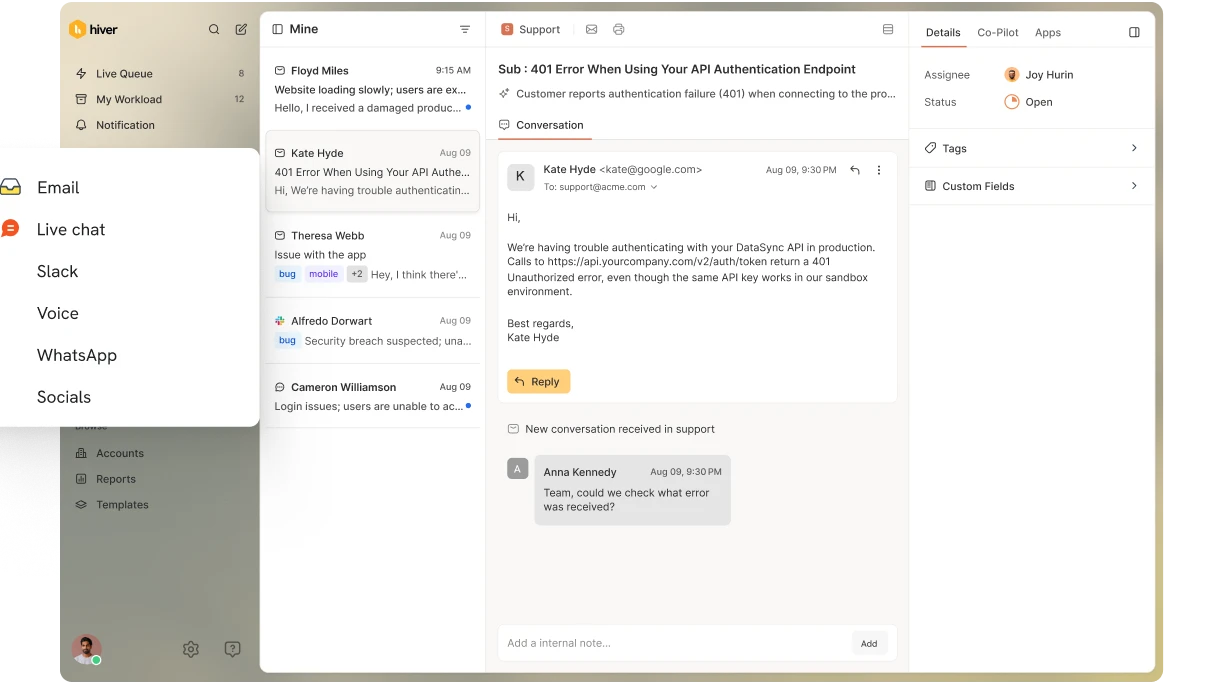
It’s an agentic customer service platform that supports email, chat, voice, WhatsApp, Slack, and more with ticketing, cross-team collaboration, workflows and integrations with 100+ tools.
Hiver connects to the systems and knowledge sources your team already relies on, bringing information from tools like Salesforce, Jira, and your CRM into the support workflow. That gives your team and its AI access to the customer context they need, all in one place.

Hiver’s agentic capabilities are built into your support workflow. AI Agents read incoming requests and reason through them using past conversations and information from your help center and connected tools. They then take the action each request requires, whether that’s updating a system, resolving the ticket, or looping in the right team for approval.
This goes beyond deflection: instead of simply answering a question or sending a customer to a help article, AI Agents can carry the request through the steps needed to reach a resolution. AI Agents can work across Hiver’s supported channels, including email, chat, voice, WhatsApp, and Slack, so the same agentic capabilities apply regardless of where the customer starts the conversation.

When a request needs a person, AI Copilot makes the handoff more of a relay than a restart. It pulls the relevant records, surfaces account health and sentiment, and drafts a reply grounded in your help center and conversation history. A teammate can then review and approve the suggested response.

Hiver also turns resolved conversations into knowledge. Its AI Help Center can identify knowledge gaps, draft help articles from resolved tickets, and keep the knowledge base current as new questions and resolutions come in. Its Customer Intelligence feature also builds a living profile of each customer, pulling information from your CRM, past conversations, and product usage so every reply is grounded in the right context.
Hiver also gives teams control and visibility over what their AI Agents do. Guardrails keep responses grounded in the knowledge sources you approve, and plain-language instructions and hand-off rules define when AI should act and when it should pass a request to a human. Observability gives your team a full transcript of every AI conversation, and teammates can monitor live and take over mid-conversation. Reviewing those conversations surfaces knowledge gaps and weak hand-off rules, so the AI improves over time.

Setting up Hiver is seamless. You can configure AI Agents, routing rules, and SLAs in natural language, and most teams go live the same day they sign up.
Group Miki recently adopted Hiver and has been able to deploy more than 300 automations, cut handling time by 67% and save 200+ hours every month.

Key features
- Omnichannel platform: Manage email, chat, voice, WhatsApp, Slack, and more from one view.
- Ticketing: Give every request clear ownership with status, priority, custom fields, SLAs, and a complete history of every action taken.
- Cross-team collaboration: Loop in engineering or finance through a linked ticket, with the full thread history attached to the handoff.
- Workflow automation: Route, tag, and escalate requests using conditions pulled from your own connected apps.
- Integrations: Connect to Jira, Salesforce, Slack, and 100+ other tools, so your team works from one platform instead of switching between tabs.
- AI Agents: Read an incoming request, reason across your help center and connected systems, and resolve it end-to-end without a person in the loop.
- AI Copilot: Draft a reply grounded in account history and past conversations, then hand it to the rep to review and send.
- AI QA: Review every conversation, human- or AI-handled, against the quality parameters your team defines.
Pricing

- Growth: $25/user/mo
- Pro: $55/user/mo
- Elite: $85/user/mo
G2 rating
4.6 out of 5 (1,283 reviews)
Pros
- Ticketing, collaboration, and Workflow Automation give your team full support foundation with AI built in
- Cross-team handoffs carry full ticket history into Slack automatically
- AI control, monitoring, and visibility give teams oversight of how AI handles customer requests
Cons
- Voice is an add-on rather than being included in every base tier.
- AI accuracy improves with more conversation data, so lower-volume teams may see that improvement happen more slowly.
2. Sierra
Sierra is an AI customer experience platform that builds and deploys conversational agents across chat, SMS, WhatsApp, email, and voice. It’s built for large enterprises, with more than 40% of the Fortune 50 now using it, including Rocket Mortgage, Gap Inc., and SiriusXM. In May 2026, Sierra raised $950 million at a valuation of more than $15 billion.

Sierra’s agents are built through Ghostwriter, which can turn an SOP, a set of call transcripts, or a plain-language goal into a production-ready agent. Its pricing model is outcome-based: you pay when the software achieves specific outcomes, rather than per seat or per usage.
Key features
- Ghostwriter: Build a production agent from an SOP, a transcript, or a plain-language description, with safety guardrails built in.
- Insights: Analyze agent performance and spot problem conversations before they escalate.
- Observability: See every tool call, action, and decision an agent made inside a conversation.
- Horizon: Carry memory across a customer’s conversations and touchpoints over time.
Pricing
Sierra doesn’t publish pricing on its site, but its costs are outcome-based, quoted per contract and tied to your use case, scope, and business goals. It has no free trial or self-serve signup.
G2 rating
Not available
Pros
- Outcome-based pricing means Sierra only gets paid when a conversation actually resolves.
- Observability shows the exact tool calls and decisions behind each agent action.
- Serves nearly 40% of the Fortune 50, demonstrating that it can operate at genuine enterprise scale.
Cons
- No public pricing page or self-serve trial, so evaluating Sierra requires a sales conversation.
- Built for large enterprise budgets rather than mid-market teams.
- Reviewers have flagged difficulties maintaining context in longer, multi-turn conversations.
3. Intercom (Fin)
Intercom is a messaging-first customer service platform, and Fin is its AI agent. Fin reads each request and works through Intercom’s “Procedures” (configured workflows that can read from and write to connected systems), then resolves the case itself wherever it can.

Pricing is per seat for the platform, plus $0.99 for each outcome Fin resolves. Intercom also offers Fin as a standalone AI layer that sits on top of an existing helpdesk, with no additional seat cost. That’s useful if your team wants to add an AI agent without migrating from your current support platform.
Key features
- Fin AI Agent: Resolve a request end-to-end using Procedures that read and write to your connected systems.
- Procedures: Configure the exact multi-step workflow Fin follows for a given request type.
- Omnichannel messenger: Run Fin across chat, email, voice, Slack, and social from one workspace.
- Standalone deployment: Add Fin on top of an existing helpdesk, including Salesforce or Freshdesk, without migrating.
Pricing

- Essential: $29/seat/mo
- Advanced: $85/seat/mo
- Expert: $132/seat/mo
- Fin AI Agent: $0.99 per resolved outcome, on any tier
G2 rating
4.5 out of 5 (3,912 reviews)
Pros
- Fin’s 76% resolution rate is backed by a large, well-documented customer base.
- You only pay $0.99 when Fin resolves a conversation, so idle capacity doesn’t add to your bill.
- Voice support runs through the same agent as chat and email.
Cons
- Complex, multi-touch cases can still require human involvement, limiting Fin’s value for teams with more complicated support workflows.
- Cross-team collaboration tools are thinner than those of platforms built around multi-department handoffs.
- Costs increase when you layer on Copilot, Proactive Support, and other paid add-ons beyond the base seat.
4. Decagon
Decagon builds AI agents for enterprise customer support, positioning them as an AI concierge that handles the customer lifecycle across voice, chat, and email. Its customers include Chime, Duolingo, American Airlines, and Hunter Douglas.
Agents are configured through Agent Operating Procedures, workflows defined in plain language rather than code. Support teams can update agent behavior without needing an engineer. Watchtower provides continuous QA monitoring in the background, while Experiments lets teams A/B test agent behavior live instead of guessing at what works.

Chime reported 70% resolution across chat and voice through Decagon, while Duolingo reported an 80% deflection rate. Decagon doesn’t publish pricing on its website. It uses a fully custom, sales-led process, with no self-serve signup or way to test the platform without speaking to sales.
Key features
- Agent Operating Procedures: Define and update how the agent behaves in plain language, without engineering work.
- Watchtower: Run continuous QA monitoring on live agent conversations.
- Experiments: A/B test different agent behaviors against real traffic.
- Multi-channel resolution: Handle voice, chat, and email through the same underlying agent.
Pricing
Not published. Decagon quotes a custom contract that combines a platform fee with usage-based charges, negotiated per customer.
G2 rating
4.8 out of 5 (30 reviews)
Pros
- Agent Operating Procedures let support teams adjust agent behavior without waiting on engineering.
- Watchtower and Experiments provide ongoing visibility into how agents perform in live conversations.
- Named enterprise results (70% to 95% resolution across cited customers) are specific and motivating
Cons
- No public pricing is available, so budgeting requires a sales conversation
- G2 review volume is still thin
- The agent needs time to absorb your team’s support content, so there can be a learning curve early on
5. Zendesk
Zendesk has been selling customer service software longer than most companies on this list have existed, and its latest bet is AI Agents. Zendesk describes them as agents that “reason through workflows dynamically rather than following rigid scripts.” They interpret intent, ask clarifying questions, and take action across connected systems instead of matching requests to a fixed decision tree.

AI Agents are included with the Suite Team plan and above, with no separate charge. Zendesk’s case studies show a wide range of results, depending on how deeply a team configures its automation. Hello Sugar reported 66% automation and $14,000 in monthly savings, while TeamSystem reported 80% automation and a 99% reduction in repetitive emails.
On the governance side, Zendesk provides policy controls and visibility into how its AI Agents behave across interactions.
Key features
- AI Agents: Interpret intent and execute multi-step actions across connected systems.
- Omnichannel workspace: Manage messaging, email, and voice from a single agent view.
- Policy and QA controls: Set the rules AI Agents follow and audit outcomes against them.
- App marketplace: Connect to over 1,500 third-party tools for CRM, commerce, and internal systems.
Pricing

- Support Team: $19/user/mo
- Suite Team: $55/user/mo
- Suite Professional: $115/user/mo
- Suite Enterprise: custom pricing
G2 rating
4.3 out of 5 (7,075 reviews)
Pros
- AI Agents are bundled into the Suite tiers rather than sold as a separate paid add-on.
- Has the largest third-party app marketplace in this category, with more than 1,500 integrations.
- Case studies span multiple industries
Cons
- Deep configuration takes significant admin time, and you’ll likely need to dedicate someone to managing it.
- Reported automation rates vary widely across case studies, ranging from around 50% to 80%.
- Enterprise-tier governance features add cost on top of an already premium base price.
How to choose the right agentic customer service software platform
Choose based on how your support team works and what you need the AI to handle:
- If your support spans multiple teams and systems, prioritize ticketing, collaboration, and workflow automation, Hiver provides that infrastructure with built-in AI that can handle complex, cross-team cases. See how it works.
- If you’d rather pay for results than seats, Sierra’s outcome-based model charges you when a conversation resolves. It’s built for enterprise teams, though, so it comes with an enterprise-level price tag.
- If you run high-volume, chat-led support and want to move quickly, Fin is worth considering. Its per-outcome pricing and 76% reported resolution rate across a large customer base make it a proven, quick-to-deploy option.
These distinctions should help you narrow the list based on your support model, implementation needs, and how you want to pay for AI.
Choose the agentic platform that actually finishes the job
Most customer service platforms now call themselves agentic, but only a few can actually resolve complex requests end-to-end, take action across connected systems, and hand off to a human without losing context.
Hiver is one of those platforms. Its AI Agents work with your ticketing, workflows, connected tools, and customer context to handle complex support requests from start to finish.
See how Hiver’s AI Agents work and sign up for a plan to test it against your own support queue.
FAQs
1. What makes AI “agentic” instead of just a chatbot?
A chatbot answers questions from a script or knowledge base and stops when it hits something not in the database. But an agentic system reasons through the request, decides what action to take, and carries it out.
2. Can agentic AI handle a request that spans multiple teams?
The best platforms can manage these kinds of requests, but the quality of their handoffs determines how useful they are. Hiver gives teams ticketing, collaboration tools, and Workflow Automation for cross-team cases. AI Agents and AI Copilot carry context, including account history and prior notes, into handoffs to teams like engineering or finance. The next person can pick up where the AI left off instead of starting over.
3. How much autonomy should you give an AI Agent?
Most support leaders take a measured approach. Hiver’s State of AI Customer Support 2026 report found that data privacy and security policies, human review before sending a response, and post-response audits are among the top governance controls teams use. Start with low-stakes requests and expand the agent’s autonomy as it proves reliable.
4. What is the difference between an AI Copilot and an AI Agent?
A copilot drafts a reply, a summary, or a next step for a person to review and send. An agent goes further. It takes the action itself and only brings a person in when the request genuinely needs judgment. Most agentic platforms, Hiver included, run both side by side, since not every request should be fully automated.
5. Is agentic AI safe to use for account-sensitive or regulated support?
It can be, with the right controls. Look for a platform with deployment controls that let you decide which request types and account tiers the AI can handle autonomously. The platform should also provide full visibility into what the AI did during each conversation and maintain audit trails you can review afterward. Without those controls, handing account-sensitive decisions to an AI agent puts your business at risk.