






Quick summary
Freshdesk works well for omnichannel support that benefits from structured ticketing, while Intercom suits high-volume support requests that can be resolved with AI. But for complex support that requires multi-team collaboration, neither handles it as well as an agentic platform like Hiver. Hiver’s omnichannel platform gives you ticketing, cross-team collaboration, workflows, and AI built for support queries that span multiple departments.
Here’s how the 3 compare at a glance:
| Tool | Key features | Pricing model | Best for | Key limitation |
| Freshdesk | Omnichannel ticketing, Freddy AI, SLA management, 1,000+ integrations | Per user/month, starting at $19 | Teams handling multiple support channels that want structured ticketing with AI layered on | Cross-team collaboration is basic, and AI is better suited to straightforward requests than complex, multi-step resolution. Some AI capabilities also require higher-tier plans, add-ons, or a separate Freshdesk Omni subscription. |
| Intercom | Fin AI agent, Messenger, inbox, workflows, help center | Per seat/month, starting at $29, plus $0.99/resolution for Fin | Teams that want to resolve high-volume chat requests with AI | Per-resolution Fin pricing makes costs hard to predict at scale |
| Hiver | Ticketing, Cross-Team Collaboration, Workflow Automation, 100+ integrations, AI Agents, AI Copilot, AI QA | Per user/month, starting at $25 | B2B teams handling complex support that needs cross-team collaboration | Smaller review footprint than Freshdesk or Intercom |
Trying to choose between Freshdesk and Intercom?
If you need a support tool and are torn between Freshdesk and Intercom, you are in the right place. Here, you’ll learn how both tools compare, from Freshdesk’s omnichannel support and structured ticketing to Intercom’s AI-first approach to high-volume chat requests.
We’ll compare both tools across supported channels, AI, automation and pricing so you can see which support scenario each best fits. We’ll also cover why complex B2B support needs a more modern alternative like Hiver.
Why listen to us?
At Hiver, our team has spent years supporting B2B support teams that operate across departments. We currently serve 10,000+ customer service, finance and HR teams worldwide, including Bynder, which ran over 2,500 automated workflows in its first year on Hiver.

We understand how many tools in this space function, including Freshdesk and Intercom, and this article is based on that knowledge.
Freshdesk vs Intercom: detailed comparison
Freshdesk
Best for: Teams handling multiple support channels that want structured ticketing with AI layered on top.
If your team handles support across multiple channels and wants every request tracked in a structured queue, Freshdesk is built for that, and over 50,000 businesses use it globally. On Freshdesk, every customer request becomes a ticket, gets assigned to a support rep, and moves through a workflow until it is resolved. Freshdesk can also bring support queries from email, chat, phone, and social channels into one place.

The platform comes with the Freddy AI agent, which can suggest replies, summarize tickets, and run a customer-facing chatbot. Its marketplace also offers 1,000+ integrations, so you can connect Freshdesk with the other tools your team uses.
Freshdesk works well when support requests come through multiple channels but still follow a defined, structured workflow from intake to resolution. But when a ticket needs input from multiple departments, requires back-and-forth between teams, or depends on context from different systems, Freshdesk won’t be able to manage it seamlessly. Plus, most of Freshdesk’s AI features are built for simple FAQ deflection rather than end-to-end resolution.
Key features
- Omnichannel ticketing: Manage email, chat, phone, and social media from a unified ticket queue.
- Freddy AI: Automate suggested replies, classify tickets, and run a customer-facing chatbot.
- SLA management: Set response and resolution targets by priority and automatically track performance.
- Marketplace integrations: Connect to over 1,000 apps, from CRMs to project management tools.
- Collaboration tools: Loop in internal teams using private notes and shared ticket ownership.
Pricing structure

- Free trial: Limited to 6 months and a maximum of 2 support reps
- Growth: $19/user/month (billed annually)
- Pro: $55/user/month (billed annually)
- Enterprise: $89/user/month (billed annually)
Pros
- Well-built platform with a massive integration ecosystem.
- Strong rules-based automation for routing and managing tickets across multiple support channels.
- Affordable entry point for small teams with either the free or Growth plans
Cons
- AI capabilities work well for simple FAQ deflection only and not multi-step, complex tickets.
- AI capabilities require higher-tier plans, extra payments or a Freshdesk Omni subscription.
- Cross-department collaboration is basic and often requires manual workarounds for multi-team tickets.
- The interface can feel dated, and some teams find the initial configuration heavier than they’d expected.
- Reporting requires manual effort to surface cross-channel insights.
Intercom
Best for: Support teams handling a high volume of chat conversations
Intercom’s AI Agent, Fin, is ideal if your team handles a high volume of chat conversations.

Fin uses your help center content and conversation history to resolve questions, giving customers answers based on true context. But Fin is priced per resolution, so your costs increase as it resolves more conversations. This can make budgeting less predictable, especially for teams with fluctuating support volume.
In June 2026, Salesforce agreed to acquire Intercom. The transaction is expected to bring Fin’s AI customer service technology into Salesforce’s broader platform. But the deal has not yet closed, and Intercom is still operating as a standalone platform for now.
Key features
- Fin AI Agent: Resolve customer questions automatically using help center and conversation data.
- Messenger: Embed a support widget directly inside your product for in-context conversations.
- Inbox and workflows: Manage conversations with assignment rules, macros, and automated routing.
- Help center: Build a self-service knowledge base that Fin references when answering questions.
- Reporting: Track conversation volume, resolution rates, and team performance across channels.
Pricing structure

- Essential: $29/seat/month
- Advanced: $85/seat/month
- Expert: $132/seat/month
Fin AI is priced separately at $0.99 per resolution.
Pros
- Fin AI resolves up to 76% of conversations on average, based on Intercom’s published data.
- In-product Messenger lets SaaS users get help without leaving the app.
- Has a clean interface that’s straightforward to set up.
Cons
- Because Fin charges per resolution, your AI costs rise and fall with volume and resolution rates, making budgeting harder.
- Email and phone support are less developed than Intercom’s messaging experience.
- Multi-department routing and collaboration aren’t a primary focus of the platform.
- The pending Salesforce acquisition creates some uncertainty around Intercom’s long-term product direction.
Freshdesk vs Intercom: which should you choose?
Freshdesk gives you an omnichannel support platform built around structured ticketing. Intercom gives you an AI-first support platform built around resolving high-volume chat requests. To decide which option is better for your support team, consider how you handle support requests and how you want customers to reach you.
If you want structured ticketing, defined workflows, and a centralized queue for handling omnichannel support, choose Freshdesk. But if you want to handle high-volume chat conversations with AI, choose Intercom.
Both tools work well for simple requests. But the challenge is, most B2B support issues aren’t straightforward. A single request might span across teams, tools and channels. Requests need input from billing, product, and engineering, with each handoff needing to carry the full conversation history and context. Neither tool can handle that. And most AI is optimized for simple FAQ deflection.
Freshdesk’s queue works best when tickets follow one path to resolution. Intercom’s messenger shines when customers can self-serve inside your app. Neither is built around the multi-team, multi-step workflows that define complex B2B support. To support those kinds of multi-team requests properly, you need an omnichannel, agentic support platform like Hiver.
The best Freshdesk and Intercom alternative: Hiver
Best for: B2B teams handling complex support that needs cross-team collaboration
You’ve probably seen a ticket bounce between three departments, losing context at every handoff. Or watched AI answer a simple FAQ, then stall when the request gets complicated. Hiver was built to solve both problems.
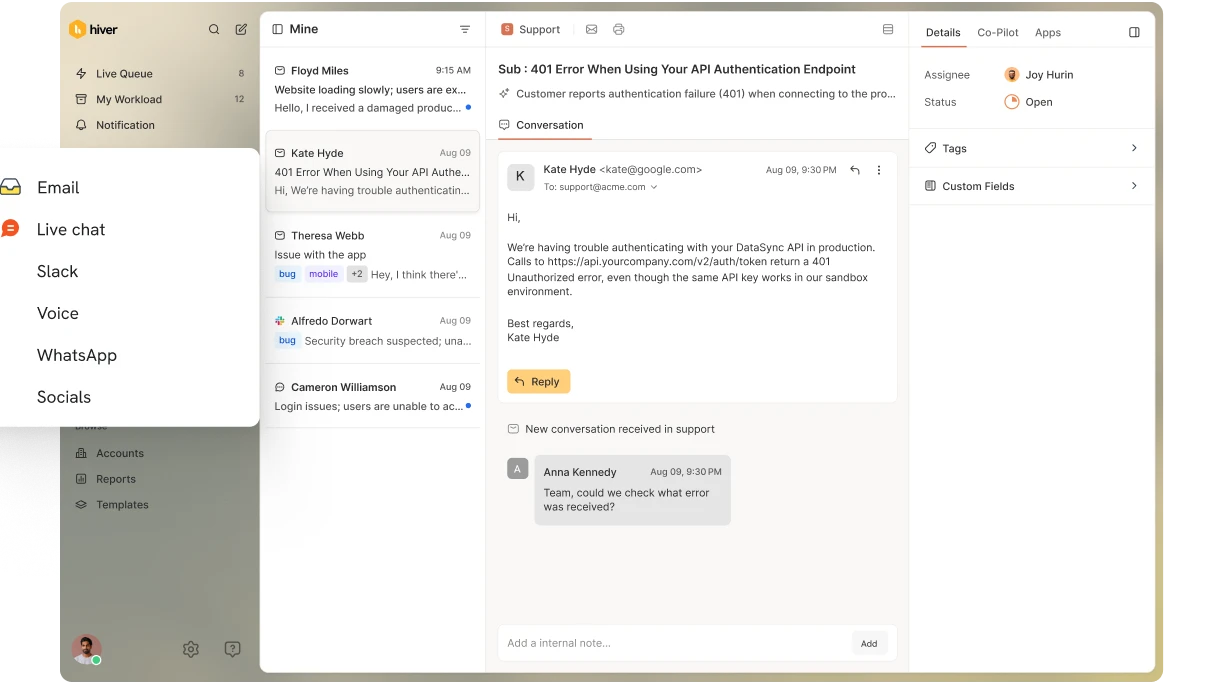
Hiver gives teams ticketing, cross-team collaboration, workflows, and integrations to tackle support requests across email, chat, voice, WhatsApp, Slack, and more from a single omnichannel platform. Every request gets clear ownership, status tracking, SLAs, and a complete history. When a ticket needs another team, the full conversation thread, internal notes, and customer context travel with it, so nobody starts over.

Hiver’s AI Agents handle repetitive requests end to end, using your knowledge base and customer data to understand what a customer needs, resolve requests autonomously and bring in a support rep when human judgment is needed.
For tickets that need human judgment, AI Copilot pulls the thread history and drafts a starting reply that your support rep edits and sends instead of typing from a blank box. And once a conversation is closed, AI QA reviews it automatically for tone, accuracy, and resolution quality.
These AI features run inside Hiver’s ticketing, collaboration, and workflows across all plans. They aren’t gated behind the highest tiers or priced as add-ons.
When Flexport’s operations team moved to Hiver, they cut resolution times by 50% because Hiver provided shared ticket context, so support reps could act on a handoff immediately instead of re-gathering information each time. ConService also switched to Hiver to automate their support workflows and now saves 265 hours every month.

Key features
- Ticketing: Give every request clear ownership with status, priority, custom fields, SLAs, and a complete audit trail.
- Cross-Team Collaboration: Loop in sales, billing, or product teams inside a ticket with internal notes, @mentions, and shared drafts, without forwarding or switching tools.
- Workflow Automation: Automate routing, tagging, and escalation based on rules or AI classification.
- Integrations: Connect to CRM, ERP, Jira, Slack, Salesforce, and 100+ tools so data flows between systems automatically.
- AI Agents: Investigate requests, follow your procedures, and resolve them end-to-end, bringing in a rep when judgment is needed.
AI Copilot: Draft replies from the full thread history so support reps can review and send. - AI QA: Review every customer conversation automatically for tone, accuracy, and resolution quality.
Pricing structure

- Growth: $25/user/month
- Pro: $55/user/month
- Elite: $85/user/month
Pros
- Built for complex, multi-department support with ticketing, collaboration, and workflows that keep context intact across teams.
- AI Agents, AI Copilot, and AI QA cover the full support lifecycle, from first reply through quality review.
- Customer Intelligence gives support reps and AI full account context on every interaction.
Cons
- Hiver’s Capterra review footprint (4.7/5, 148 reviews) is smaller than Freshdesk’s (4.5/5, 3,474 reviews).
- Some advanced analytics features are limited to the Pro and Elite plans.
Freshdesk vs Intercom vs Hiver: feature comparison
| Feature | Freshdesk | Intercom | Hiver |
| Email support | Yes | Yes | Yes |
| Live chat | Yes | Yes (Messenger) | Yes |
| Phone/voice | Yes (Freshcaller) | Yes | Yes |
| Social channels | Yes | Yes | Yes (WhatsApp included) |
| Ticketing | Structured ticket queue | Conversation-based | Ticketing with ownership, SLAs, custom fields |
| Cross-team collaboration | Private notes, shared ownership | Team inboxes, notes | Internal notes, @mentions, shared drafts |
| Workflow automation | Rules-based | Workflows, macros | Workflow Automation + AI classification |
| Integrations | 1,000+ marketplace apps | App store integrations | 100+ native app connections (CRM, ERP, Jira, Slack, Salesforce) |
| AI-powered replies | Freddy AI (higher tier plans) | Fin ($0.99/resolution) | AI Copilot (all plans) |
| AI agent/bot | Freddy AI chatbot | Fin AI agent | AI Agents |
| Quality assurance | Manual + reporting | Conversation ratings | AI QA (automated) |
| Customer context | Contact history | User data, events | Customer Intelligence (full account view) |
| Knowledge base | Yes | Yes | AI Knowledge Hub (self-updating) |
| Free plan | Yes (6-month period and 2 support reps) | No | No |
| Starting price (paid) | $19/rep/month | $29/seat/month | $25/user/month |
Choose the support platform that fits your workflow
Now that you know what each platform offers, compare those features against how your support team actually works. If your team supports customers across multiple channels and your priority is structured ticketing, Freshdesk’s centralized queue and workflows fit that setup. If your priority is using AI to resolve a high volume of chat requests, Intercom’s Fin makes more sense.
But if your support requests regularly cross teams, tools and channels, Hiver is built for that complexity. Hiver combines omnichannel ticketing, cross-team collaboration, workflows, and AI Agents in one platform, so your support team can route requests, coordinate handoffs, surface customer context, and resolve multi-step issues without losing the conversation history along the way.
Sign up for a plan to see how Hiver can help your team resolve complex support requests faster.
FAQs
1. Which of Freshdesk or Intercom is better for small teams?
Intercom only has paid plans, but Freshdesk has a free plan for up to 2 support reps. That makes it a no-cost option for small teams that want structured ticketing across multiple support channels.
2. How does Intercom’s Fin AI’s pricing work?
Fin charges $0.99 per resolution on top of your seat-based subscription. This means your AI costs rise or fall with Fin’s resolution rates, making budgeting difficult.
3. Can Hiver handle phone and social media support?
Yes. Hiver supports email, chat, Slack, voice, WhatsApp, and voice from a single Omnichannel Platform. This gives your team one place to manage conversations across channels, with shared context and ownership throughout the support process.
4. Which platform is best for B2B teams with complex support?
For teams where support involves multiple departments, account history, and issues that take more than one reply to resolve, Hiver is the best option. Hiver gives teams ticketing, cross-team collaboration, workflows, and integrations as the foundation. AI Agents, AI Copilot, and AI QA layer on top to handle the full support lifecycle.
Both Freshdesk and Intercom only work well for straightforward requests.
5. Is Intercom still independent after the Salesforce acquisition?
As of September 2026, Intercom is still operating as a standalone platform. Salesforce announced the acquisition in June 2026, but the deal hasn’t been finalized yet. So far, Intercom’s pricing, features, and product structure haven’t changed.