

About the company
Travelist.pl is a premium travel deals platform that blends editorial storytelling with curated offers from leading hotels across mostly Poland and Europe. The platform reaches millions of users who rely on Travelist for verified prices, availability, and high-quality visuals — all updated daily.
To keep operations running smoothly, Travelist has used Hiver since 2018. The platform helps coordinate internal requests, track ownership, and maintain service quality across multiple teams. We spoke with Sławomir Piotrowski, Head of Data Processing, and Daria Betcher, Data Processing Coordinator, who shared how Hiver has become indispensable for Travelist’s internal operations.
The challenge: Unstructured inboxes slowed critical updates
Travelist’s Operations division handles hundreds of internal requests every week across three departments — Data Processing, Connectivity, and Visual Content. These requests range from rate and availability updates to new hotel uploads, image replacements, content edits, and integrations with channel manager partners’ software.
Before Hiver, all of these updates were managed through shared inboxes and manual coordination between team members. Each message required someone to review the request, decide who should handle it, and track completion manually in spreadsheets or chats.
1. No clear ownership: Multiple people often picked up the same request, while others were overlooked. This caused confusion and duplicate work.
2. No structured prioritization: Urgent or business-critical tasks (like price corrections or promotional updates) were mixed with low-priority ones.
3. No visibility for managers: There was no unified view of who was handling what, making it hard to monitor progress or spot delays.
4. No performance tracking: Turnaround time and SLA data had to be gathered manually. Managers lacked real-time metrics to identify bottlenecks or optimize workloads.
This lack of structure created real business risk. A single delay in updating hotel rates or availability could lead to inaccurate listings on the platform, partner dissatisfaction, and even lost revenue from outdated deals.
“Even small oversights could affect live offers — pricing, photos, or availability. That impacts both the user experience and our partners.” — Sławomir Piotrowski, Head of Data Processing, Travelist
Discovery and implementation — Finding the right fit for internal operations
When the Travelist team decided to look for a better workflow solution, they evaluated tools already used within the organization — including Freshdesk and Salesforce. However, both options proved too complex for their specific needs.
These platforms required heavy configuration, user training, and ongoing maintenance, which didn’t suit Travelist’s internal setup. The Operations team wasn’t looking for an external customer support solution; they needed a system that could bring structure to internal communication without creating additional overhead.
That’s when they discovered Hiver.
Hiver offered exactly what Travelist needed:
● A simple, structured system for handling internal requests
● Transparent ownership and tracking for each task
● SLA monitoring and reports for measuring turnaround times
● Ease of adoption — requiring minimal setup or IT support

“We tested Freshdesk and Salesforce, but they were too complex for us. Hiver struck the right balance — simple enough for daily use, structured enough to track everything.”
Sławomir Piotrowski
Travelist
With Hiver in place, Travelist established:
● A shared process for all internal requests
● Defined SLAs for high-priority or time-sensitive tasks (for example, Sales-originated changes)
● Visibility into workload distribution across teams
This transition gave the team a consistent, measurable way to manage internal communication — without disrupting their existing workflows.
The solution — Bringing visibility, accountability, and speed to internal operations
After adopting Hiver, Travelist’s Operations team — which includes the Data Processing, Connectivity, and Visual Content departments — transformed how they managed internal requests. The platform became their central workspace to coordinate tasks, monitor progress, and maintain accountability across every step of their workflow.
Here’s how Hiver helped streamline their operations:
1. Clear ownership and accountability
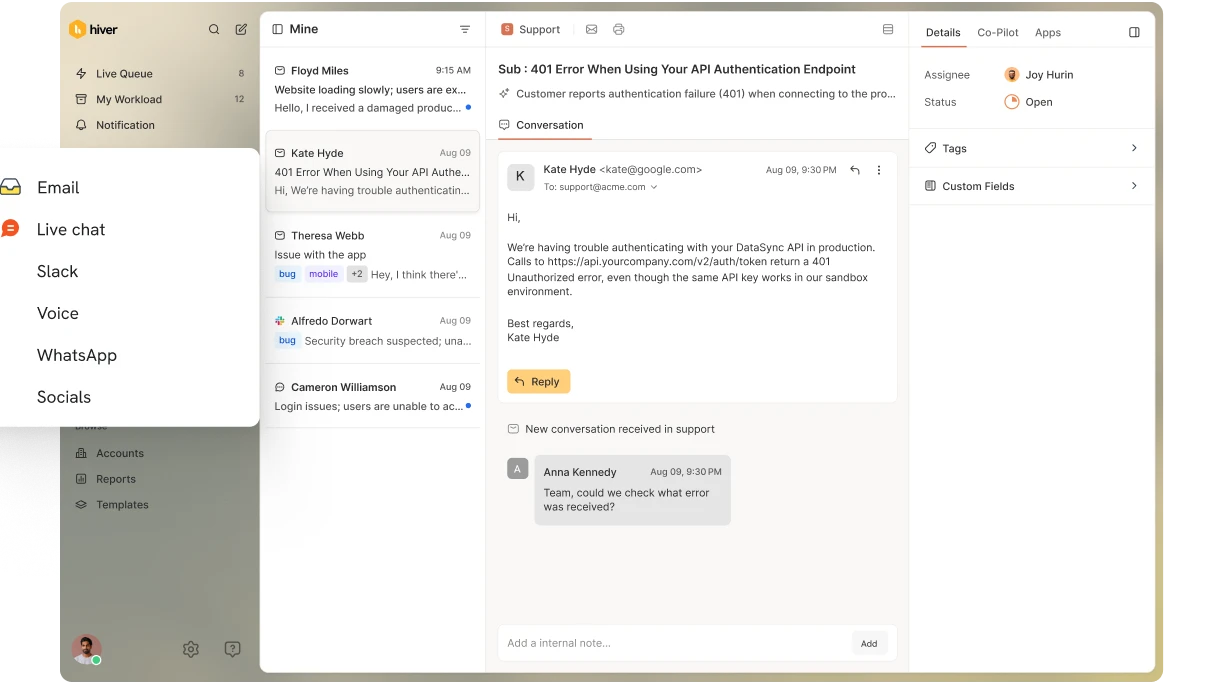
Previously, internal requests were scattered across shared inboxes, making it difficult to track who was responsible for what. Now, every email or request is assigned to a specific team member inside Hiver.
Each request shows:
● Its assignee and current status (open, pending, closed)
● Notes and internal comments for added context
● Shared visibility across teams to avoid duplication
2. Organized workflows with Tags, Automations, and Custom Fields
Travelist processes hundreds of tasks every week, so structure and categorization were essential. The team uses Hiver Tags, Custom Fields, and Automations to classify requests by type, urgency, and source. For instance:
● “Pricing update”
● “Availability change”
● “New promo”
● “QA check”
● “New hotel production”
With over 250 automation rules in place, repetitive actions such as categorization, task creation, and follow-up assignments now happen automatically.
This setup helps the team:
● Ensure uniform organization of all incoming requests
● Route specific types of updates to the right sub-team
● Minimize manual effort and speed up triage
3. Reliable SLAs for urgent requests
The team uses Service Level Agreements (SLAs) inside Hiver to handle time-sensitive requests — especially those originating from the Sales department.
A strict four-hour SLA is applied to these high-priority updates, with alerts notifying both the assignee and manager before a breach occurs.
If a deadline is approaching or missed, Hiver automatically flags it, helping managers intervene early and prevent delays.
This ensures that urgent updates — such as rate changes, partner deal uploads, or campaign listings — are processed on time and never missed.

4. Real-time analytics and performance tracking
Prior to using Hiver, tracking performance required manual spreadsheets. Today, the Operations team relies on Hiver Analytics to get complete visibility into productivity and turnaround times.
The team exports data directly from Hiver and uses it to generate over 30 internal charts, tracking:
● Incoming and completed requests
● SLA adherence
● Volume per category
● Team and individual performance trends
This data-driven visibility helps managers plan resources more effectively and address bottlenecks before they impact timelines.

According to Slawomir,“Hiver turned our daily work into something we can measure and manage. We finally see where time goes, what slows us down, and how to improve it.”
5. Seamless collaboration and consistent communication
Hiver has also improved how the three departments collaborate. Using Shared Drafts, Notes, and @mentions, team members can discuss a request within the thread — without switching to chat tools or risking context loss.
Templates are used for recurring communication, ensuring that messages sent to internal or partner teams are accurate and consistent.
This has reduced coordination delays and standardized the tone and structure of updates across all three departments.
“Our communication is now structured and transparent. Everyone knows what they’re responsible for, and managers have full visibility of what’s happening.” — Daria Betcher, Operations Coordinator, Travelist
Results — Measurable efficiency gains across teams
By bringing structure, automation, and visibility into daily workflows, Hiver has significantly improved efficiency across the Data Processing, Connectivity, and Visual Content teams.
- 160+ Hours Saved Every Month
With structured workflows, automations, and clear ownership in place, repetitive handling and manual routing have been drastically reduced.
Across teams, this translates to over 160 hours saved per month, freeing up valuable time for higher-impact work like quality assurance, content verification, and new partner onboarding.
- 250+ Automation rules cut repetitive actions by 40%
The team configured more than 250 automation rules to streamline repetitive tasks such as categorizing incoming requests, assigning owners, and applying tags. These automations have reduced manual intervention by around 40%, saving 8 hours of routine work every week for team leads and coordinators.
- 25% faster responses with 20 reusable Templates
To standardize communication, the Operations team created 20 pre-defined templates for internal updates, partner communication, and report submissions. This change improved response times by 25%, ensuring faster acknowledgment and fewer back-and-forth exchanges for common tasks.
- On-time delivery for urgent updates improved by 40%
With 4-hour SLAs defined for Sales-originated and other high-priority tasks, the team now receives automatic alerts for approaching deadlines or SLA breaches. This has increased the on-time completion rate of urgent requests by nearly 40%, ensuring that live listings, pricing changes, and promotional campaigns go live without delays.
- 30+ Analytics charts for data-driven planning
The Operations team uses Hiver Analytics exports to generate over 30 internal dashboards tracking incoming requests, SLA compliance, and workload distribution.
This data provides real-time insight into efficiency and helps managers plan staffing or redistribute tasks before backlogs form. As a result, Travelist has improved forecast accuracy by 20%, making resourcing decisions more proactive and evidence-based.
- Coordination delays reduced by 30%
By using Notes, Tags, and Shared Drafts, all communication related to a request now stays in one thread. Team members can collaborate instantly without losing context or relying on chat tools. This has reduced coordination delays by approximately 30% and eliminated confusion during handoffs between teams. Slawomir says,
“It’s not just about time saved — our entire process is clearer, more consistent, and far easier to manage.”
Looking ahead — Continuous improvement, consistent results
After nearly a decade of using Hiver, Travelist’s Operations team continues to refine their internal workflows rather than overhaul them.
The platform has remained a consistent part of their day-to-day operations, scaling smoothly as request volumes and team structures evolved.
Today, the team focuses on small, continuous improvements — adding automation rules where needed, optimizing SLA reports, and refining dashboards to capture more detailed performance metrics. This measured approach ensures that efficiency gains compound over time without disrupting existing workflows. In Slawomir’s words,
“Over the years, we’ve learned that efficiency isn’t about doing things faster — it’s about doing them right, every time. Hiver gives us that consistency, and that’s what really drives performance.”