

Up until recently, soccer was largely viewed with a narrow lens: goals, shots, and possession percentage. But at the ‘26 FIFA World Cup, we saw a new layer of stats that gave everyone a much deeper read on the game,
We saw teams dominate ‘possession’ and still lose, because although the players looked busy, they weren’t actually creating any scoring opportunities. The number of ‘Expected Goals’ (xG) told you how much of a real threat a player’s shot was; not just how it looked in the moment, but the actual probability of a score. The match momentum graphic showed which way the momentum and control of the game was swinging.
I could go on and on, but I’ll stop for I know what you’re thinking. What’s soccer got to do with customer experience? Turns out, quite a lot.
AI has pushed customer support forward on almost every front, from autonomously resolving tickets to assisting support agents in real time. Analytics, however, hasn’t kept pace. You’re left staring at a dashboard trying to glean insights from the same old handful of metrics – ticket volume, first response time, resolution time, CSAT. Although these numbers matter, they tell you what happened, not why, or what to do next.
Even platforms that have pushed harder on analytics are mostly doing the same thing with better packaging – more filters, more chart types, more ways to slice the same numbers. The depth really hasn’t changed much.
AI+ Support Analytics – here’s how Hiver does it
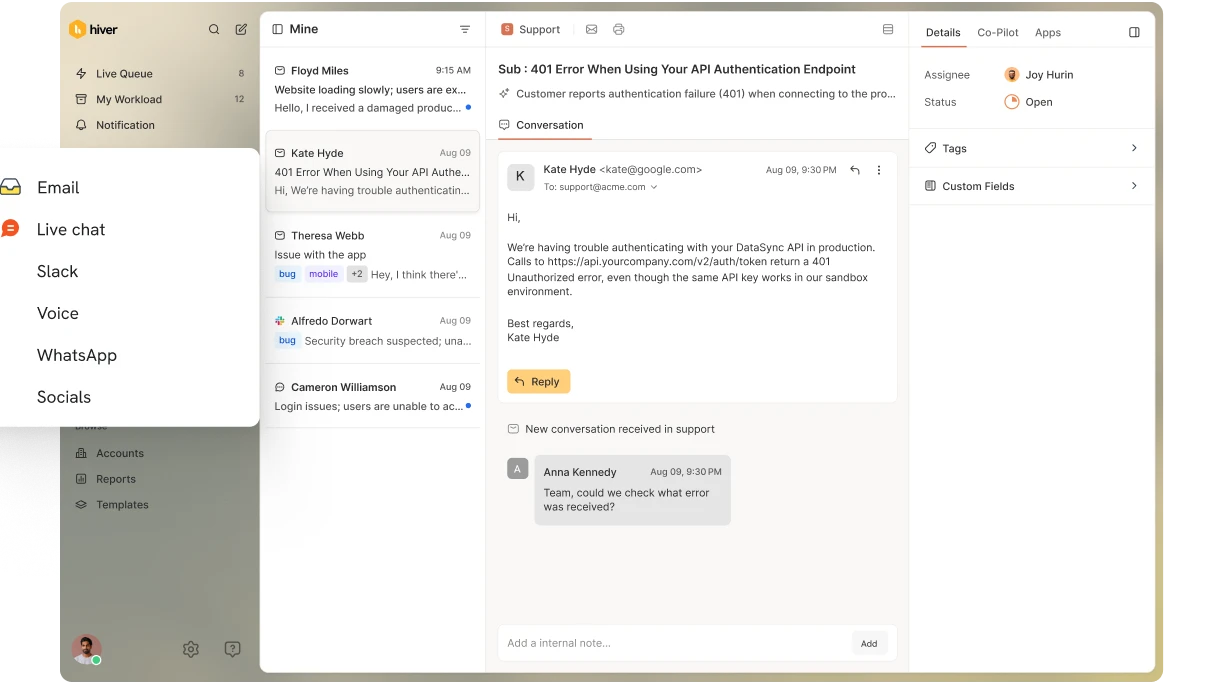
At Hiver, we believe support analytics should go beyond just compiling a dashboard of numbers based on tickets that come into your system. We’ve embedded AI deeply into our analytics model, turning raw ticket data into insight you can act on. Support leaders can now get a much clearer picture of:
- The top reasons customers are reaching out to you
- Which of those customers are at risk
- The quality of your team’s responses
Here are some of the core analytics features that Hiver brings to the table.
1. Know what’s actually driving your ticket volume

A final score tells you which soccer team won. It doesn’t tell you which flank the attack came from, or which matchup on the pitch decided the game. Ticket volume is the same kind of number. It tells you support got busier, but not why.
Hiver’s AI Insights automatically sorts and groups incoming conversations by topic. Instead of just seeing how many tickets came in, you see what’s actually driving that number, the recurring topics and themes behind it.
It could be billing questions spiking on a particular week. Or a product issue generating repeat contacts. Or perhaps a policy change customers didn’t get enough communication about.
And it doesn’t stop at categorization. Each topic carries its own response time, resolution time, and CSAT numbers. You see not just what customers are reaching out about, but how well your team is handling each type of issue.
This is a huge value-add for support teams. So a manager isn’t just told refund requests exist – they’re told refund tickets are running 40% below the team’s average CSAT. This tells them that there’s a coaching opportunity here or a larger process change that needs to happen.
2. Spot customer frustration before it turns into churn

Most support teams find out a customer was unhappy when they get a bad CSAT response. Or worse, when they churn. By then it’s too late to do much about it.
Hiver’s AI reads the tone of every conversation and gives you a view of how sentiment is trending across your queue – not just per ticket, but over time. If negative sentiment starts climbing before it shows up in a survey, you catch it while there’s still time to fix things.
It’s like the little bar TV broadcasts now show during a football match which tells you, second by second, which team is actually on top, even if the score hasn’t changed yet. A team can still be winning 1-0 while that bar shows the other side taking over. It’s a warning sign before the scoreboard catches up. Sentiment works the same way: it tells you something’s wrong before the CSAT survey ever gets sent.
And your team can use this information to drill straight into the flagged conversations. From there it’s simple: coach the agent, fix the process, or follow up with a customer who deserved a better experience.
3. Get automated QA scores across every conversation your team handles

Traditional QA is a sampling exercise. The way it works is someone on the team picks a handful of conversations at random, scores them, and calls it a review. The problem is that most conversations never get looked at and the mistakes get repeated.
Hiver’s AI QA automatically reviews every single reply your team sends. Tone, accuracy, completeness, empathy, policy adherence – set your rubric once and every conversation gets measured against the same bar. No sampling, and no subjectivity. Think of the semi-automated offside technology made in soccer. Close calls used to depend on one linesman catching them in real time, one shot at getting it right. Now every relevant frame gets checked automatically, instantly, on every play. Zero human error.
With Hiver, every conversation also gets a score, and all of those scores roll up into one dashboard tied to CSAT. See who’s performing well, spot the skills your team keeps struggling with, and know exactly where a coaching conversation is needed. When you want to dig deeper, drill into any conversation and see precisely what triggered a low score.
There’s a real-time layer as well. AI reads each reply as it’s being written and flags issues before the agent hits send. A tone that reads sharper than intended. A missing step. An answer that’s technically correct but incomplete. The customer never sees the version that would have cost you a CSAT point.
4. Know exactly where the gaps in your knowledge base lie

Often, gaps in your knowledge base aren’t very obvious. The same routine questions keep coming in because customers can’t find answers on their own, and your agents end up manually handling tickets that shouldn’t need a human at all.
Hiver’s AI analyzes incoming conversations, groups them by topic, and flags when something keeps coming up without a matching article in your knowledge base. You don’t have to guess what to write next because the data tells you.
And once you know what’s missing, Hiver takes it a step further. It’ll auto-draft the article for you based on how your team has been answering the question, ready for you to review and publish.
It also works the other way. AI scans your existing knowledge base for duplicate or overlapping articles across connected sources and flags them. So your help center stays clean, agents aren’t pulling up conflicting answers, and customers always get the right information.
5. Reports and dashboards that actually fit your workflow

Not every support team tracks the same things. A team managing enterprise accounts, for instance, cares about SLA adherence. A high-volume B2C team on the other hand, cares more about first response time and queue depth. A team that’s just scaled up wants to see workload distribution across agents.
Hiver lets you build customized dashboards around what actually matters to your team. Track response times, resolution times, SLAs, CSAT, and workload – all in one place. Use tags and custom fields to group conversations by issue type, customer type, or priority, so you’re always looking at the right slice of data, not just everything dumped into one view.
You can also schedule reports to go out automatically to leadership, so the right people always have a clear picture of how support is performing without having to ask for it.
This is what modern support analytics looks like
Support teams and the way they work has evolved past the existing support analytics infrastructure that most legacy tools offer. Think about it, with the rapid advancements in AI and the fact that most support teams have incorporated AI into their day-to-day workflows, can the same old metrics of the past suffice? No.
The questions that actually matter to a support leader today go deeper – why are customers frustrated, which agents need coaching, where are the gaps in your knowledge base? Legacy analytics wasn’t built to answer any of that.
Soccer didn’t get better analytics by adding more charts to the same box score. It got there by asking different questions of the same match. That’s what we’ve built at Hiver. From AI-powered topic categorization and sentiment analysis to QA scores on every conversation, and knowledge base gap detection – it’s a much wider and deeper view of what’s actually happening inside your support operation.
If you like what you’ve heard about Hiver and want to see it in action, get the 7-day free trial and see for yourself.