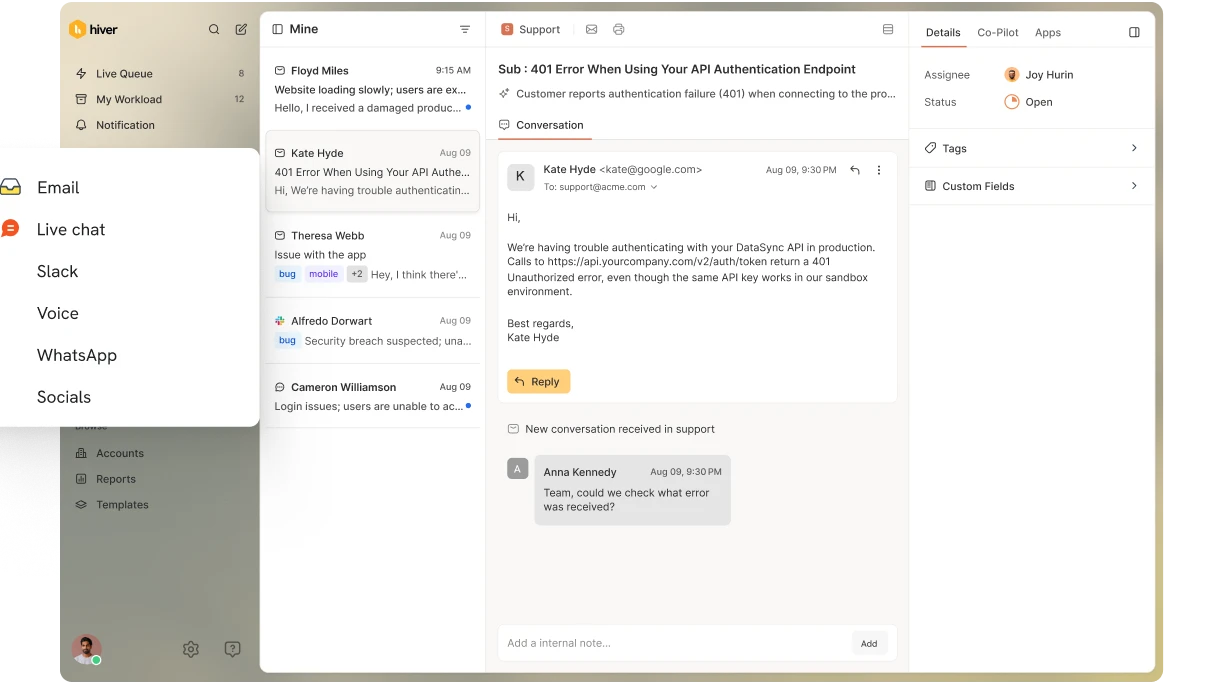







90% of customers* say an “immediate” response is essential. But meeting these expectations with an in-house team alone isn’t always feasible, especially when support needs fluctuate or you’re scaling fast. That’s where BPO customer service can help.
It helps you keep things running smoothly without hiring and training new agents from scratch. You get access to trained professionals who follow your workflows, use your tools, and provide support across time zones, without adding to your headcount.
In this guide, we’ll explain what BPO customer service means, how it works, when it makes sense to outsource, and what to watch out for before making the switch.
Let’s dive in!
What Is BPO Customer Service?
BPO customer service involves outsourcing customer support and back-office work, like data entry and order processing, to a third-party service provider. These BPO companies manage support across all channels, including inbound and outbound calls, live chat, email tickets, and social media inquiries.
They plug into your playbooks and SLAs, scale staffing up or down for busy periods, and use your brand guidelines to ensure every interaction feels in-house. This frees your team to focus on strategic projects while keeping customers happy and served around the clock.
Types of BPO Call Center Services and How They Work
BPO call centers usually offer two main types of services: inbound and outbound. Each serves a different purpose, depending on whether you’re responding to customer needs or reaching out proactively.

Inbound BPO Call Center Services
Inbound services focus on handling incoming calls or customer messages – whether they need help, want to place an order, or are following up on something. Here’s how businesses typically use inbound BPO services:
- Support Questions: Handle large volumes of product or plan inquiries (e.g., a healthcare provider outsourcing hundreds of daily “What’s covered?” calls).
- Order Processing: Agents take orders by phone, enter and manage customer data, process payments, and push orders to fulfillment during peak seasons or across time zones.
- Dispatch: Manage service requests (like taxi or courier dispatch) on an as-needed basis. This ensures no call goes unanswered without full-time staff.
Outbound BPO Call Center Services
Outbound services focus on proactively reaching out to customers or prospects, whether to generate leads, close sales, or gather feedback. Here’s how businesses typically use outbound BPO services:
- Telemarketing & Lead Gen: Call warm leads, run cold outreach, or follow up after signups and events, so your sales team focuses only on qualified prospects.
- Telesales & Renewals: Reach out to existing customers to renew subscriptions or upsell new plans. Great for SaaS, insurance, or membership-based businesses that rely on repeat revenue.
- Market Research & Surveys: Conduct phone-based surveys and feedback calls following your question set. This helps gather insights for campaigns and product improvements.
What Are the Benefits of BPO Customer Service?
BPO customer service helps businesses scale faster, cut costs, and provide better support across time zones and channels. It’s especially useful for companies looking to expand without growing their internal team. Here’s an overview of the advantages:

1. Reduce Operational Costs and Improve ROI
Hiring, training, and managing a full in-house team gets expensive fast. BPOs help you reduce overhead by tapping into lower-cost labor markets and shared infrastructure.
Instead of paying fixed salaries, you move to a usage-based model, which helps you cut your cost per ticket by 20–50%. That extra budget can be directed to growth-focused areas like marketing, product, or customer success.
2. Scale Your Support Team On Demand
Seasonal peaks, product launches, and marketing campaigns can quickly overwhelm your in-house support team. This can lead to longer wait times and frustrated customers.
Partnering with a BPO lets you scale support agents up or down without hiring or training in-house. That keeps your SLAs on target during busy times, protects your core team from overload, and keeps customers happy.
3. Deliver 24/7 Global Customer Coverage
Customers expect 24/7 support. In fact, around 52% of customers expect their queries to be resolved within a day. So, if you miss after-hours inquiries, you risk driving churn.
Partnering with a BPO provides round-the-clock coverage without forcing your team into night shifts. This follow-the-sun approach closes response gaps and helps build customer loyalty across every market you serve.
4. Refocus Internal Resources on Strategic Priorities
Support teams often get bogged down by repetitive questions that don’t need their full attention. With a BPO handling routine tasks, your in-house team can focus on higher-impact work like improving NPS or engaging proactively with VIP customers.
5 Common Limitations of Customer Service BPOs
While BPO partnerships can help you scale and save money, they’re not without trade-offs.
For example, in the early 2000s, Dell moved part of its corporate tech support to India. But after a wave of customer complaints about communication barriers and service quality, Dell brought that support back in-house. Customers said they felt misunderstood or frustrated, especially when dealing with complex technical issues.
This highlights a key limitation of outsourcing: if quality control, context, or cultural alignment is missing, your customer experience can take a hit. Here are five common limitations to keep in mind as you evaluate whether outsourcing is right for your support team:

1. Language & Cultural Barriers
Even when agents speak the same language, regional accents, idioms, or cultural references can lead to misunderstandings. This can frustrate customers and erode trust. To avoid these pitfalls, build in cultural training sessions and share a glossary of local terms so agents stay on point.
2. Data Security Concerns
Sharing customer data with a third party introduces new compliance risks. Without the right protections, you’re exposed to potential breaches or compliance violations. So use end-to-end encryption on all data transfers and ensure they meet GDPR, HIPAA, or other standards.
3. Quality Control Issues
Maintaining consistent service quality across a remote team can be challenging. Without rigorous monitoring, feedback loops, and regular calibration sessions, you may see fluctuating CSAT scores or deviating brand voice over time. Run weekly scorecard reviews and joint calibration calls between your team and the BPO to keep quality aligned.
4. Integration & Communication Gaps
If your BPO can’t integrate with your CRM or support stack, agents might resort to clunky workarounds, like copy-pasting between tools or juggling spreadsheets. This slows down responses and increases error rates.
5. Vendor Dependency & Hidden Costs
Relying on a single provider can backfire if they suddenly raise prices. You might also get hit with surprise fees for busy seasons or special reports. To protect yourself, put limits on extra charges, insist on clear pricing rules, and include straightforward exit terms in your contract so you can switch providers if needed.
How to Choose the Right BPO Partner in 2025
Not all BPOs are built the same. Before you start reviewing vendors, get clear on what good support looks like for your business, then look for a partner who can deliver that consistently. Here’s a checklist to guide your evaluation:

1. Partner with a BPO That Knows Your Industry Inside Out
Does the BPO have experience in your industry? Look for vendors who can show case studies, client references, or certifications specific to your field. Ask for sample tickets or call recordings from similar clients so you can benchmark their baseline expertise before committing.
2. Check Compatibility with Your Systems
Before you sign on, confirm that your BPO partner can integrate with your existing tech stack. Run a sandbox test—have your IT team verify API or webhook connections to your help desk, CRM, and other project management tools. Make sure they support your specific versions and custom workflows, and get a written timeline for each integration to keep the rollout on track.
3. Verify Key Metrics: FCR, CSAT & Response Times
Demand real performance data. This includes first-contact resolution (FCR) rates, customer satisfaction scores (CSAT), and average response or handle times, from at least three current clients in your industry. Compare those numbers with your SLAs, and include penalty clauses for missed targets in your agreement to keep quality on track.
4. Make Sure Agents Understand Customers’ Language
Can the BPO communicate effectively with your customers? To ensure this, arrange a live demo or shadow session with the agents handling your account. Listen for accent clarity, cultural fluency, and tone consistency.
If your customers expect a particular style, such as formal, friendly, or technical, confirm that the BPO’s training program covers those nuances. Also, ask them to review their agent onboarding materials.
Recommended reading
Multilingual Customer Support: How To Assist A Global Audience
5. Confirm the BPO Can Adjust Capacity to Your Demand
Can the BPO scale up or down to meet your business needs? Review their agent-ramp process: get concrete timelines for recruiting, training, and certifying new hires during peak seasons or product launches.
Insist on a documented surge plan with minimum notice periods, backup staffing pools, and turnaround guarantees.
6. Implement Strict Compliance and Security Standards
Treat security as non-negotiable. Ask if they comply with relevant industry regulations like GDPR (for finance), HIPAA (for healthcare), or other specific requirements like ISO 27001 or SOC 2. Verify their encryption standards for data at rest and in transit. Review their audit schedules. Have your legal team sign off on a detailed non-disclosure and data-processing agreement.
9 Best Practices to Make BPO Customer Service Work
To make sure that your collaboration with your BPO partner is smooth, it’s important to establish clear expectations and shared processes from day one. Use the following five best practices to align both teams, streamline onboarding, and maintain service quality as you scale:

1. Define and Align KPIs & SLAs
Before you start, agree on the exact metrics you’ll track like average handle time (AHT), first-contact resolution (FCR), CSAT, and abandonment rate—and establish SLAs for each.
Then include those SLAs in your contract with the help of an AI Contract Lifecycle Software, and build live dashboards in your help desk tool so both your team and the BPO can monitor performance together
💡Pro Tip: Use color-coded alerts (green/yellow/red) in your dashboard to instantly flag when you’re approaching or missing targets. No manual checks required.
2. Build a Modular Training Curriculum
Divide onboarding into short, 15–30 minute segments—like product feature spotlights, mock support calls, brand-voice practice, and escalation scenarios. Host each segment as a brief video or interactive quiz so you can update individual modules easily whenever features change or new policies roll out.
💡Pro Tip: Tag each module by skill level and topic. That way, when you launch a new feature, you can auto-assign only the relevant modules to agents who handle related tickets.
3. Pilot with a Targeted Customer Segment
Select a low-risk segment, e.g., non-VIP accounts or simple billing inquiries, for a 4-week test. Gather weekly reports on SLA adherence, CSAT, and agent feedback. Use a shared “Lessons Learned” doc to capture successes, hiccups, and process tweaks.
💡Pro Tip: Include a short post-interaction survey for customers in the pilot. A two-question NPS-style pulse check helps you spot issues before scaling to your entire customer base.
4. Ensure Seamless System Integrations
Ensure your core systems, like CRM (Salesforce) and ticketing systems (Hiver, Zendesk, Freshdesk), are connected so customer data, ticket statuses, and tags sync automatically. Assign a person on both your team and your BPOs to own each integration. Then run end-to-end tests (create, update, close tickets) to confirm everything flows correctly.
Finally, simple daily health checks or error alerts should be set up to catch and fix sync failures before they affect customers.
💡Pro Tip: Set up webhook-based alerts for integration failures. This way, the moment a ticket or customer record doesn’t sync, you get notified and can fix it before it impacts SLAs.
5. Implement Continuous Quality Monitoring
Establish a QA program that auto-flags 100% of interactions based on keywords (escalation triggers, compliance terms) and randomly samples additional tickets. Review low-scoring calls or chats weekly with your BPO lead, then update training and playbooks based on the findings.
💡Pro Tip: Run monthly calibration sessions where your in-house SMEs and BPO QA analysts listen to and score the same sample calls together. This keeps scoring consistently and uncovers rubric blind spots.
6. Set Up Escalation Paths and Clear Ownership Rules
One of the biggest risks in outsourced support is the “hot potato” effect. Basically, tickets bounce; it means tickets bounce between agents without anyone taking actual ownership.
This leads to delays, frustrated customers, and missed SLAs. To prevent this, establish clear escalation paths and define ownership for every type of issue right from day one.
Make sure both in-house and BPO teams understand when a ticket should be escalated, who it goes to, and what the turnaround expectations are. Documenting this flow and making it easily accessible eliminates confusion and builds accountability.
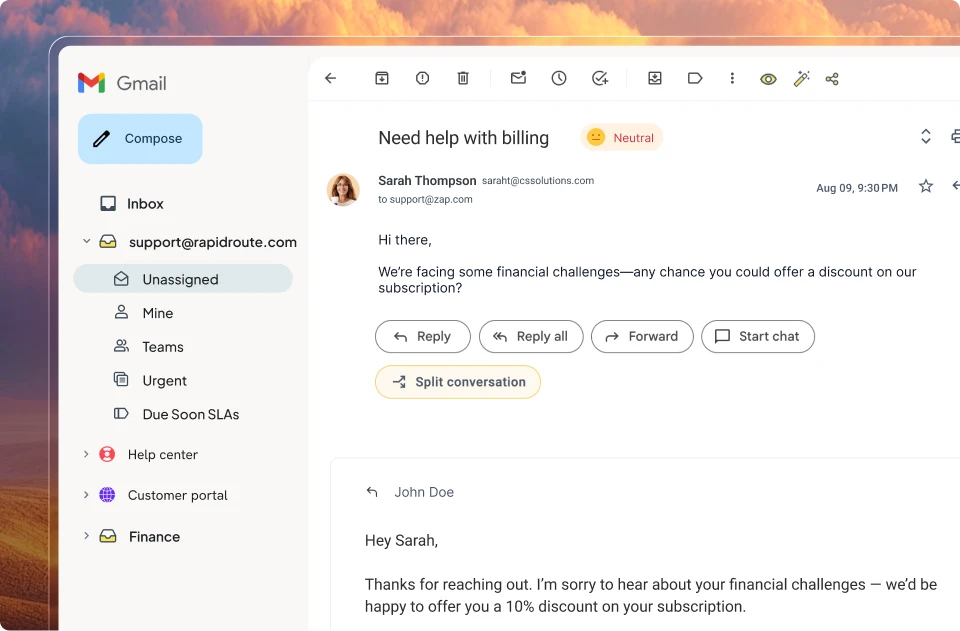
Pro Tip: Encourage the team to set up rules that help auto-assign incoming emails to the right people based on keywords, subject lines, or even the time of day. For example, billing queries can go straight to the finance team, while urgent issues can be routed to senior agents. Hiver’s auto-assign feature makes this easy and ensures no email sits unclaimed in the inbox.
You can also use internal notes and @mentions to loop in teammates, share context, or ask for help.
7. Align BPO Performance Reviews with Internal QA Standards
If your in-house and BPO teams are measured differently, your customer experience will feel inconsistent. That’s why reviewing both groups using the same performance criteria is important, so everyone is held to the same standard. Set up a shared QA process that includes:
- QA rubrics (checklists for tone, clarity, and accuracy)
- CSAT goals (customer satisfaction scores collected through post-ticket surveys)
- Resolution accuracy (was the problem actually solved?)
- Communication tone (did the agent sound helpful, clear, and empathetic?)
When both teams are graded the same way and know what “good” looks like, it becomes easier to maintain quality, spot issues early, and build trust across the board.
💡 Pro Tip: Use a tool that tracks team performance metrics like CSAT, resolution time, and ticket categories. This makes it easier to compare how your BPO and in-house agents are doing and spot any gaps. Hiver, for example, offers analytics that give you a clear view of what’s working well and where extra support or training might be needed.
8. Rotate BPO Agents Through Shadowing or Simulation Sessions
BPO agents often miss the nuanced understanding of your product and customers that internal teams pick up naturally. Shadowing your in-house agents or participating in simulated customer conversations can help close this gap quickly.
These sessions help outsourced agents learn how your team handles edge cases, strikes the right tone, and uses internal tools to resolve issues. Over time, this builds confidence, judgment, and alignment.
💡 Pro Tip: Organize monthly sessions where BPO agents observe live ticket handling. You can also use recorded conversations as training modules for specific ticket types.
9. Treat Your BPO Vendor as a Strategic Partner, Not Just a Vendor
Many businesses treat their BPO provider as an external resource that’s simply “given tasks.” But the best results come when you bring them into the fold — share updates, involve them in planning, and loop them into product or policy changes that may affect customer conversations.
This approach gives BPO teams more context and a deeper sense of ownership. It also helps them anticipate support trends (like spikes in volume after a product update) so they can prepare in advance.
💡 Pro Tip: Give your BPO leads access to Hiver’s Conversation Reports so they can proactively identify common queries and adjust training or staffing as needed. Pair this with a monthly roadmap sync to keep them in the loop on upcoming launches or changes.
Should You Outsource Customer Service to a BPO or Keep It In-House?
Deciding between outsourcing and keeping customer service in-house depends on several factors. Below is a comparison table to help you weigh your options:
| Criteria | BPO | In-house |
|---|---|---|
| Cost | More cost-effective with lower operational expenses | Higher costs due to salaries, training, and infrastructure |
| Scalability | Easily scalable to match demand | Limited by internal resources |
| Control | Less control over day-to-day operations | Full control over customer service |
| Tech Access | Access to advanced technology without upfront investment | Dependent on in-house capabilities |
| Focus | Allows focus on core business activities | Diverts resources from key areas |
| Security and Compliance | Must ensure BPO compliance with regulations | Direct oversight and control over data security |
To understand this even better, let’s consider two scenarios and see which option is better for each:
Scenario 1: Seasonal Spikes in Retail
Let’s say you run an online retail store that sees a massive spike in orders during the holiday season. During this period, customer inquiries about shipping, returns, and product details skyrocket.
In this case, outsourcing to a BPO allows you to scale up customer service without the need to hire and train temporary staff. The BPO can handle the increased volume, and you can scale back down after the holidays, only paying for the services you need.
Scenario 2: Complex SaaS with Enterprise Integrations
Consider a scenario where you run a cloud security platform where customers set up custom firewall rules and encryption policies. When a client asks, “Why isn’t my new rule blocking traffic as expected?” they need someone who knows your codebase, deployment pipelines, and network architecture inside out.
In this case, keeping support in-house is more beneficial. Your engineers and product experts can immediately debug the issue, apply fixes, and even feed lessons into development. That level of deep knowledge keeps satisfaction high and prevents customers from churning.
Scenario 3: Tiered Support for a Growing SaaS
Imagine you run a project-management app used worldwide. Your team handles complex Tier 2 issues—API integrations, custom workflows—but you still need fast replies for Tier 1 questions like “How do I reset my password?” or “Where can I find my invoice?”
Here, a hybrid approach can help. You can outsource Tier 1 queries to a BPO for 24/7 basic support. At the same time, your in-house experts can handle escalations and deep troubleshooting. You’ll keep response times low on routine queries without pulling your engineers off roadmap work.
When Does It Make Sense to Consider BPO Customer Service?
Consider these scenarios as you decide whether to outsource support or keep support in-house:
- You see big swings in ticket volumes: If ticket volumes surge during holidays, promotions, or product launches, a BPO’s flexible staffing lets you quickly scale agents up or down.
- You need round-the-clock support or global coverage: To support customers 24/7 or across different time zones without forcing your team into night shifts, partner with BPO centers in onshore, nearshore, and offshore locations.
- Your in-house team is tied up with complex tasks: Offload routine tickets to a BPO so internal resources can focus on deep technical support, product development, or strategic initiatives.
- Your industry’s volume and complexity align: E-commerce, retail, telecom, and travel benefit most from outsourced support because of high query volumes and seasonality. Conversely, in highly regulated sectors like healthcare and finance, it’s best to keep customer service in-house.
Use these guidelines as your decision checklist. Weigh your support volumes, customer complexity, and regulatory requirements. This way, you’ll know precisely when a BPO partnership will work and when keeping support internal is the smarter move.
Frequently Asked Questions (FAQs)
1. Is BPO the Same as a Call Center?
Not exactly. A call center is just one type of service that can be offered through BPO (Business Process Outsourcing). Call centers usually handle phone-based customer support, both inbound (like answering questions) and outbound (like sales or follow-ups). BPO is a broader term. It includes call centers and other support channels like email, live chat, social media, data entry, and back-office tasks. So, while all call centers can be part of BPO, not all BPO services are limited to call center work.
2. What’s the difference between BPO and KPO in customer service?
BPO (Business Process Outsourcing) customer service focuses on repetitive, task-based support like answering emails, handling live chat, processing returns, or managing basic product queries. These tasks usually follow scripts or standard workflows and don’t require deep technical knowledge.
On the other hand, KPO (Knowledge Process Outsourcing) customer service handles more specialized and complex queries. These might include technical troubleshooting, onboarding high-value customers, or responding to legal and compliance-related issues. KPO agents often need deeper product expertise or certifications in specific areas.
3. How much does outsourcing customer service to a BPO cost?
The actual cost to outsource customer support varies significantly depending on the region and service complexity:
- Offshore (e.g., India, Philippines): ~ $1,000 – $2,000 per agent per month
- Nearshore (e.g., Latin America): ~ $1,200 – $2,200 per agent per month
- Onshore (e.g., North America): ~ $2,600 – $3,400 per agent per month
Additional costs for multi-lingual support, 24/7 availability, or specialized technical roles may apply. It’s essential to request an itemized quote that includes setup fees, training, and ongoing management costs.g costs, and ongoing management charges.
4. Will customers notice if we outsource support?
If the BPO team is poorly trained or overly scripted, customers might pick up on the difference. Responses can sound robotic or lack the empathy your internal team would naturally show. However, with proper onboarding, tone training, and regular QA reviews, customers typically won’t know, or care, who’s behind the message.
Most companies reach full productivity in 6–12 weeks, though highly technical or regulatory environments can extend the process.
5. Can I blend in-house support with outsourced BPO agents?
Yes, many teams adopt a hybrid model to balance cost and control. To make it work:
- Use a help-desk platform: Pick a tool like Hiver, Zendesk, Freshdesk, or HubSpot Service Hub and give both teams access under different roles.
- Centralize your knowledge base: Maintain one internal knowledge base and tag content by ticket type so everyone follows the same playbook.
- Automate intelligent ticket routing: Leverage built-in rules, such as skill-based routing for technical vs. billing and round-robin for load balancing.
- Sync regularly and monitor metrics: Host a weekly 20-minute check-in to review AHT, CSAT, and volume trends via dashboards and adjust SLAs or routes as needed.
6. Will customers notice if we outsource support?
If the BPO team is poorly trained or overly scripted, customers might pick up on the difference. Responses can sound robotic or lack the empathy your internal team would naturally show. However, with proper onboarding, tone training, and regular QA reviews, customers typically won’t know, or care, who’s behind the message.
7. How do I keep outsourced agents updated when my product changes frequently?
If your product evolves often, keeping your BPO team updated is crucial. Start by creating a central knowledge base that is regularly maintained and easy to navigate. Supplement this with short weekly update emails, recorded walkthroughs (e.g., Loom videos), or quick-reference PDFs that highlight what’s changed. Make sure there’s a point person from your team who can field questions and provide clarification when needed. You can also host monthly syncs with BPO leads to discuss changes and gather feedback from the frontlines.
*https://blog.hubspot.com/news-trends/live-chat-go-to-market-flaw?__hstc=238111519.cbd8783df7086b3e5447ce36219f1660.1747680501666.1750325410339.1752860421180.6&__hssc=238111519.2.1752860421180&__hsfp=1116504371
Start using Hiver today
- Collaborate with ease
- Manage high email volume
- Leverage AI for stellar service