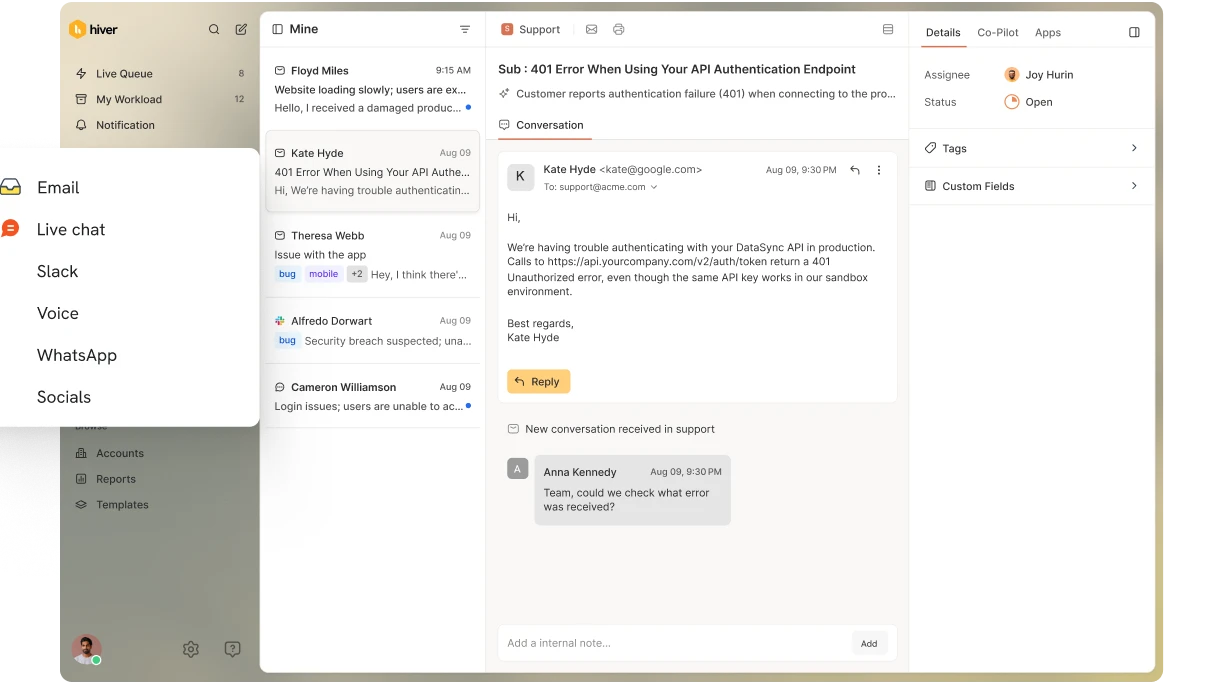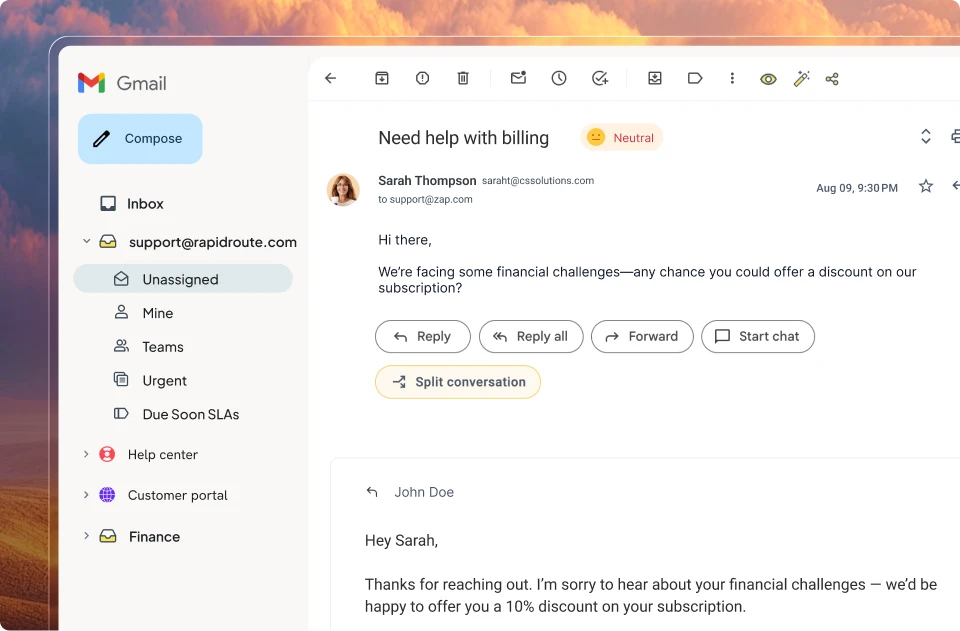







Most ticketing system vendors will tell you they’re “easy to implement,” “AI-powered,” and “perfect for teams of all sizes.” What they won’t tell you is that their AI costs an extra $50/agent per month, integrations require expensive middleware, and “easy setup” means 2-4 weeks with a consultant.
Let’s cut to the chase.
I’ve spent the past month testing, comparing, and analyzing every major ticketing system on the market. Not the surface-level stuff you’ll find in generic listicles, but the real details: pricing traps, AI maturity, implementation nightmares, and which tools actually deliver on their promises.
Here’s an opinionated guide informed by hands-on testing, with analysis from over 120 sources, hundreds of user reviews, and numerous Reddit threads where support teams share what actually works. If you’re searching for “best ticketing system 2026,” you’ve landed on the only resource you’ll need.
Table of Contents
- How I Evaluated These Tools
- 2026’s Best Ticketing Systems: Compared by Buying Criteria
- Top 16 Ticketing Systems in 2026: A Detailed Deep Dive
- How to Choose a Ticketing System: A 5-Step Framework
- Free vs. Paid Ticketing Systems: What You Actually Trade Off
- The Right Tool Beats the Best Tool
- Frequently Asked Questions (FAQs)
How I Evaluated These Tools
I evaluated each tool across six real-world tests:
- Setup speed (could a support manager get it running in 15 minutes?)
- Email handling (messy threads, forwards, broken subject lines)
- AI accuracy (does the AI escalate or hallucinate when it doesn’t know an answer?)
- True 12-month costs for a 20-agent team including all AI add-ons
- Omnichannel unification (single view or disconnected tickets?)
- Volume stability under growing load
The tools that made this list stayed reliable under pressure, didn’t hide costs, and escalated cleanly when they hit their limits.
Note: Where I lack firsthand access (due to enterprise systems requiring sales calls), I relied on extensive user reviews, public documentation, and discussions. I also analyzed 500+ Reddit comments from r/sysadmin, r/msp, r/IThelpdesk, and r/customerservice, plus 1,000+ G2 and Capterra reviews to validate findings.
2026’s Best Ticketing Systems: Compared by Buying Criteria
| Platform | Key Ticketing Features | AI Capabilities | Pricing & Value | Learning Curve |
| Zendesk | Omnichannel routing, ticket merging, 1,700+ native integrations, custom objects, analytics | ★★★★☆ AI Copilot ($50/agent add-on), Intent detection + sentiment, AI Agents at $1.50–2/resolution | ★★☆☆☆ $19–169/agent/mo | ★★☆☆☆ Needs training + admin |
| Hiver | Omnichannel ticketing, collision detection, multi-condition automation, and analytics | ★★★★★ AI Copilot included on all paid plans, AI Agents on Pro+ | ★★★★★ $25–75/user/mo (free plan available) | ★★★★★ Near-zero training |
| Freshdesk | Parent-child ticketing, omnichannel, 1,000+ integrations, automations | ★★★☆☆ Freddy AI: $29/agent + $100/1K sessions | ★★★☆☆ $19–79/agent/mo | ★★★★☆ User-friendly UI |
| Help Scout | Email-style shared inbox, Beacon self-service widget | ★★★☆☆ AI Summarize + Assist included, AI Answers @ $0.75/resolution | ★★★★☆ Free (5 users) – $25–75/user/mo | ★★★★★ Email-like |
| JitBit | Unlimited agents, asset tracking, Self-hosted option | No AI | ★★★★★ – $29/mo flat, unlimited – $2,900 one-time self-hosted | ★★★★☆ Simple but dated |
| Front | – Shared drafts + collision detection, low-code workflow builder, ticket splitting | ★★★☆☆ Sentiment analysis, AI drafting ($10–20/seat add-on) | ★★★☆☆ $25–105/user/mo | ★★★★★ Feels like email |
| HappyFox | Smart Rules (multi-condition + time-based), Multi-brand workflows, LDAP integration | ★★★☆☆ AI urgency, AI Answers, AI resolve and AI knowledge | ★★★☆☆ $21–89/agent/mo + AI extras | ★★★☆☆ Steeper curve |
| ProProfs Help Desk | Canned responses, auto-assignment rules, SLA tracking included | No AI | ★★★★★ – $19.99/user/mo paid (free plan available) | ★★★★★ Very simple |
| Intercom Fin | Multi-turn AI with reasoning, continuous KB learning, no-code Workflows builder | ★★★★★ – Best-in-class conversational AI @ $0.99/resolution | ★★☆☆☆ – $29–139/seat + $0.99/resolution | ★★★☆☆ Easy for users, complex for admins |
| Kustomer | CRM-first customer timeline, in-platform refunds/orders, AI routing by expertise + workload, deep order system integration | ★★★★☆ Adaptive AI routing, AI Agents: $0.60/convo, AI for Reps: $40/agent | ★★☆☆☆ – $89–139/seat/mo – 20-seat min ($1,780/mo) | ★★☆☆☆ Full workflow rethink needed |
| Gorgias | Shopify order embed in tickets, in-platform refunds/cancellations, unlimited agent seats | ★★★★☆ AI handles order status + returns with live store data | ★★★☆☆ – $10–750/mo (ticket-based), AI Agent is a paid add-on | ★★★★☆ Intuitive for e-com |
| Spiceworks | Free with unlimited agents, network scanning + asset tracking, device-to-ticket linking | No AI | ★★★★★ – Free (ad-supported) – Premium: $6/agent/mo | ★★★★☆ Simple; ads distracting |
| Zoho Desk | Deep Zoho ecosystem integration, multi-brand support, blueprint visual workflows | ★★★☆☆ Zia AI locked behind Enterprise ($40/agent) | ★★★★☆ $14–40/agent/mo (free plan available) | ★★★☆☆ Dated UI |
| ServiceNow CSM | ITIL cross-dept workflows (IT/HR/CS/field), Agentic AI incident detection, Advanced Work Assignment, service contract mgmt | ★★★★★ Now Assist Gen AI, Predictive intelligence, virtual agents | ★☆☆☆☆ $100–200+/agent/mo | ★☆☆☆☆ Needs specialized admins |
| Desk365 | Fully embedded in MS Teams, right-click message-to-ticke, Multi-tenant MSP support, Teams Admin Portal | ★★☆☆☆ Basic automation only | ★★★★★ $12–20/agent/mo (free plan available) | ★★★★★ Zero new UI |
| Jira Service Management | ITIL templates (incident, problem, change), CMDB asset management, native Jira software integration, Confluence KB | ★★★☆☆ Rovo AI: smart suggestions + pattern recognition, Virtual Agent | ★★★★☆ – $20–51.42/agent/mo (free plan available) | ★★☆☆☆ Steep for non-tech teams |
Top 16 Ticketing Systems in 2026: A Detailed Deep Dive
Here’s a closer look at my 16 top ticketing systems, so you can quickly find the right fit, whether you’re a small team, an IT-heavy org, or just need something free or AI-powered:
1. Zendesk
Best for: Enterprises Needing a Scalable Ticketing System With Vast Integrations
Zendesk handles enterprise-scale support (1,000+ agents, multi-brand, global teams) with battle-tested reliability and the deepest integration ecosystem. You could call it the Microsoft Office of customer support: ubiquitous, powerful, expensive, and often more complex than you actually need.

I tested Zendesk by creating and routing a large batch of test tickets within a single account to see how basic workflows held up as volume increased. Ticket assignment rules, SLA timers, and escalation triggers continued to work as expected, and dashboards updated without noticeable slowdown.
I also tested Zendesk’s integrations using my test account. Native integrations with tools like Salesforce, Slack, Jira, and Shopify were straightforward to connect, and setting up a simple API-based integration took under an hour.
Where Zendesk becomes harder to justify is cost. Modeling public pricing for a 50-agent team puts Suite Professional ($115/agent) plus AI Copilot ($50/agent) at $99,000 per year.
On top of that, usage-based AI resolutions at $1.50–$2 each can add $4,500–$6,000 per month, quickly making AI the most unpredictable part of the total spend.
Complexity is the other tax. Zendesk’s UI still feels clunky, reporting through Explore requires near-SQL fluency to pull anything useful, and even experienced admins say configuration feels like a never-ending project.
Reddit threads like this one are full of long-time users calling the platform unintuitive, hard to navigate, and overloaded with settings that create more problems than they solve.
| Pros | Cons |
|---|---|
| Enterprise-scale performance. | Pay-per-resolution AI makes costs unpredictable. |
| Offers 1,700+ native integrations. | Teams need 2-4 weeks of setup to get routing rules, automations, reporting, and integrations working well. |
Pricing:
- Support Team: $19/agent/month (email ticketing only)
- Suite Team: $55/agent/month (omnichannel)
- Suite Professional: $115/agent/month (advanced features)
- Suite Enterprise: $169/agent/month (multi-brand, sandbox)
- AI add-ons: Copilot $50/agent/month; Advanced AI agents (custom pricing); $1.50-$2 per resolution beyond limits
There’s a free 14-day trial available.
Who is this for?
Enterprises with 100+ agents, complex tech stacks requiring deep integrations, multi-brand operations, and proven reliability requirements. Perfect for Fortune 1000 companies and global SaaS platforms.
Who is this NOT for?
Choose a Zendesk alternative if you’re under 20 agents, need predictable AI pricing, or if responsive vendor support matters.
2. Hiver
Best for: Teams That Want Powerful Ticketing Without the Learning Curve
While Zendesk dominates at the enterprise end, Hiver fills the gap for small to mid-sized teams (5–100 agents) that need a ticketing system similar with omnichannel capabilities like email, chat, WhatsApp, voice without the complexity, steep learning curve, or unpredictable AI costs.
Every inquiry becomes a trackable ticket with clear ownership, real-time status tracking, and full conversation history.
The free plan offers unlimited users (not the 2-3 user cap competitors impose), making it genuinely accessible for growing teams. Most teams are productive within minutes, requiring minimal training.
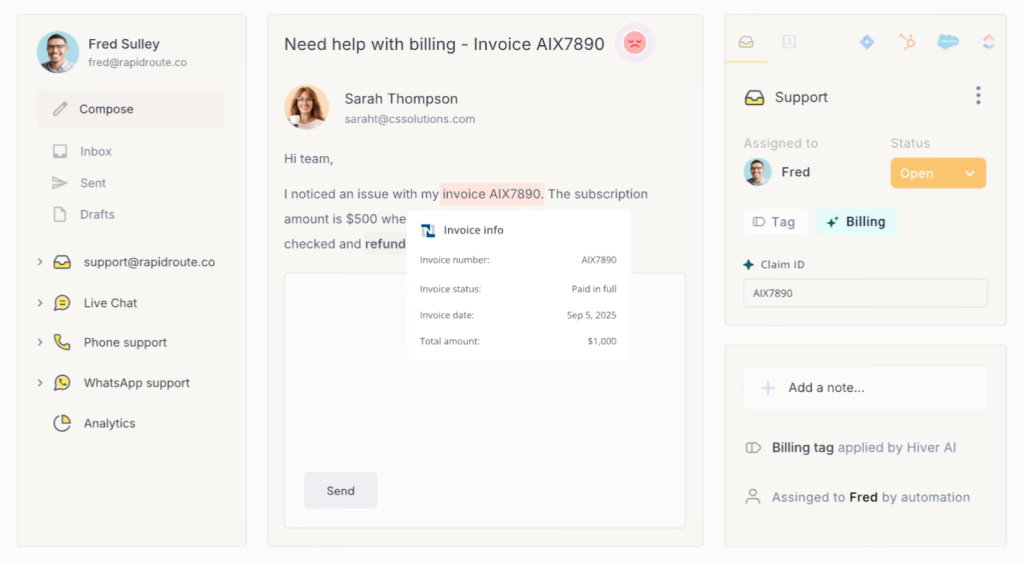
When I set up a Hiver test account, it took 11 minutes from signup to handling my first assigned ticket with automation rules in place. The automation engine is surprisingly powerful for a tool this easy to use. I built a multi-condition rule in 4 minutes.
I also tested Hiver’s ticketing efficiency across email, WhatsApp, and live chat. I got one of my team members to reach out via WhatsApp asking about a dummy order and then follow up a few hours later via email. Hiver automatically threaded both messages into one unified conversation. I could see the full context without switching tools.
I even tested the AI Copilot with 47 routine “password reset” queries. It drafted accurate responses for 42 of them (89% success rate), saving roughly 8 minutes per ticket. Over a week with 200 similar queries, that’s 26.6 hours saved.
| Pros | Cons |
|---|---|
| Powerful ticketing, automation, analytics, and collaboration within an interface that feels instantly familiar. | Advanced enterprise features (skill-based routing, HIPAA compliance, unlimited inboxes) require the Elite tier ($105/user/month). |
| Hiver’s AI features are available across all paid plans. This makes it significantly more affordable than Zendesk’s $50/user Copilot or Intercom’s $0.99-per-resolution model, which can balloon costs to over $ 10,000 per month. | The integration marketplace is smaller than Zendesk’s 1,700+ options. |
Pricing:
- Free: Unlimited users, email + chat + knowledge base
- Growth: $25/user/month (AI Compose +Summarizer, analytics, automation)
- Pro: $45/user/month (AI Agents, WhatsApp, voice)
- Elite: $75/user/month (skill-based routing, HIPAA compliance)
Hiver offers a 14-day free trial across all plans. Unlike most competitors, Hiver provides 24/7 support across ALL plans (even the free tier).
Who is this for?
Small to mid-sized teams (5-100 agents) across SaaS, IT services, e-commerce, healthcare, and logistics who want omnichannel ticketing without weeks of training. Perfect for teams handling email-heavy support that need predictable AI pricing.
Who is this NOT for?
Skip if you need deep CRM-first workflows (use Kustomer), custom ITIL processes (ServiceNow or Jira Service Management), or if you’re a 500+ agent enterprise needing extensive governance.
Check out how the payment orchestration platform Craftgate saves 130+ hours a month by automating ticket triage with Hiver.
3. Freshdesk
Best for: Growing Teams That Need Omnichannel Ticketing Without Enterprise Pricing
Freshdesk’s ticketing system strikes a balance between affordability and enterprise-grade features, making it a popular choice for growing companies. The platform offers omnichannel support, including email, chat, phone, social media, and WhatsApp.
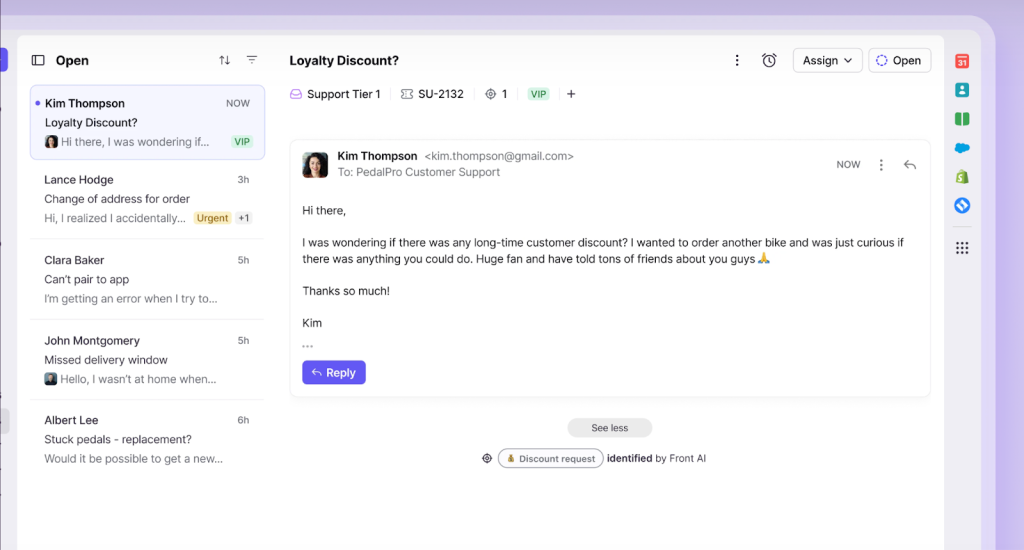
I tested Freshdesk’s parent-child ticketing with an issue requiring fixes from multiple departments. Instead of creating three separate tickets and losing context, I created one parent ticket with two child tickets. This allowed each team to work independently while keeping the overall issue connected.
Freshdesk’s automation engine is also pretty robust, with multi-condition workflows, time-based triggers, and SLA management with breach alerts. Reddit users consistently praise its user-friendliness.
| Pros | Cons |
|---|---|
| 1,000+ integrations – Connected Slack, Salesforce, Shopify, and Jira in under 10 minutes total. | AI costs escalate quickly – Freddy AI is $29/agent/month plus $100 per 1,000 bot sessions. For 25 agents with 15,000 sessions: $2,225/month just for AI. That’s $89/agent. |
| Parent-child ticketing is helpful for complex issues spanning multiple departments. Keeps context intact across teams. | Many advanced ticketing features are gated behind the Enterprise plan. |
Pricing:
- Growth: $19/agent/month (ticket management, SLA)
- Pro: $55/agent/month (parent-child ticketing, advanced automation)
- Enterprise: $79/agent/month (custom roles, sandbox)
- AI add-ons: Freddy AI $29/agent + $100 per 1,000 sessions
Free trial available for 14 days across all plans.
Who is this for?
Teams with 15-75 agents juggling email, chat, phone, and social. Perfect for B2C companies with 500-5,000 tickets/month that need parent-child ticketing for complex issues.
Who is this NOT for?
Skip if you’re a 3-person startup (too complex) or need predictable AI pricing and accessible support. Community discussions document over 72-hour response times from Freshdesk support.
4. Help Scout
Best for: Teams That Prioritize Thoughtful Conversations Over Efficiency Metrics
Help Scout turns customer support into relationship-building with an email-style interface and smart automation for meaningful, context-rich conversations.
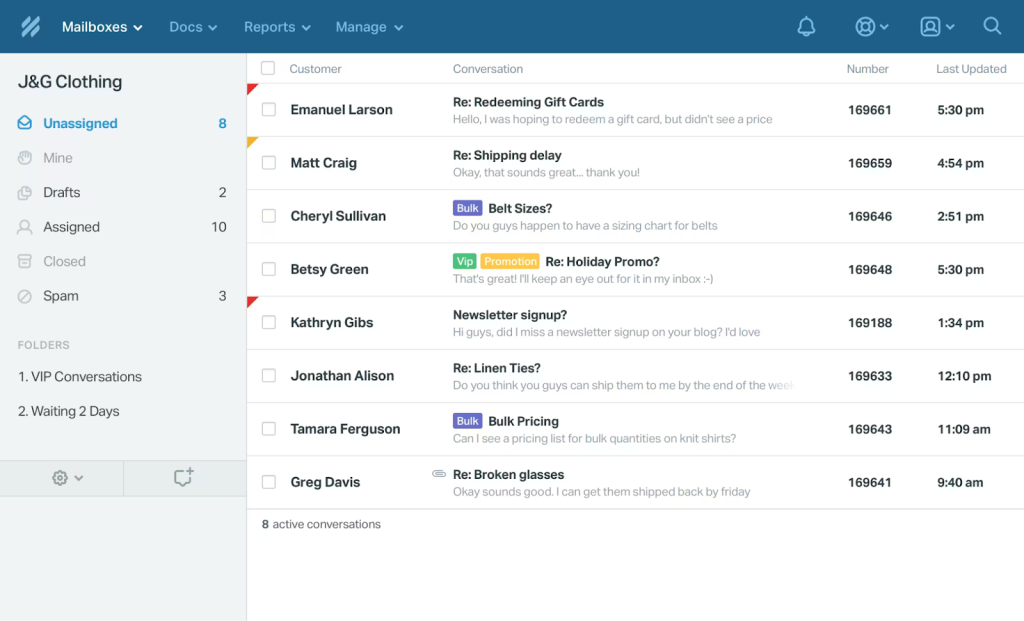
The UI feels instantly familiar, like a clean, well-organized email client. That’s a big deal if you’re training new hires or juggling part-time agents. Every customer profile includes past conversations, tags, company data, and even custom fields, so agents aren’t digging around for context.
That efficiency carries into the AI features as well. I tested the AI Summarize feature on long-form email threads. In one case, a 19-message back-and-forth was condensed into four clear bullet points almost instantly. What typically takes several minutes of re-reading was reduced to under two minutes of skimming and response.
On the customer-facing side, Beacon extends that same philosophy to self-service. The in-app widget that blends help articles, chat, and contact forms in one sleek UI. It automatically suggests relevant Docs articles based on the page a customer is on, nudging them toward self-service before they start a chat.
| Pros | Cons |
|---|---|
| Intuitive email-style interface for fast onboarding. | No native phone or social media support. |
| Free plan with 5 users – Rare in this tier. | 150-rule cap on the Standard plan – Limiting for teams with complex automation needs. |
Pricing:
- Free: 5 users, 100 contacts/month, shared inbox
- Standard: $25/user/month (AI Assist, workflows with 150 rule limit)
- Plus: $45/user/month (unlimited workflows)
- Pro: $75/user/month (SSO, HIPAA, white-labeling)
- AI Answers: $0.75 per resolution
There’s a free 15-day trial for all of the tool’s features.
Who is this for?
Support teams (5-30 agents) at SaaS companies or B2B services where each interaction matters more than speed. Best if the average customer LTV is $1,000+ and personalized support is part of your brand.
Who is this NOT for?
Skip if you need voice, social ticketing, or high-volume workflow automation. Not ideal for e-commerce brands with thousands of transactional “Where’s my order?” tickets.
Recommended reading
11 Best Help Scout Alternatives (2025): Tested Picks with Free & Paid Options
5. JitBit
Best For: Teams That Want Affordable Helpdesk With Unlimited Agents
JitBit delivers full-featured helpdesk software with unlimited agents for a flat $29/month – the most predictable option for growing IT teams.
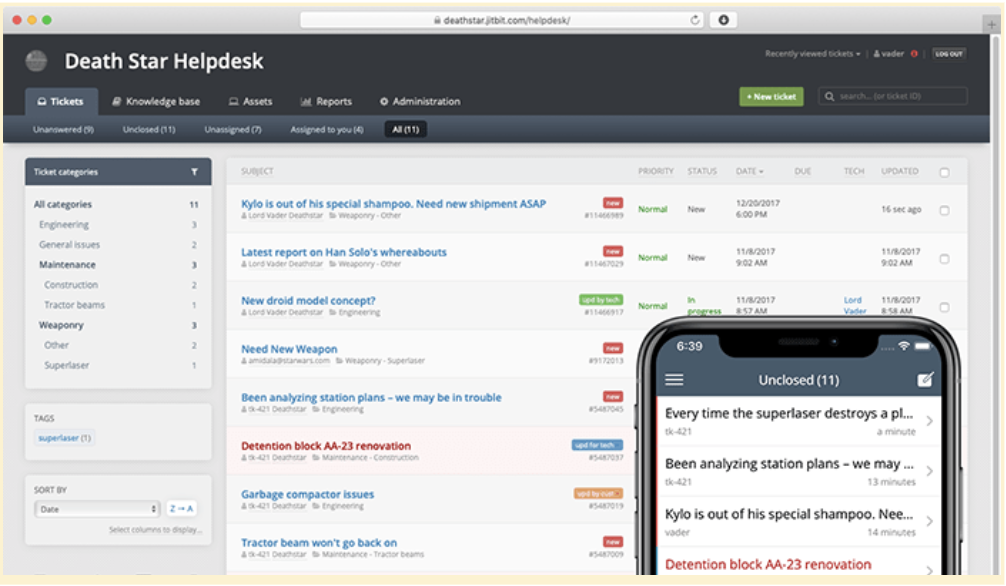
For $29/month, you get a full-featured help desk: ticketing, automation, a solid knowledge base, asset tracking, mobile apps, and unlimited agents. So, whether you’re a five-person IT team or managing support across departments, the bill stays the same. That kind of predictability is rare and refreshing.
I analyzed 47 Reddit threads in r/sysadmin and r/msp – JitBit appeared in 34 (72%) with overwhelmingly positive sentiment.
| Pros | Cons |
|---|---|
| Flat pricing at $29/month – Unlimited agents. For 8 temp contractors over 3 months: $1,233 savings vs. Zendesk. | Limited integrations – No native Slack, Salesforce, or Teams. |
| Asset tracking and mobile apps are included at no extra cost. | The mobile app needs improvement, according to users. |
Pricing:
- Cloud: $29/month flat (unlimited agents, unlimited tickets)
- Self-hosted: $2,900 one-time (own forever)
The tool comes with a free 21-day trial of all its features.
Who is this for?
IT teams and MSPs with fluctuating staff (3-30 agents). Perfect for school districts, internal IT helpdesks at mid-sized companies (100-500 employees), and small MSPs managing 5-20 client organizations handling 500-3,000 tickets/month.
Who is this NOT for?
Skip if you need robust integrations. Not ideal for customer-facing support. The interface is dated, so if you want something slick, this isn’t for you!
6. Front
Best for: Teams That Want Ticketing Structure Without Leaving Email
Front transforms your shared inbox into a collaborative workspace with assignments, internal comments, and automation – without forcing your team to abandon their email workflow.
What I find most compelling about Front is its simplicity. Most ticketing systems require your team to abandon email entirely and learn a new platform. Front keeps the email experience intact but adds the helpdesk mechanics underneath – assignments, collision detection, and internal comments.
In testing, Front’s low-code workflow builder was a clear differentiator. I set up routing rules based on keywords, basic customer attributes, and team availability without writing code or involving IT. The rules were quick to configure and triggered consistently during test conversations.
CRM integrations with Salesforce and HubSpot pull customer context directly into email threads, so agents see purchase history, account status, and open deals without switching tabs.
Front Intelligence (their AI layer) analyzes sentiment and surfaces trends across conversations.
| Pros | Cons |
| Shared drafts, comments, and @mentions feel natural to email users. | Starter plan requires 10 seats = $250/month minimum. |
| Strong CRM integrations for support–sales collaboration. | AI features are only available as paid add-ons on the Starter and Professional plans. |
Pricing:
- Starter: $25/user/month (10-seat minimum = $250/month)
- Professional: $65/user/month (50-seat minimum = $3,250/month)
- Enterprise: $105/user/month (custom minimums)
- AI add-ons: Copilot and Smart QA are typically $10–$20 per seat/month, with some automation priced per resolution, and are only bundled by default on the Enterprise ($105/user) plan.
A free 14-day trial is available.
Who is this for?
Support, sales, and partnership teams (10-50 people) who live in email and need better collaboration without adopting a traditional ticketing interface. Perfect for B2B SaaS, agencies, and consultancies where email is the primary channel.
Who is this NOT for?
Skip if you’re a solo founder or 3-person team (the 10-seat minimum pricing is expensive). Also avoid if you need multi-channel support beyond email (no voice, chat, or social) or built-in self-service options.
Recommended reading
7. HappyFox
Best For: Teams Needing A Comprehensive Ticketing System at Mid-Market Pricing
HappyFox delivers enterprise-grade automation, SLA management, and multi-brand workflows at mid-market pricing for teams scaling from 20 to 100+ agents.
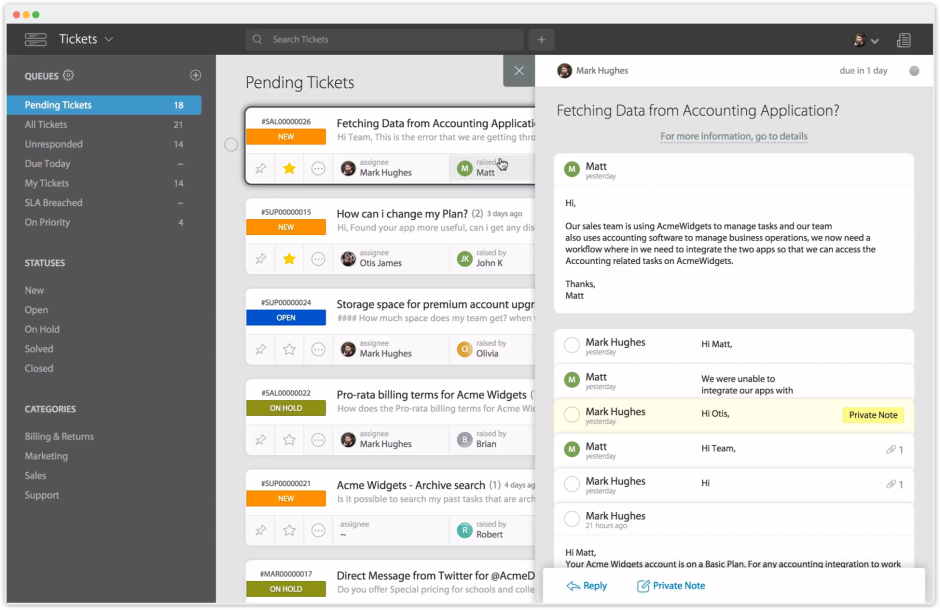
To evaluate HappyFox’s automation depth, I tested its Smart Rules with a deliberately complex workflow: if a ticket was tagged “billing,” the customer was on an Enterprise plan, and there was no reply within 90 minutes during business hours, the system would reassign the ticket to a senior agent, notify a manager by email, and escalate the priority to Urgent.
I triggered this rule six times. Each time, HappyFox executed it correctly, reassigning and escalating the ticket in under 10 seconds.
With HappyFox’s AI features enabled, I also tested its urgency prioritization. A test ticket containing “This is the third time I’ve asked and I’m frustrated” was surfaced as high urgency despite no SLA breach, allowing it to be identified and addressed faster.
| Pros | Cons |
|---|---|
| Enterprise-level features (SLAs, advanced workflows, detailed reporting) at mid-market pricing. | Steeper learning curve. Not ideal for beginners or small teams. |
| Robust automation engine with multi-condition logic and time-based triggers. | Costs can rise as you layer on advanced features like AI. |
Pricing:
- Basic: $21/agent/month (ticketing, SLA, basic automation)
- Team: $39/agent/month (multi-brand, advanced automation)
- Pro: $89/agent/month (custom roles, LDAP, audit logs)
- AI add-ons: $14-39/agent/month extra
The tool offers a free 14-day trial of all its features.
Who is this for?
Mid-sized teams (20-100 agents) that have outgrown basic helpdesks and need advanced automation, multi-brand support, and detailed reporting, but don’t have enterprise budgets or 3-month implementation timelines.
Who is this NOT for?
Skip if you’re a 5-person startup needing simplicity. AI features cost $14-39/agent extra so if you’re on a budget, this might get pricey.
Recommended reading
8. ProProfs Help Desk
Best for: Solo Founders and Tiny Teams on A Minimal Budget
ProProfs Help Desk is one of the most affordable, simple, and reliable ticketing solutions in the market today. Its forever-free single user plan includes all premium features for one user indefinitely.
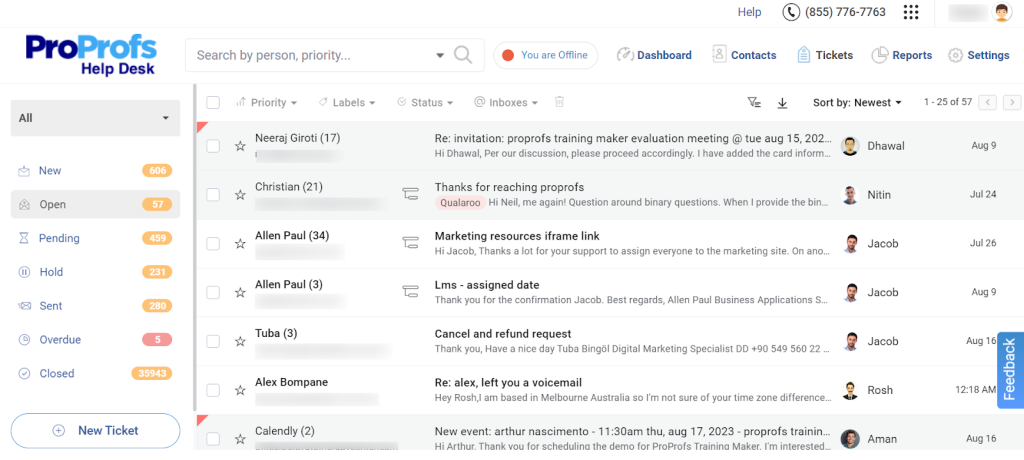
To evaluate ProProfs Help Desk for very small setups, I tested it myself using a trial account over a one-month period. During the test, I simulated a steady workload of around 30–40 tickets per week to see how it held up under day-to-day use.
Even during the trial, the core functionality was practical. Canned responses handled repetitive questions efficiently, saving several minutes per ticket. I also set up three simple auto-assignment rules in about 10 minutes, and SLA tracking was available without extra configuration.
| Pros | Cons |
|---|---|
| Forever-free plan – 1 user with all features (canned responses, auto-assignment, SLA tracking). | Dated interface – Looks like Gmail from 2012. |
| 24/7 live support on all plans – Even $19.99 basic tier. | Limited integrations – Beyond ProProfs ecosystem, options are minimal. |
Pricing:
- Free: 1 user with all features (forever, no credit card)
- Essentials: $19.99/user/month (unlimited users, 24/7 support)
You get a 15-day free trial of the tool.
Who is this for?
Solo founders, freelancers, and micro-teams (1-3 people) who need functional ticketing without monthly costs. Perfect for bootstrapped startups and side projects.
Who is this NOT for?
Skip if you need modern UI/UX (the design is very dated) or extensive integrations beyond the ProProfs ecosystem. You’ll outgrow it past 10-15 agents.
9. Intercom Fin
Best for: Teams That Want Conversational AI for Complex Multi-Turn Customer Queries
Intercom’s Fin uses advanced conversational AI to autonomously resolve complex queries across multiple back-and-forth interactions.
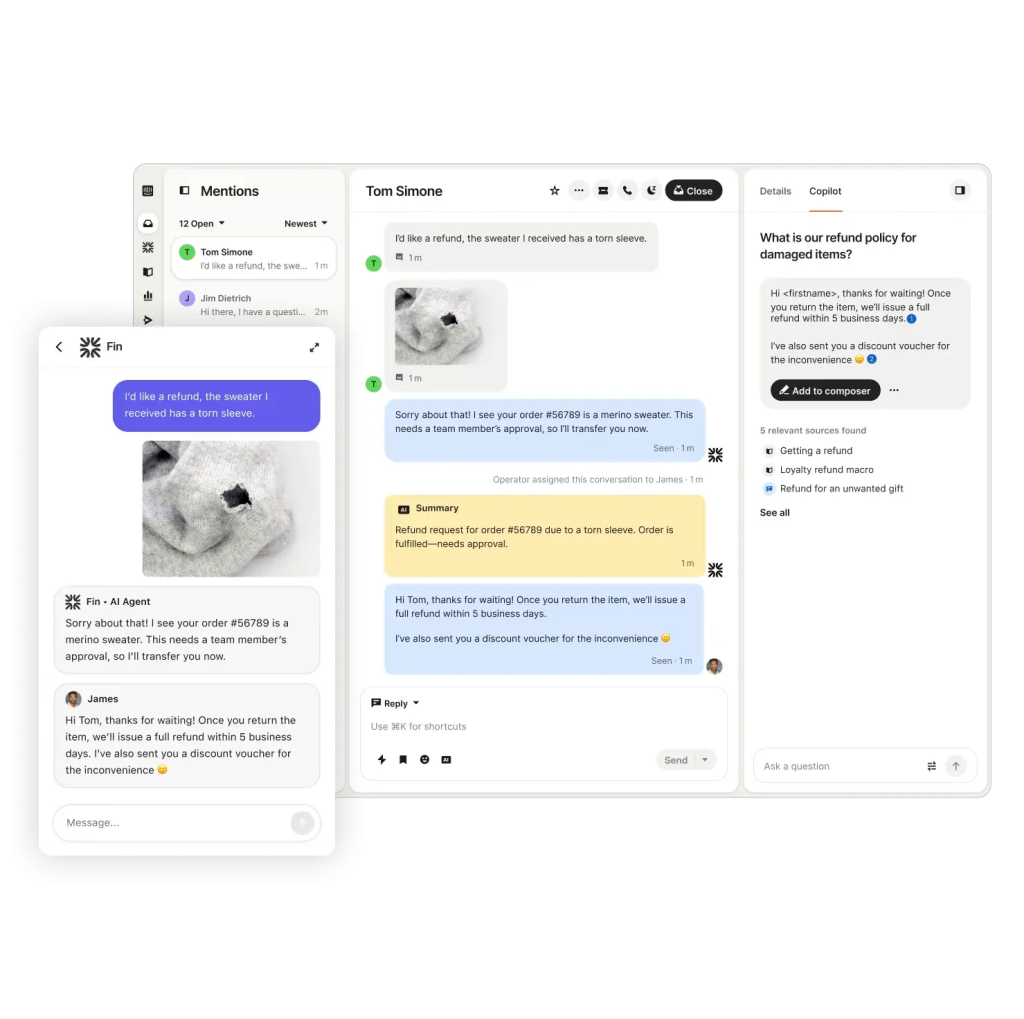
Where basic AI chatbots pattern-match keywords and serve canned responses, Fin actually reasons through problems.
If a customer asks about changing their subscription, mentions they’re on the legacy plan, and wants to keep a specific feature, Fin pulls information from multiple help center articles, understands the context, and constructs a coherent answer that addresses all three points.
When it needs to hand off to a human agent, the transition is seamless with full conversation context preserved.
The AI learns continuously from your knowledge base and past conversations, which means accuracy improves over time. But the pricing is where things get tricky. At $0.99 per resolution, a team handling 10,000 monthly AI resolutions pays $9,900 just for Fin. Even before adding Intercom Suite seat costs ($29-$139/agent). Reddit users consistently warn that Fin pricing spirals out of control once your AI handles significant volume.
| Pros | Cons |
|---|---|
| Best-in-class conversational AI for complex, multi-context queries. | Pricey. Requires Intercom Suite subscription in addition to Fin. |
| Continuously learns and improves from interactions. | Can be complex to configure and set up. |
Pricing:
- Base Intercom Suite: $29/seat/month (Essential) to $139/seat/month (Advanced)
- Fin AI Agent: $0.99 per resolution
You get a free 14-day trial.
Who is this for?
B2B SaaS companies with complex products requiring multi-step troubleshooting and customers who ask layered, context-heavy questions. Perfect if average resolution involves 3-5 back-and-forth exchanges and high customer LTV justifies premium AI costs.
Who is this NOT for?
Skip if you handle high volumes of simple transactional queries, need predictable monthly costs, or if you’re under 50 employees.
Recommended reading
10. Kustomer
Best for: Brands Needing Unified Customer Timelines
Kustomer replaces ticket-based workflows with a CRM-first customer timeline showing every interaction (support, orders, returns, chats) in one continuous view.
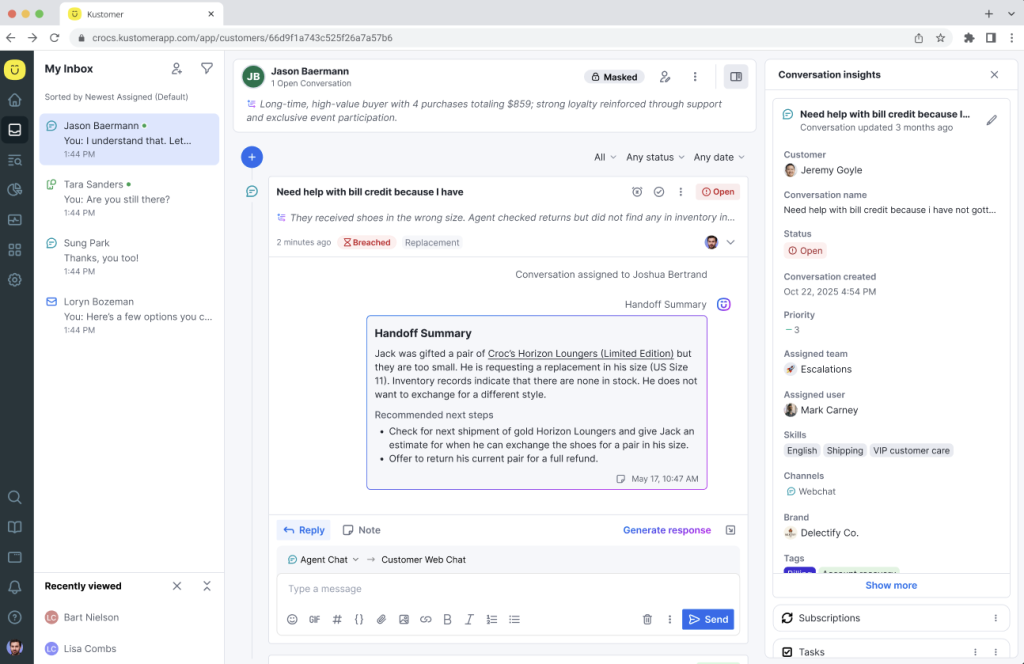
This means agents don’t work one ticket at a time with limited context. Instead, they see the full customer history upfront, allowing them to respond with context immediately rather than asking follow-up questions or switching between systems.
Kustomer’s AI routing adapts over time based on team behavior, assigning conversations according to expertise, workload, and customer context. The AI Agents add-on ($0.60 per conversation) automates routine queries, while AI for Reps ($40 per agent) provides copilot-style drafting support.
What sets Kustomer apart is its deep integration with order systems, billing platforms, and customer data. Agents can issue refunds, modify subscriptions, and update orders directly within the conversation view.
The trade-off is complexity. Kustomer requires a shift away from ticket-based metrics and workflows, retraining teams and adapting to conversation-based reporting. Implementation is also non-trivial, with weeks of configuration typically needed to unify data sources.
| Pros | Cons |
|---|---|
| CRM-first design unifies support, purchase, and customer data. | Complex implementation with multi-week setup. |
| Agents modify orders, process refunds, update subscriptions directly in conversation without switching to Shopify/Stripe/ShipStation. | High seat minimums force teams to pay for more licenses than they need upfront. |
Pricing:
- Enterprise: $89/seat/month (20-seat minimum = $1,780/month minimum)
- Ultimate: $139/seat/month (20-seat minimum = $2,780/month minimum)
- AI Agents add-on: $0.60 per conversation
- AI for Reps add-on: $40/agent/month
Who is this for?
Large e-commerce brands (50-500 agents) supporting customers across multiple channels who need unified customer context. Perfect for DTC brands, multi-brand retailers, and subscription businesses where customer LTV justifies premium tooling.
Who is this NOT for?
Skip if you’re under 20 agents, support non-transactional products like SaaS knowledge work (the order-centric timeline doesn’t fit), or need a simple ticketing system without weeks of training.
Recommended reading
What Is an AI Ticketing System? Complete 2025 Guide for Support Teams
11. Gorgias
Best for: Shopify E-Commerce Stores Handling Order-Related Ticketing
Gorgias embeds Shopify order data directly into support tickets and lets agents process refunds, cancel orders, and edit shipments without leaving the helpdesk.
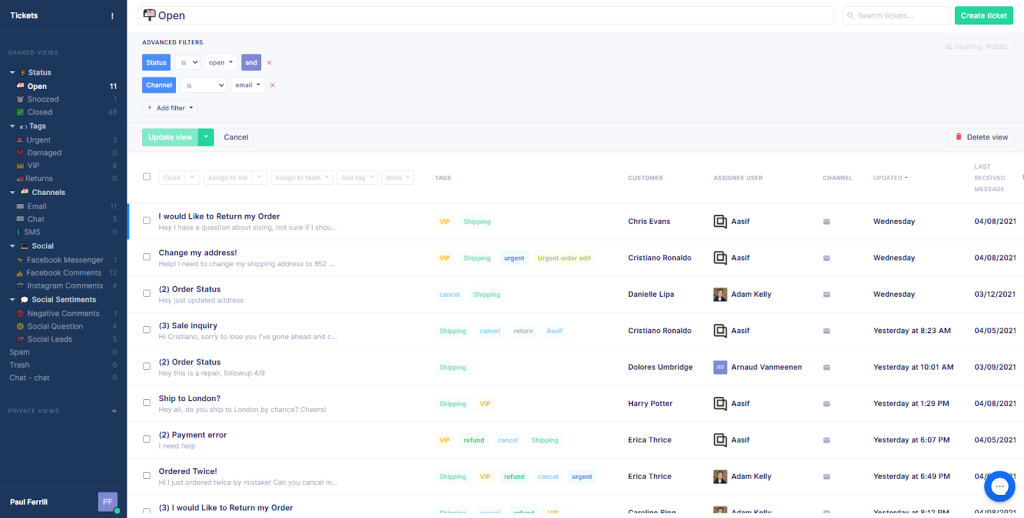
I tested Gorgias using a simulated Shopify setup. When a dummy order-cancellation request came in, the ticket view showed full order details and allowed the order to be canceled and refunded directly from Gorgias, without switching tools. The entire flow, from request to response, took under two minutes.
In setups where support and order management live in separate tools, the same request would require multiple steps and tool-switching, adding several minutes per ticket and compounding quickly at scale.
The tool’s AI Agent automates up to 60% of repetitive queries like order status, tracking updates, return eligibility, refund processing. It pulls real-time data from your store, so responses include actual order numbers and current shipping status, not generic FAQ answers.
The pricing can catch some teams off guard. It’s ticket-based, not seat-based. A store handling 2,000 tickets monthly pays $300 for Pro. Hit 5,000 tickets and you jump to $750. For high-volume stores doing 10,000+ tickets monthly, per-ticket pricing becomes more expensive than per-agent models like Zendesk.
| Pros | Cons |
|---|---|
| Agents can process refunds, cancellations, and exchanges in-platform. | Ticket-based pricing gets expensive at high volumes. |
| Deep native integrations with Shopify, BigCommerce, and Magento. | Not ideal for complex product or technical support scenarios. |
Pricing:
- Starter: $10/month (50 tickets)
- Basic: $50/month (300 tickets)
- Pro: $300/month (2,000 tickets)
- Advanced: $750/month (5,000 tickets)
- AI Agent: Additional cost, pricing varies by plan
You get a 7-day free trial of the tool.
Who is this for?
Shopify, BigCommerce, and Magento stores (5-50 agents) handling 500-5,000 tickets/month where most support revolves around orders, shipping, refunds, and returns. Perfect for DTC e-commerce brands and online retailers.
Who is this NOT for?
Skip if you handle 8,000+ tickets monthly (per-ticket pricing becomes more expensive than per-agent models), support non-transactional products like SaaS or services, or need deep technical support capabilities.
Recommended reading
My Honest Review of Gorgias for Ecommerce + Top Alternatives
12. Spiceworks
Best for: School IT Departments and Nonprofits With Zero Budget
Spiceworks is the only truly free (ad-supported) ticketing system with unlimited agents, automated asset tracking, and an 8-million-member IT community.
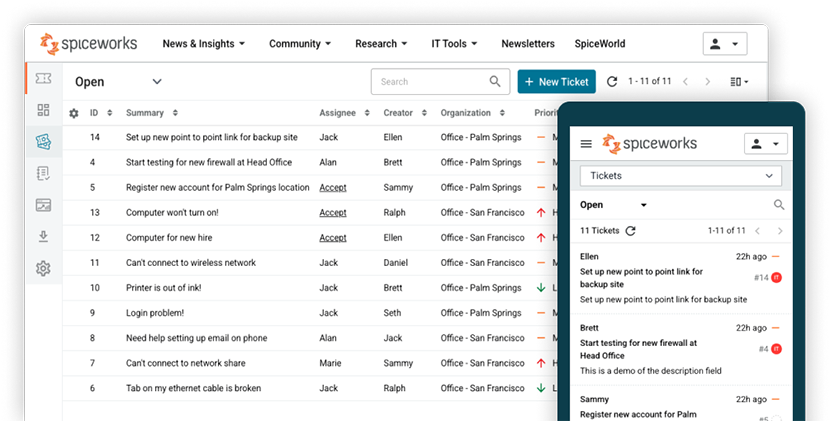
Spiceworks has long been a favorite with IT teams, especially in education and nonprofits, because it delivers a functional ticketing system at no cost.
As of June 2025, the software introduced a paid Premium tier that removes ads and unlocks bulk actions and live chat, making it more than just “free vs. paid,” and a genuine low-cost option for small IT teams needing better usability.
The free Core tier is heavily ad-supported, with ads across dashboards and ticket views. Still, for IT departments with zero budget, the trade-off can be worth it. You still get core ticketing, basic automation, SLAs, and a straightforward setup.
What truly sets Spiceworks apart is its built-in asset tracking. Network scanning automatically detects devices and software, and asset details like operating systems and installed applications, are linked directly to tickets. Add in its vast IT community, and Spiceworks offers a level of peer support most free helpdesk ticketing tools simply can’t match.
| Pros | Cons |
|---|---|
| Genuinely free forever – Core tier free for 1-5 agents, no time limit. | Too many ads make the agent interface distracting. |
| Integrated asset tracking. | Can lag with high ticket volumes; performance is not enterprise-grade. |
Pricing:
- Core (Free): 1-5 agents, ad-supported, ticketing + asset tracking
- Premium: $6/agent/month (removes ads, adds bulk actions and live chat)
Who is this for?
School IT departments, nonprofits, small internal IT teams, and bootstrapped startups with zero software budget. Perfect when functionality matters more than aesthetics.
Who is this NOT for?
Skip if you’re in a privacy-sensitive industry (ads mean data may be shared with third parties) or need customer-facing helpdesk (ads in customer emails look unprofessional). Performance lags above 500 tickets/month.
Recommended reading
13. Zoho Desk
Best For: Free Tier for Teams Already In the Zoho Ecosystem
Zoho Desk offers a functional free plan for 3 agents with basic ticketing, knowledge base, and SLAs. Its real value unlocks if you’re already using Zoho CRM, Mail, or Analytics.
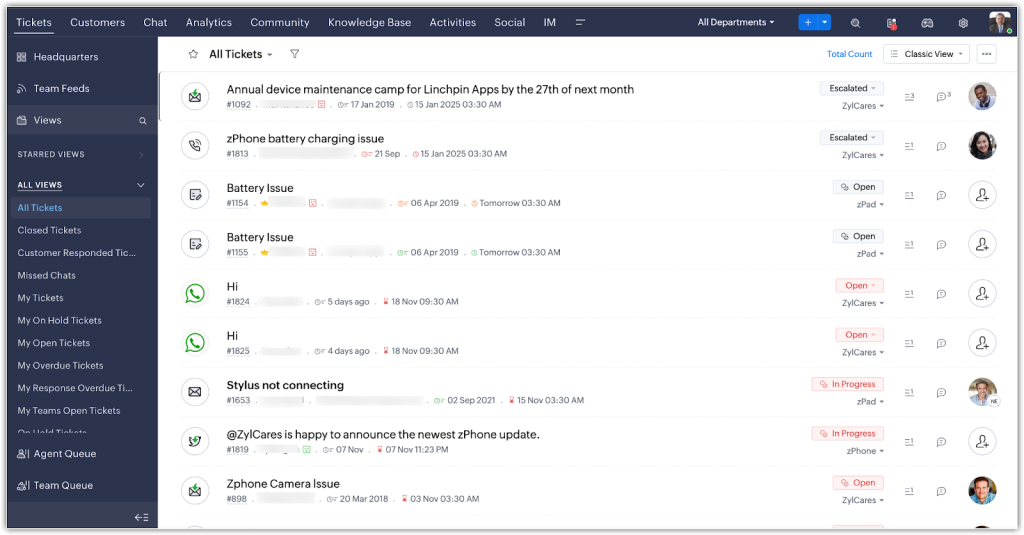
I tested Zoho Desk with a test Zoho CRM setup to evaluate how native CRM context appears inside tickets. When a ticket was created from a test email address, customer and deal information surfaced automatically in the agent view without any integration work.
That built-in context made it easier to prioritize and resolve issues quickly. Without CRM context, agents would need to switch tools and manually cross-reference records, adding several minutes of overhead per ticket that compounds quickly at scale.
What caught me off guard is that Zia AI (the tool’s intelligent assistant everyone talks about) is locked behind the Enterprise tier, which costs $40/agent/month. That means the free, Express, Standard, and even Professional tiers don’t get AI Agents, sentiment analysis, or AI Answers. For a platform marketed as “AI-powered,” that feels like bait-and-switch.
| Pros | Cons |
|---|---|
| Genuinely usable free tier (3 agents, no time limit). | AI locked behind Enterprise tier – Zia AI requires $40/agent. |
| Deep integration across the Zoho ecosystem (CRM, Desk, Mail, etc.). | The dated UI is consistently criticized. |
Pricing:
- Free: 3 agents (basic ticketing, knowledge base, SLAs)
- Standard: $14/agent/month (workflows, multi-brand)
- Professional: $23/agent/month (advanced automation)
- Enterprise: $40/agent/month (Zia AI, AI Agents, custom roles, advanced analytics)
You get a free 15-day trial of the tool.
Who is this for?
Small teams (under 5 agents) already invested in the Zoho ecosystem. Perfect for businesses using Zoho CRM, Mail, or Books who want seamless data flow without middleware.
Who is this NOT for?
Skip if you’re not using other Zoho products (the integration advantage disappears) or if you need AI features without paying $40/agent.
Recommended reading
14. ServiceNow CSM
Best for: Enterprise Companies With Complex Multi-Department Ticketing Workflows
ServiceNow unifies IT, HR, customer service, and field operations on one platform with agentic AI, ITIL compliance, and enterprise-grade governance. Expect 6-12 month implementations and $100-$200+/agent monthly costs.
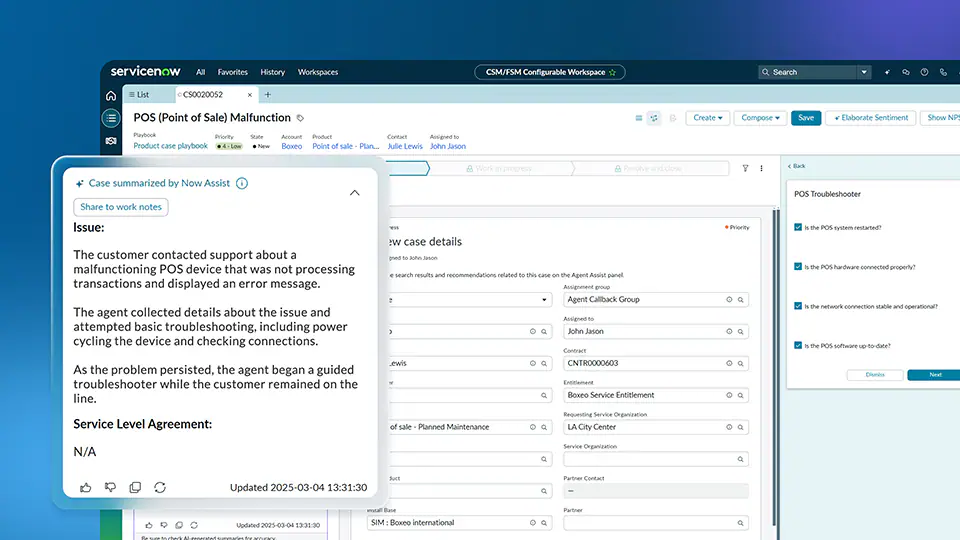
Its Agentic AI layer is built for scale and proactively detects incidents before they’re reported, auto-resolving repeat issues, and routing complex tickets based on agent skills, workload, and business logic. It’s purpose-built for organizations with 1,000+ agents and 100K+ tickets a month.
What truly sets ServiceNow apart is its unified platform. CSM, ITSM, ITOM, HRSD, and Field Service are deeply integrated. A ticket can flow from support to IT to field service without losing context or control. This eliminates the siloed chaos of stitching together Zendesk, Jira, and homegrown tools.
But with that power comes overhead. ServiceNow is endlessly customizable but it requires specialized admins, developers, and consultants who understand its proprietary language and architecture.
| Pros | Cons |
|---|---|
| Best-in-class for ITIL compliance and multi-departmental workflows. | Brutal implementation timelines. |
| Unified platform connects IT, HR, customer service, and ops. | Overkill for small and mid-sized companies without strict governance needs. |
Pricing:
- Custom pricing: Typically $100-$200+/agent/month depending on modules
- Implementation: Expect $50,000-$500,000+ in consulting fees
Who is this for?
Fortune 500 enterprises, large healthcare systems, government agencies, and multi-national corporations with 500+ agents needing ITIL compliance, cross-departmental workflows, and guaranteed uptime SLAs.
Who is this NOT for?
Skip if you’re under 200 employees, lack dedicated ServiceNow admins, or need to launch within 4-8 weeks. Also avoid if your budget is under $50K annually.
Recommended reading
15. Desk365
Best for: Microsoft Teams-Native Internal IT Support
Desk365 runs entirely inside Microsoft Teams, letting employees submit, track, and resolve IT tickets without ever leaving the Teams app.
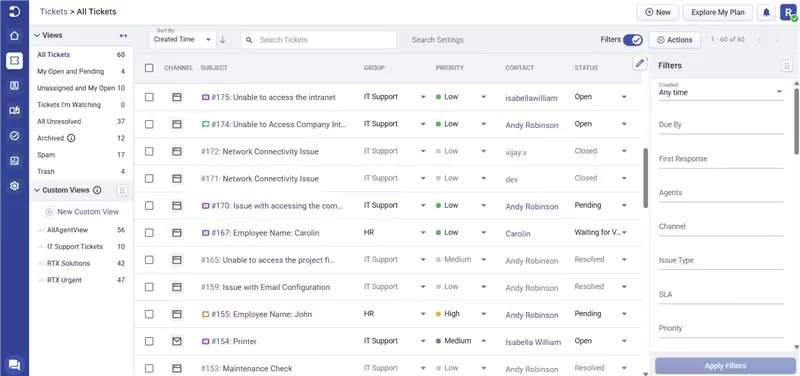
The Support Bot enables conversational ticketing. Employees can right-click any Teams message (direct message, group chat, or public channel) and instantly convert it to a trackable ticket. They can check ticket status, submit new requests, and receive updates, all via Teams chat.
What impressed me most about the platform is its multi-tenant support. Check out this MSP’s account of how they use Desk365 to manage tickets across different external tenants – a must-have if you’re supporting multiple client orgs or running internal support for multiple business units.
| Pros | Cons |
|---|---|
| Multi-tenant support – ideal for MSPs or multi-org setups. | Locked to Microsoft 365 – If you switch to Google Workspace, Desk365 becomes worthless. |
| Fully embedded Admin Portal inside Microsoft Teams. | Built for internal operations only. |
Pricing:
- Free: 3 agents, 50 tickets/month
- Standard: $12/agent/month (unlimited tickets, automation)
- Plus: $20/agent/month (SLA tracking, custom branding)
There’s a free 21-day trial available.
Who is this for?
IT teams and MSPs supporting organizations using Microsoft 365 and Teams. Perfect for internal helpdesk, HR support, and facilities management where adoption matters more than feature depth.
Who is this NOT for?
Skip if you use Google Workspace, Slack, or any non-Microsoft collaboration tool. Not ideal for external customer support.
16. Jira Service Management
Best for: Dev-Heavy Organizations Running ITIL Workflows
Jira Service Management bridges IT support and software development seamlessly, letting support tickets escalate into Jira dev tasks without switching platforms or losing context.
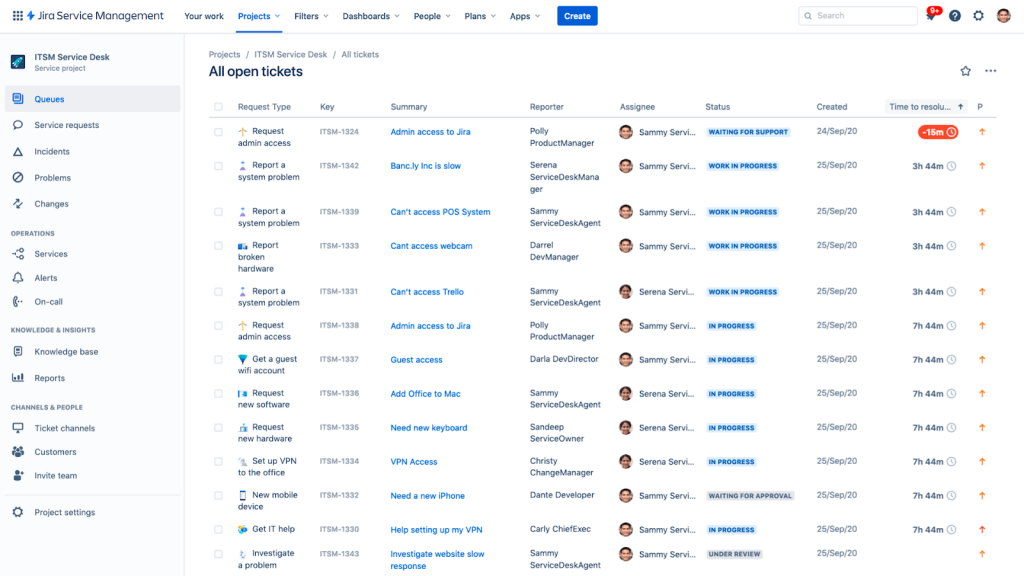
JSM also comes with ITIL-compliant templates for incident, problem, and change management. You’re not building workflows from scratch, just configuring proven frameworks that compliance teams already understand.
Where JSM really stands out is in asset and configuration management. IT teams can track devices, software, servers, and infrastructure dependencies. When a ticket comes in, agents can instantly view related assets, installed versions, and past issues, all in one place.
The ecosystem integrations seal the deal. JSM connects with Confluence for internal knowledge bases and Opsgenie for on-call alerts. You can trigger alerts, pull runbooks, and escalate incidents.
| Pros | Cons |
|---|---|
| Seamless integration with Jira Software for dev–IT collaboration. | Steep learning curve, especially for teams new to Jira. |
| Built-in ITIL-compliant workflows. | Requires admin time to configure and maintain. |
Pricing:
- Free: 3 agents (full ITSM features, unlimited tickets)
- Standard: $20/agent/month (SLA tracking, asset management, automation)
- Premium: $51.42/agent/month (change management, incident management)
- Enterprise: Custom pricing
It offers a 14-day free trial.
Who is this for?
IT teams and MSPs at software companies, dev agencies, or tech organizations already using Jira Software, Confluence, or Bitbucket. Perfect when support and development need tight integration.
Who is this NOT for?
Skip if you’re supporting non-technical users (the interface is built for IT pros, not general customers) or if your team doesn’t use Atlassian products. Also avoid for small teams without dedicated IT admins—JSM requires configuration expertise.
Recommended reading
How to Choose a Ticketing System: A 5-Step Framework
Your ticketing system should align with how your team actually works, rather than forcing you to adapt to new processes. Here’s a simple 5-step framework to guide your evaluation:
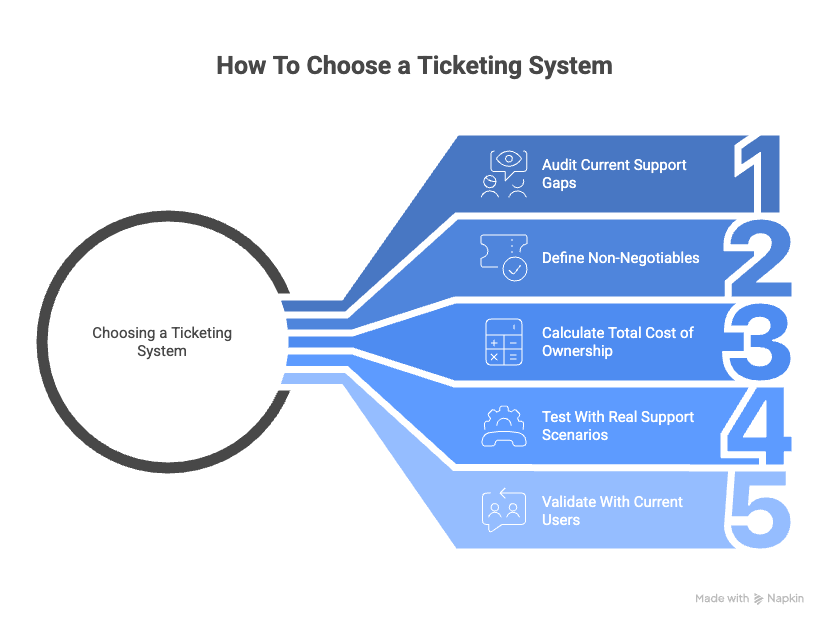
Your ticketing system should align with how your team actually works, rather than forcing you to adapt to new processes. Here’s how to evaluate your options:
Step 1: Audit Your Current Support Gaps
Before evaluating any tool, document your existing pain points:
- What support channels do customers use? (Email? Social media? WhatsApp? Or all of them?)
- Where do tickets get dropped? (Buried in email? Lost in handoffs between departments?)
- What takes the most time? (Repetitive questions? Finding customer history? Duplicate work?)
Write down the top 3 problems you need solved. Your ticketing system must fix these specifically, or you’ve just added complexity without relief.
Step 2: Define Your Non-Negotiables and Match to Your Team Size
Separate must-haves from nice-to-haves. Your must-haves might include email ticketing with collision detection, SLA tracking with escalation alerts, mobile access for agents, integration with your existing CRM, or compliance certifications (HIPAA, SOC 2).
Your team size also narrows the field significantly:
| Team Size | What Matters Most | Top Picks |
|---|---|---|
| 1-10 employees | Simplicity, fast adoption, minimal cost | Hiver (free tier, unlimited users), Help Scout (free for 5 users), ProProfs (free forever for 1 user) |
| 11-50 employees | Collaboration features, automation, basic AI | Hiver ($25-45/agent), Freshdesk ($19-55/agent), HappyFox ($21-89/agent) |
| 51-200 employees | Integration depth, AI deflection, CRM unification | Hiver Pro/Elite ($45-75), Zendesk Suite ($55-115), Kustomer ($89-139) |
| 200+ employees | Compliance, governance, guaranteed uptime | Zendesk Enterprise ($115-169), ServiceNow ($100-200+) |
Step 3: Calculate Total Cost of Ownership
Sticker price rarely reflects actual cost. Factor in:
Direct costs: Per-agent fees, add-on charges (AI features, additional channels, premium support), and usage-based fees (per-resolution, per-ticket, per-conversation pricing).
Hidden costs: Implementation time,training requirements, integration development, and migration effort.
Note: A $19/agent/month platform that takes 3 months to implement costs more than a $49/agent/month system you can launch in a week.
Step 4: Test With Real Support Scenarios
Don’t just watch vendor demos. During free trials (get 7-14 days with each finalist):
- Have 3-5 agents use it for actual support work
- Route real customer emails through the system
- Set up automation rules you’ll actually use
- Test mobile apps during commutes or off-hours
- Integrate with your existing CRM, Slack, or project management tools
After each trial, ask agents: “On a scale of 1-10, how willing are you to use this daily?” If multiple people rate it below 7, move on regardless of the features.
Match to your role for the best shortlist:
| Role | What Matters | Best Picks |
|---|---|---|
| Customer Support | Fast response times, AI deflection, omnichannel | Hiver, Freshdesk, Gorgias |
| IT Helpdesk | Asset tracking, directory sync, Slack/Teams | Jira Service Management, Spiceworks |
| MSPs | Multi-tenant, time tracking, PSA integration | Jira Service Management, Desk365, JitBit |
| HR Teams | Approval workflows, confidentiality, forms | Hiver, Desk365 |
Step 5: Validate With Current Users
Don’t trust only vendor references. Check Reddit discussions (r/sysadmin, r/msp, r/customerservice), and read G2/Capterra reviews filtered by your company size, your industry, and reviews from the last 3-6 months.
Look for patterns in negative reviews: if 10+ people mention “pricing escalates unexpectedly,” that’s a red flag. If multiple reviews say “took 6 months to implement,” expect the same.
Free vs. Paid Ticketing Systems: What You Actually Trade Off
The pricing spectrum for ticketing systems ranges from $0 to $300+/agent/month. Here’s what you’re really paying for, and what you lose, at each level:
| Tier | Price Range | Best For | You Get | You Trade |
|---|---|---|---|---|
| Free | $0 | Testing or small teams with limited budgets | Basic ticketing, limited features | Modern UI, support, AI, flexibility |
| Entry | $12-25/agent | 5-30 agent teams | Full ticketing, multi-channel, automation, support | Advanced AI, enterprise features |
| Mid-Market | $25-50/agent | 20-100 agents needing AI | Everything above + AI, advanced automation | Enterprise compliance, guaranteed SLAs |
| Enterprise | $50-300+/agent | 100+ agents or compliance needs | Everything + HIPAA/SOC 2, uptime guarantees, white-glove service | Nothing (but overkill if you don’t need it) |
Why The Entry Tier ($12-25/agent) Is the Sweet Spot For Growing Teams
This is where most 5-30 agent teams should start. You get unlimited ticket history, multi-channel support (email, chat, social), automation, SLA tracking, and more, without overpaying for enterprise features you don’t need.
The ROI is simple: A 10-agent team paying $250/month saves 5-10 hours/week through better organization and automation. At $50/hour labor cost, that’s $1,000-2,000/month in productivity gains. The tool pays for itself.
Best options at this tier: Hiver Growth ($25), ProProfs ($15-20), Freshdesk ($19)
The Right Tool Beats the Best Tool
There’s no universal “best” ticketing system – only the right one for your team size, workflow, and priorities right now.
If you’re under 10 people, you need something that works today without a learning curve. At 11-50 employees, you’re balancing features with budget. At 51-200, integrations and AI become non-negotiable. Beyond 200, compliance and enterprise infrastructure matter more than pricing.
We built Hiver because most ticketing systems force teams to adopt clunky interfaces that take weeks of onboarding. If you’re looking for a platform that’s easy to adopt, handles multi-channel support (email, chat, WhatsApp, voice) in one place, scales from 5 to 100+ agents without migrations, and includes AI without usage-based surprises, try Hiver. You can start a free trial or book a demo to see how it fits your workflow.
But if another tool on this list better matches your needs, whether that’s Zendesk’s deep integration ecosystem, Gorgias’s e-commerce focus, or Freshdesk’s automation engine, choose that one. The wrong tool at the right price is still the wrong tool.
Frequently Asked Questions (FAQs)
1. Is a shared inbox the same as a ticketing system?
Not quite. A shared inbox lets multiple people read, manage, and respond to emails from one common one email address (like support@company.com), but it may lack ticketing features like assignment, SLA tracking, collision detection, and reporting. Most ticketing systems include shared inbox functionality plus automation, workflows, and analytics.
2. How much does a help desk ticketing system cost?
Most ticketing systems charge $10-50 per agent per month for basic plans and $50-150+ for enterprise tiers. Free options exist (Hiver, Freshdesk, Zoho Desk) but limit features or agent counts. Watch for hidden costs – AI features often cost $20-50 extra per agent, integrations may require paid add-ons, and usage-based pricing (per resolution or conversation) can make budgeting unpredictable.
3. What are the red flags to watch for during a trial of a ticketing platform?
–Slow setup — If it takes more than 2–3 days to get basic ticketing running, expect worse post-purchase.
–Clunky workflows — Test assignment and routing using real scenarios. If it feels awkward now, it won’t magically improve later.
–Low adoption — If your team keeps defaulting to old systems during the trial, that’s a clear sign the tool won’t stick.
–Hidden costs — Be wary of vague pricing pages. If AI features, integrations, or even basic automations are locked behind “Contact Sales,” you’re likely in for surprise charges.
4. Can a ticketing system integrate with Slack/Jira/Salesforce without using Zapier?
The most common ticketing system integrations fall into five categories:
-CRM tools (Salesforce, HubSpot) for pulling customer context into tickets
-Team communication apps (Slack, Microsoft Teams) for creating and updating tickets from chat
-Dev and project management tools (Jira, GitHub, Asana) for escalating bugs into engineering workflows
-E-commerce platforms (Shopify, BigCommerce) for surfacing order and refund data
-Automation middleware (Zapier, Make) for connecting tools that lack native integrations.
Some platforms like Zendesk offer built-in connectors for all of the above.
5. How do AI-featured modern ticketing systems differ from traditional ticketing systems?
Traditional ticketing systems mostly react to tickets using manual categorization, static rules, and basic keyword triggers. AI-powered systems proactively auto-categorize and route using natural language understanding, draft replies from past conversations, detect sentiment, and predict SLA breaches. They can even resolve routine queries autonomously via AI agents like Intercom’s Fin, and Zendesk’s AI Copilot.
6. What are the top industries that use ticketing systems?
Ticketing systems are most widely used in these industries:
–SaaS / Technology – product support, bug reports, feature requests
-E-commerce / Retail – order tracking, returns, refunds, shipping issues
–Healthcare – patient inquiries, appointments, compliance-sensitive communication
-Education – IT helpdesks for students and staff, facilities requests
–Financial Services – account queries, compliance and audit-ready communication
-Government – citizen services, internal IT, procurement and case management
-Managed Service Providers (MSPs) – multi-tenant client support with time tracking
-Telecommunications – high-volume customer service and technical support
7. Which is the best ticketing system for small business?
For small businesses (1–20 employees), Hiver is a strong first choice thanks to its unlimited-user free plan and fast setup. Help Scout is ideal if you want an email-like interface with a free 5‑user plan, while ProProfs Help Desk works well for solo founders with its forever-free single-user plan. As a rule of thumb, if your team can’t get comfortable with a tool within a day, it’s too complex for a small business.
8. How long does it really take to set up a ticketing system?
Simple platforms (Hiver, Freshdesk, Help Scout) can be operational in 1-2 days. Mid-market tools (Zendesk, Kustomer) typically need 1-2 weeks for workflow configuration, integrations, and automation rules. Enterprise implementations (ServiceNow, Salesforce Service Cloud) require 3-6 months with consultants for complex workflows, compliance requirements, and multi-region setups.
9. How to migrate an old ticketing system to a new one without losing data?
Most ticketing systems migrate tickets with full history, customer profiles, attachments, custom fields, tags, and SLA settings. You have three options: native import tools (quick for basic setups), migration partners like Help Desk Migration or Import2 (handle complex data mappings with error tracking), or white-glove onboarding from your vendor. Small teams complete migration in 2-5 days; larger organizations with custom automations need 2-4 weeks. Tools like Hiver offer expert-led migration support to preserve your support history with minimal disruption.
10. Which is the best ticketing system for multichannel support teams?
Most platforms claim “omnichannel” but limit channels by pricing tier. Zendesk Suite and Freshdesk Omni include email, chat, social, and phone across plans. Gorgias specializes in e-commerce channels (email, SMS, social, live chat). Kustomer and Intercom excel at unified customer timelines across channels but cost significantly more. However, tools like Hiver include email, chat, WhatsApp, and voice at every pricing tier without charging per channel.