How to deploy AI across the support lifecycle without losing control
- August 11, 2026
- 2:00 PM EDT
- 45 Minutes
About this event
Every support leader wants AI to take on more. Few are confident in handing it more, and that's not a gap in what AI can do. It's a gap in how clearly you've defined what it's allowed to do.
A password reset has a single correct answer, so handing it to AI was never a risk. But most support teams have a much larger opportunity ahead of them.
- AI that prepares a ticket before an agent opens it.
- AI that resolves complex, multi-step requests end-to-end.
- AI that coaches agents in real time on the tickets that still need a human.
- AI that reviews every conversation, not a sample, and tells you where quality is slipping before it shows up in CSAT.
The real question isn't whether AI can do all of that. It's whether you've defined the rules precisely enough to trust it with your highest-stakes customers.
Nitesh Nandy (Hiver), Nate Brown (CX Accelerator) and Christian Sokolowski (Rebuy Engine) join host Sarah Caminiti (SupportNinja) to walk through what it takes to deploy AI confidently across the full support lifecycle, so you can extend it into the harder parts of your queue with the same confidence you'd have in a well-trained agent.

Speakers
We surveyed 700+ support leaders globally, and one finding stood out - 9 out of 10 leaders are uncomfortable with AI representing their brand directly in customer-facing interactions.
In this session, we explore where that hesitation comes from, how accountability shifts when AI is involved, and where teams should draw the line between human judgment and automation
Hear from a panel of distinguished CX leaders, who are figuring out how to use AI responsibly in real support operations.
Moderator

Lucas Via
SVP of Customer Success
@Hiver
What you can expect to take away
from this discussion
Inside the Team
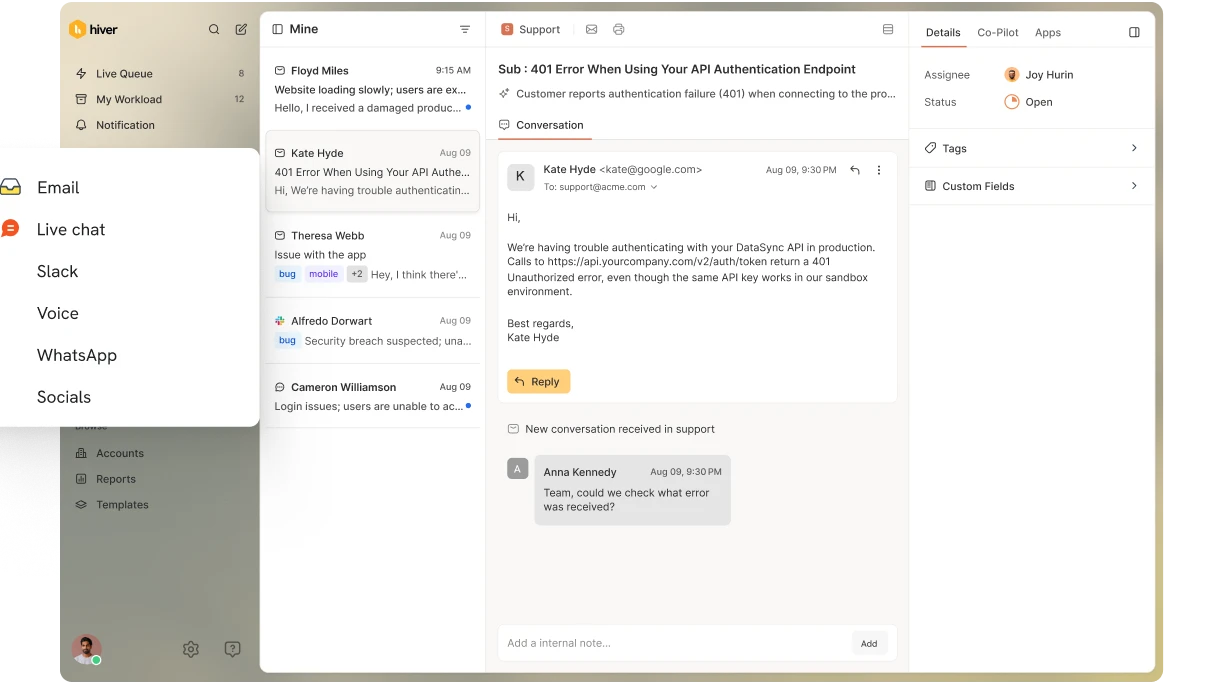
Prevent information gaps when tickets change hands by ensuring context, decisions, and account history are seamlessly passed between agents.
Cross-Team Coordination
Effectively loop in departments like engineering, finance, and CSMs without forcing them to work outside their native tools or losing the original conversation thread.
Customer Visibility
Reduce unnecessary escalations by providing customers with clear visibility into the status and progress of their support requests.
Welcome and Opening Context
Sarah opens by setting up the central tension of the session. Deflection gave support teams a first win with AI. This conversation is about what comes next and what it takes to get there without losing track of what AI is doing.
Where most AI deployments stall
Sarah asks Nitesh, Nate, and Christian about the gap between what AI can do in support and what most teams actually use it for, and why complex, judgment-heavy queries are where rollouts usually stop.
AI across the full support lifecycle
Nitesh, Nate, and Christian walk through each stage of a ticket and what AI can realistically own at each one.
See how AI improves every stage of support: preparing tickets before agents even open them with tagging, data extraction, and sentiment detection; resolving complex, multi-step requests with AI Agents; helping human agents respond faster with real-time suggestions, knowledge retrieval, and tone guidance through Copilot; and enabling managers to review every conversation with AI-powered QA instead of relying on small samples.
Knowledge management: the foundation underneath it all
None of the above works if the knowledge behind it is stale or incomplete. Nitesh on what it looks like when a system keeps that knowledge current automatically, instead of leaving it to whoever has time.
AI Operating Procedures: defining what AI is ready for
How to write rules precise enough that AI knows when to act on its own, when to bring a human in, and when to escalate. Including how those rules can cover complex actions like data retrieval and conditional triggers across other systems.
Live Q&A
Sarah takes questions from the floor on writing AOPs for complex scenarios, getting agent buy-in, handling early AI mistakes, and realistic deployment timelines.
Closing thoughts
One thing Nitesh, Nate and Christian each wish they'd defined earlier when scaling AI in their own support operations.