




Quick Summary
Table of Contents
- Quick Summary
- The Metric Most Teams Never Track
- Why Listen to Us
- What is Gmail Response Time Tracking?
- Which Response-Time Metrics Actually Matter
- Top 8 Recommended Gmail Response Time Tracking Tools
- 11 Benefits of Using a Gmail Response Time Tracking Tool
- How We Picked The Tools on This List
- Your Team Deserves More Than a Stopwatch
Hiver leads this list: Ticketing, SLA timers, response-time analytics, and shared inbox workflows built for support, finance, and operations teams that need real accountability, not just a number. EmailMeter is the strongest pure reporting layer if you don’t need shared inbox workflows. Mixmax fits sales teams tracking follow-ups rather than support response times. The rest of this guide covers all 8 tools in detail, plus which response-time metrics are actually worth tracking.
| Tool | Key Features | Ideal For | Gmail / Outlook Support | Pricing |
| Hiver | Ticketing, SLA timers, response-time reporting, alerts, shared inbox | Support, finance & operations teams that need accountability and faster responses | Gmail + Outlook + any other email service provider | Paid plans start at $25/user/mo (annual) |
| EmailMeter | Response-time analytics, workload trends, volume reports, historical data | Teams that need reporting + visibility (not shared inbox workflows) | Gmail + Outlook | Free version; paid plans from $15/user/mo |
| Mixmax | Real-time tracking, sequences, reminders, engagement analytics | Sales teams managing follow-ups and outreach | Gmail + Outlook | $29–$89/user/mo, no free plan |
| Streak | Gmail-native CRM, pipeline tracking, basic email view tracking | Freelancers, founders, individual CRM users | Gmail only | Free plan; paid plans start at $49/user/mo |
| Gmelius | Collaboration inside Gmail, Kanban boards, templates, light automation | Teams wanting shared inbox + workflow boards inside Gmail | Gmail only | Paid plans start at $19/user/mo, no free plan |
The Metric Most Teams Never Track
Most teams don’t know their actual email response time until a customer complains about it. But the clock starts the moment a message hits the inbox, and how fast (or slow) that first reply lands shapes customer satisfaction, sales outcomes, and how efficiently your team is actually working.
This guide compares 8 Gmail and Outlook response time tracking tools so you can measure it properly, and covers which metrics actually matter once you start tracking.
Why Listen to Us
Hiver has helped teams like Rush Order cut response times by 20% by giving managers visibility into which emails were actually answered and which were quietly piling up. That’s the same accountability every tool in this guide claims to offer; the difference is whether it’s actually measurable.

What is Gmail Response Time Tracking?
Gmail response time tracking measures how long it takes to reply to an incoming message, manually by checking timestamps, or automatically with a dedicated tool that tracks and reports it for you.
The value differs slightly by team. Support teams use it to catch slow replies before they become complaints. Sales teams use it to prioritize and follow up on leads fast enough to not lose them to a competitor. Managers use it for visibility into who’s responsive and where the workflow is breaking down.
Which Response-Time Metrics Actually Matter
Most tools on this list track some version of “response time.” Here are the key response-time metrics teams should be tracking to accurately measure support performance.
- First response time is how long it takes for the first reply to go out after a message arrives. This is the number customers actually feel, an acknowledgment that someone’s looking at their issue, even before it’s resolved.
- Resolution time is how long it takes to actually close out the request, not just acknowledge it. A fast first reply followed by a slow resolution still frustrates a customer; both numbers need tracking, not just one.
- SLA compliance measures whether first response and resolution are landing inside the targets your team has committed to, by priority, by customer tier, or overall. This is the number that turns “we’re generally pretty fast” into something you can actually report on and improve.
Tracking all three matters because they catch different failure modes. A team can have a fast average first response time while quietly missing SLA on high-priority tickets, a gap a single “average response time” number hides completely.
Reporting and analytics go further than basic time tracking: every metric, including SLA compliance, breaks down by customer, location, team, and agent.
Top 8 Recommended Gmail Response Time Tracking Tools
Navigating the array of Gmail response time tracking tools can be a tad overwhelming, hence picking the one that aligns with your needs is crucial.
In this section, we’ll recommend a few of the best Gmail response time tracking tools on the market.
| Tool | Key Features | Pricing |
| Hiver | Integrates with Gmail and Outlook, Omnichannel support, SLA management; detailed insights on email response time and resolution time, ability to build custom reports | Growth: $25/user/monthPro: $55/user/monthElite: $85/user/month |
| EmailMeter | Response time trends; broad email analytics; visual analytics; data accessibility up to 2 years. | Free versionTeams: $15/user/month |
| Mixmax | Real-time tracking, engagement analytics, reporting | Inbox Copilot: $29/user/month; Meeting Copilot: $29/user/month; Engagement Copilot: $49/user/month (required for sequences); Suite: $89/user/month; no free plan |
| Streak | Free email view tracking; basic CRM functionalities; link tracking. | Free planSolo: $15-$19/user/monthPro: $49-$59/user/monthPro+: $69-$89/user/monthEnterprise: $129-$159/user/month |
| Gmelius | Email tracking; robust analytics; automation features; team collaboration within Gmail. | Meli: $19/user/month; Growth: $24–29/user/month; Pro: $36–40/user/month; Enterprise: custom; no free plan |
| Timetoreply | Response time tracking across Gmail and Outlook; SLA monitoring; team performance dashboards; custom reports; mailbox analytics | 14-day free trial availableOptimize: $34/mailbox/month+Intelligence: $49/mailbox/monthEnterprise: from $95/mailbox/month |
| EmailAnalytics | Gmail and Outlook response time tracking; team activity dashboards; SLA alerts; historical email reports; shared mailbox analytics | 14-day free trial availablePaid plan: $19/inbox/month |
| Zendesk | SLA-based tracking, agent reports, lifecycle analytics, omnichannel insights | Support Team: $19/agent/month; Suite Team: $55/agent/month; Suite Professional: $115/agent/month; Suite Enterprise + Copilot: custom, no published rate |
Let’s examine each tool in more detail.
1. Hiver
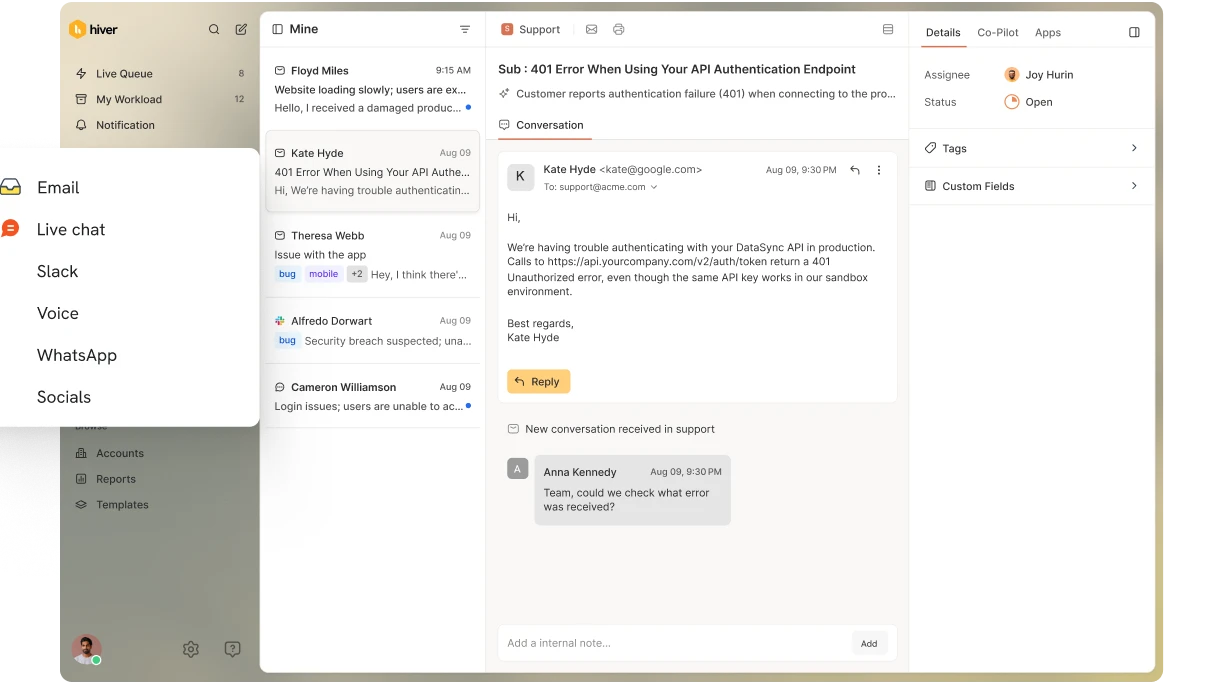
Hiver is an agentic omnichannel customer service platform built for teams running collaborative email support from one place, across Gmail, Outlook, or any other provider.
Response and resolution time tracking is built in, alongside SLAs to hold the team accountable to set standards, and AI QA to check quality on top of speed. Here’s how Hiver handles time tracking specifically.
Business hours. Set your team’s working hours so time tracking only counts during actual support windows, not when everyone’s offline, and so customers see accurate availability upfront.

Hiver’s UI
Create SLAs for meeting response time standards
Hiver lets you create SLAs (Service Level Agreements) for key metrics like first response time and average resolution time, so both your team and your customers know what to expect.
For example, you might set an SLA that all customer queries should be acknowledged within 1 hour, and resolved within 24 hours for low-priority issues—or faster for high-priority ones. These guidelines help set clear expectations and keep things running smoothly.
What happens when an SLA is breached?
Hiver gives you the tools to catch potential SLA violations before they happen. If the SLA is still missed, Hiver automatically alerts the manager or supervisor, so they can step in and take action immediately.
You can set up automated alerts that notify the assigned team member an hour before the SLA deadline approaches.
This proactive alert system helps your team stay on top of time-sensitive queries and ensures nothing slips through the cracks—especially with high-priority customer issues.
Can you view team performance against the set SLAs?
Absolutely. Hiver lets you set up SLA reports to track detailed compliance and violation records for every email conversation. These insights help you:
- Make smarter, data-driven decisions to improve your support operations
- Measure how well your team is meeting SLA standards
- Spot recurring patterns in delays
- Identify bottlenecks or training needs
Email response time analytics
First response time is tracked automatically, with reports that surface patterns, like replies slowing down during specific hours, so you can rebalance workload before it becomes an SLA problem.
Advanced analytics and reports
Beyond response and resolution time, Hiver breaks reporting down by conversation, by agent (including CSAT), and by tag, so managers can see both team-wide trends and individual performance without building a custom dashboard from scratch. Custom reports are also available for anything not covered by the defaults.
Recommended reading: 6 Essential Customer Service Reports That You Need to Track
Pricing:
Paid plans start at $25/user/month, billed annually.
*Pricing verified as of August 2026.
Case study: Here’s how Kiwi achieved a 100% SLA success rate with Hiver
2. EmailMeter
EmailMeter is a Gmail and Outlook analytics platform focused on response-time reporting rather than shared inbox workflows.

Reporting in EmailMeter
Features:
- Response-time trends: tracks reply speed week over week, showing whether performance is improving or slipping.
- Custom metrics: build and save filtered views to monitor specific segments of email activity.
- Visual analytics: daily, weekly, and monthly breakdowns make patterns easy to spot at a glance.
- Historical data: up to 2 years of past data, exportable in CSV, for long-term analysis.
Pricing:
free version available; paid plans start at $15/user/month.
*Pricing verified as of August 2026.
3. Mixmax
Mixmax is built for sales teams tracking outreach and follow-ups, not primarily a support response-time tool.

Mixmax Analytics
Features:
- Real-time tracking: see opens, clicks, and engagement as they happen.
- Sequences: automate multi-step outreach with built-in reminders.
- Engagement analytics: see which emails and sequences actually perform.
- Reporting: available on higher tiers, gives a deeper view of response and engagement rates.
Pricing:
Restructured in 2025 into modular Copilot tiers. Inbox Copilot and Meeting Copilot are $29/user/month each; Engagement Copilot (required for sequences) is $49/user/month; the full Suite bundling all three is $89/user/month. The free plan was cut significantly in 2025 and is no longer meaningfully available.
*Pricing verified as of August 2026.
4. Streak
Streak is tailored towards integrating a CRM (Customer Relationship Management) system within Gmail, but it also boasts features that can be leveraged for email time tracking.

Tracking your email on Streak
Features:
- Email view tracking: free, shows if and when recipients opened your email, and how many times.
- Pipeline tracking: manage deals or requests through customizable stages.
- Mass email tracking: send follow-ups only to recipients who viewed your last email.
- Chrome extension setup: start tracking immediately, no additional configuration needed.
Pricing:
Free plan available for individuals; paid plans start at $49/user/month for full CRM functionality.
*Pricing verified as of August 2026.
5. Gmelius
Gmelius is a collaboration platform integrated within Gmail, offering an array of features to streamline email management and team collaboration.

Analytics in Gmelius
Features:
- Shared inbox: manage addresses like info@ or support@ without leaving Gmail.
- Kanban boards: turn emails into visual tasks and track them through stages.
- AI reply assistant: drafts personalized replies using past conversations and connected data.
- Workflow automation: automate assignments, follow-ups, and tagging, capped on lower tiers.
Pricing:
$19–$40/user/month across tiers (Meli, Growth, Pro), 7-day free trial, no free plan.
*Pricing verified as of August 2026.
6. Timetoreply
Timetoreply is a dedicated response-time analytics platform built specifically for Gmail, Outlook, and Microsoft 365.

Features:
- Time tracking: first reply time, average reply time, and volume, tracked per mailbox or shared inbox.
- SLA tracking: set custom response targets and track compliance against them.
- Real-time alerts: get notified before an SLA deadline is missed, not after.
- Dashboards and leaderboards: compare individual and team performance live.
Pricing:
14-day free trial, no credit card required. Optimize starts at $34/mailbox/month. +Intelligence is $49/mailbox/month (adds AI risk detection and automated summaries). Enterprise starts at $95/mailbox/month.
*Pricing verified as of August 2026.
7. EmailAnalytics
EmailAnalytics connects to Gmail and Outlook to track team response times automatically, without changing existing workflows.

Its email time tracking features include:
Features:
- Automatic tracking: calculates response times with no manual setup required.
- Activity dashboards: visualize busiest times, top senders, and bottlenecks.
- SLA monitoring: alerts before deadlines are missed.
- Shared mailbox support: works with Gmail delegated inboxes and Outlook shared mailboxes.
Pricing:
14-day free trial. Paid plan is $19/inbox/month, including unlimited inbox tracking, SLA monitoring, and AI sentiment analysis.
*Pricing verified as of August 2026.
8. Zendesk
Zendesk helps teams track and improve email response times through its ticketing system, reporting dashboards, and SLA management tools.

Features:
- SLA-based tracking: set targets by ticket type, customer, or priority level.
- Agent performance reports: Zendesk Explore breaks down reply time, resolution time, and workload.
- Ticket lifecycle tracking: see how long tickets spend waiting, assigned, or actively handled.
- Omnichannel analytics: response performance across chat, social, and voice, not just email.
Pricing:
14-day free trial. Support Team is $19/agent/month, Suite Team $55/agent/month, Suite Professional $115/agent/month. Suite Enterprise + Copilot is custom, quote-only pricing.
*Pricing verified as of August 2026.
11 Benefits of Using a Gmail Response Time Tracking Tool
Here are some of the benefits of using a Gmail response time tracking tool in more detail:
- Automatic tracking: Gmail response time tracking tools automatically track the time it takes you to respond to each email. This saves you time and effort and ensures that you have accurate data on your email response times.
- Detailed reports: Gmail response time tracking tools can generate a variety of reports, such as:
- Average response time: This metric shows you how long it takes you to respond to emails on average.
- Response time by sender: This metric shows you how long it takes you to respond to emails from different senders. This information can be helpful for identifying important clients or customers who need to be prioritized.
- Response time by day of the week: This metric shows you how long it takes you to respond to emails on different days of the week. This information can be helpful for identifying trends in your email workflow.
- Response time by time of day: This metric shows you how long it takes you to respond to emails at different times of the day. This information can be helpful for identifying time slots when you’re most productive or when you need to take breaks.
- Emails that have not been responded to: This report shows you a list of all of the emails that you have not yet responded to. This can help you to stay on top of your inbox and avoid forgetting to respond to important emails.
- Team tracking: Gmail response time tracking tools can also track the email response times of your team members. This can be helpful for managers who want to ensure that their team is responding to emails in a timely manner. You can use this information to identify team members who need additional support or to identify areas where your team’s email workflow can be improved.
- Benchmarks: Some Gmail response time tracking tools also provide benchmarks for different industries and job titles. This can help you compare your email response times to those of your peers and identify areas where you can improve.
- Identify areas for improvement: Tracking your email response time can help you to identify areas where you need to improve. For example, if you notice that you are taking longer to respond to emails on certain days of the week, you can try to set aside more time for email on those days. Or, if you notice that you are taking longer to respond to emails from certain senders, you can prioritize those emails or delegate them to someone else.
- Meet SLAs without chasing every email: A Gmail response time tracking tool helps you meet SLAs by flagging emails that need urgent replies before deadlines are missed. This ensures faster responses, fewer escalations, and a more consistent customer experience.
When you know that you are tracking your email response time, it is more likely that you will make a conscious effort to respond to emails promptly. This is because you will know that your performance is being measured, and you will want to make sure that you are meeting your own expectations.
Overall, Gmail response time tracking tools can be a valuable asset for businesses of all sizes. They can help you to improve customer satisfaction, sales, and team productivity.

How We Picked The Tools on This List
Curious about the criteria we used to make this list? Here’s what we considered.
We focused on the factors that determine whether an email response time tracking tool can actually help customer-facing teams work better, not just whether it can measure time to reply.
Each tool was evaluated based on core features like:
- Response Time Tracking: Does the tool show how quickly teams respond to customer emails? And can you track metrics like first response time, average response time, and resolution time to understand your team’s responsiveness?
- Team Performance Insights: Can it help managers understand how individuals and teams are performing? Can you identify response delays, workload gaps, or areas where teams need support?
- SLA Monitoring: Can your team set response time goals and track whether they’re meeting customer expectations? Does the tool help prevent important emails from going unanswered?
- Reporting and Analytics: Does the platform turn email activity into useful insights? Can your support teams spot response time trends, compare performance over time, and make better workflow decisions?
- Ease of Setup and Integrations: How quickly can teams start tracking response times? Does the tool work with existing Gmail or Outlook workflows without requiring major changes?
- Scalability: Can it support growing teams and higher email volumes?
- Pricing: How much does the tool cost compared to the value it promises? Does it offer transparent pricing, a free plan, or a free trial so you can evaluate whether it fits your needs before committing?
We verified all product details, features, and pricing information using each tool’s official website, product pages, and help centers as of July 2026. So, the information in this list reflects the latest available details.
Your Team Deserves More Than a Stopwatch
Most tools on this list tell you a reply went out and leave the rest to you. You need something that tracks first response, resolution, and SLA compliance automatically, and catches quality and risk before they become a problem.
Hiver’s AI QA checks every reply against your quality standards the moment it’s sent, and automated reporting flags SLA risk before a deadline is missed, not after.
See it working on your own inbox. Book a demo.